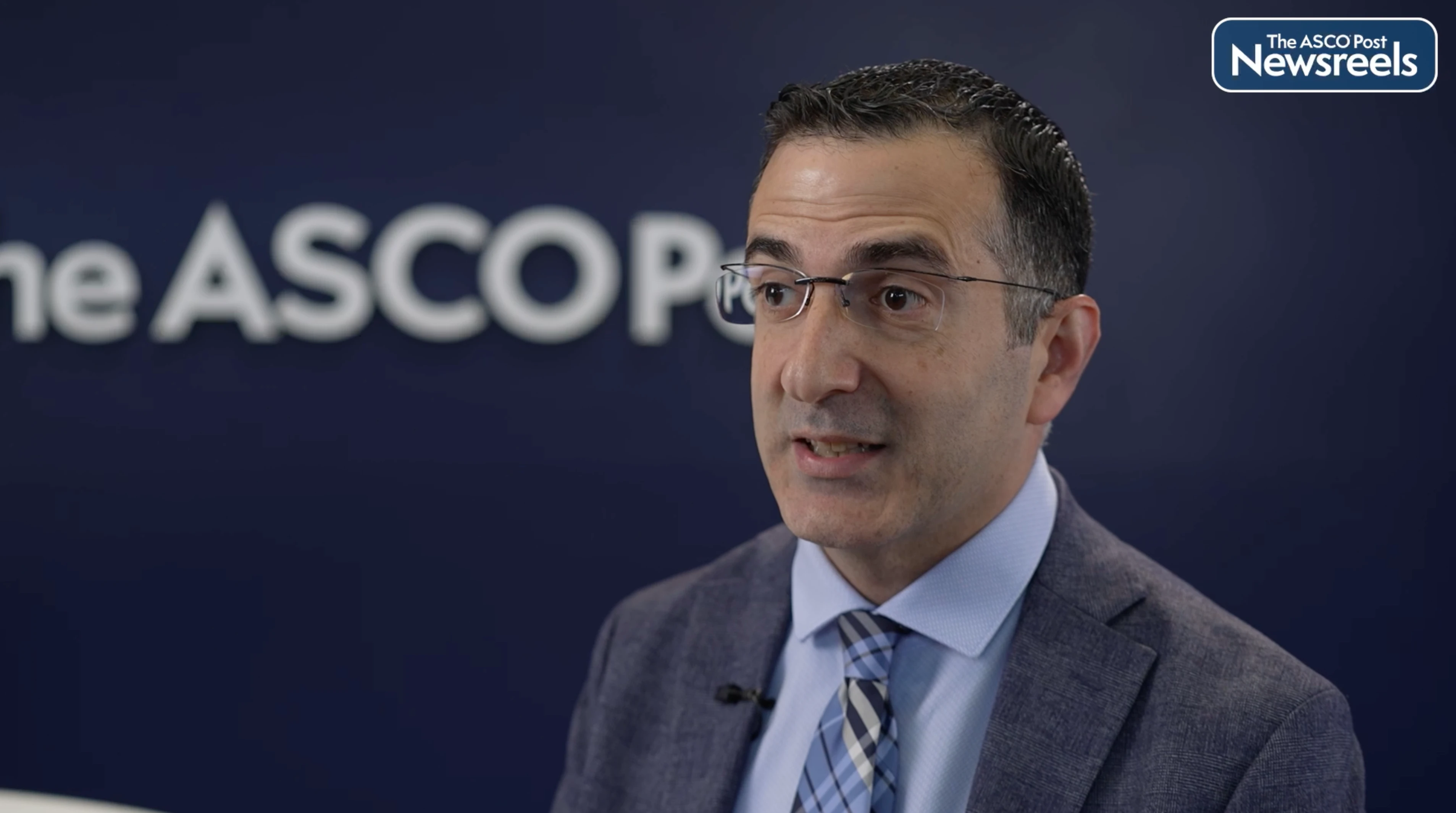
Supriya Gupta, MD, on Investigational CAR T-Cell Therapy in Relapsed or Refractory NHL and CLL
ASCO 2026Advertisement
Supriya Gupta, MD, of the University of Minnesota, presents data on azercabtagene zapreleucel, an investigational anti-CD19 allogeneic chimeric antigen receptor (CAR) T-cell therapy, in combination with low-dose interleukin-2 in patients with relapsed or refractory non-Hodgkin lymphoma (NHL) and chronic lymphocytic leukemia (CLL) (Abstract 7012).
Transcript
Disclaimer: This video transcript has not been proofread or edited and may contain errors.
My name is Supriya Gupta, and we just wrapped up a very interesting session on hematologic malignancies, specifically focusing on lymphoma and CLL, where I presented the results of a phase 1b study examining azercabtagene zapreleucel, or azer-cel, which is an allogeneic, off-the-shelf, CD19-directed CAR T-cell therapy for CAR T-naive patients with relapsed or refractory B-cell non-Hodgkin lymphoma and CLL. So azer-cel is, as I mentioned, an off-the-shelf, allogeneic, CD19-directed CAR T product. It is manufactured using the proprietary ARCUS gene-editing technology, which introduces the CAR transgene via electroporation. This does 2 things simultaneously. It knocks out the native T-cell receptor, thereby preventing graft-vs-host disease, and it introduces the chimeric antigen receptor targeting CD19 and enabling antitumor activity. Today, we're focusing on the CAR T-naive cohort of this particular study. The dose-escalation phase is complete and has identified the optimal phase 2 regimen, which includes lymphodepletion with augmented cyclophosphamide at a dose of 750 mg/m² and fludarabine at a dose of 30 mg/m² for 3 consecutive days, from day –5 to day –3. Azer-cel is administered as a single infusion on day 0, and this is followed by 14 days of interleukin-2, which is administered at a dose of 1,000,000 international units daily for 14 days as exogenous cytokine support. So the CAR T-naive cohort includes various different histologies, including large B-cell lymphoma, follicular lymphoma, marginal zone lymphoma, Waldenström macroglobulinemia, primary CNS lymphoma, and CLL. There were 25 patients included in this cohort, and what we found is that the highest signals were noted in marginal zone lymphoma and CLL. In CLL, there were 4 patients who were enrolled, and all were evaluable and responded. Three continued to respond at 6 to 7 months, 1 converted to a CR, 2 had ongoing PRs, and 1 patient had progressed at 2.8 months. Critically to note here, this is a heavily pretreated population, with 100% of patients having received a BTK inhibitor and 75% of patients having received venetoclax. The patient with progressive disease was double refractory. Despite this, all patients with CLL responded to azer-cel. Pharmacokinetics also confirmed robust CAR T expansion in this cohort, as shown by the CAR T copy number and the AUC during the first 28 days, as well as the time to peak concentration. Coming to the toxicity profile, 84% of patients enrolled in this cohort had cytokine release syndrome, and all cases were grade 1 or grade 2. ICANS occurred in about 40% of patients, with a few patients having grade 3 or grade 4, but notably clustering in the diffuse large B-cell lymphoma cohort, with no patients with CLL having any ICANS. So in conclusion, azer-cel, which is an off-the-shelf, allogeneic, CD19-directed CAR T-cell therapy, demonstrates very promising clinical activity across a broad range of CD19-positive B-cell malignancies, with the deep and most durable response signal noted in marginal zone lymphoma and CLL. Acknowledging that these are early data and very small cohorts, this study continues to enroll at multiple sites across the United States and Australia in both the CAR T-naive cohort and a newly open cohort using concurrent BTK inhibitor therapy. So more to come.