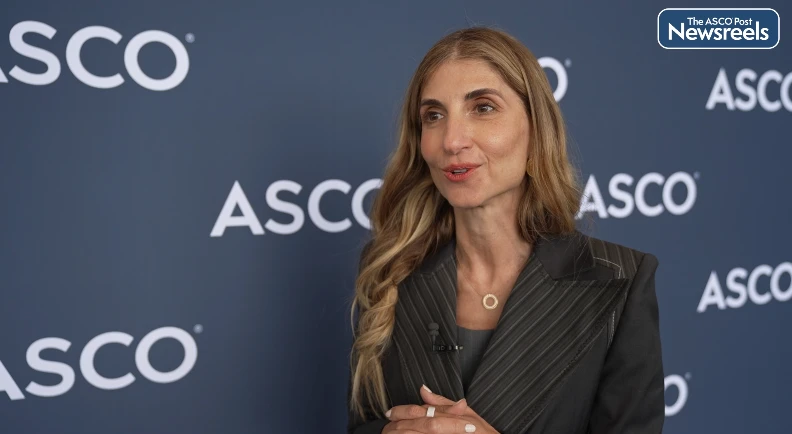
Elizabeth Smyth, MD, on New Data in Gastric/Gastroesophageal Cancers
ASCO 2026
Elizabeth Smyth, MD, of Oxford NIHR Biomedical Research Centre, Churchill Hospital, discusses three major studies presented at this year’s meeting: the antibody-drug conjugate izalontamab brengitecan in recurrent or metasatic esophageal squamous cell carcinoma (Abstract 4008); the ATTRACTION-6 study of chemoimmunotherapy in HER2-negative advanced gastric/gastroesophageal junction (GEJ) cancer (Abstract 4006); and an investigational EP4 antagonist in combination with chemoimmunotherapy as a first-line strategy for HER2-negative gastric/GEJ cancer (Abstract 4007).
Lorenza Rimassa, MD, of IRCCS Humanitas Research Hospital, and David James Pinato, MD, PhD, of Imperial College London, discuss positive phase III findings in intermediate-stage hepatocellular carcinoma (HCC) with immunotherapy-based combinations with TACE, second-line data from IMbrave251, and novel targeted and bispecific antibody therapies.
The ASCO Post Staff
Mali Barbi, MD, MS, of Northwell Health Cancer Institute Center for Women's Cancer, discusses durable survival benefits shown in the NRG-GY018 trial with pembrolizumab and the RUBY trial with dostarlimab for patients with mismatch repair–deficient (dMMR) endometrial cancer. In addition, B7-H4 antibody-drug conjugates such as puxitatug samrotecan are emerging as options for relapsed/metastatic disease.
The ASCO Post Staff
Mazyar Shadman, MD, of the University of Washington and Fred Hutchinson Cancer Center, describes the safety and efficacy results of the all-oral first-line combination regimen of sonrotoclax and zanubrutinib for patients with treatment-naive chronic lymphocytic leukemia/small lymphocytic lymphoma (CLL/SLL), as well as the doublet’s effect on measurable residual disease (Abstract 7043). He also discusses the phase III BGB-11417-304/CELESTIAL-TNCLL-2 trial; this ongoing study is evaluating sonrotoclax plus zanubrutinib vs venetoclax and acalabrutinib in treatment-naive patients with chronic lymphocytic leukemia (CLL) (Abstract TPS7099).
The ASCO Post Staff
Shilpa Gupta, MD, of Taussig Cancer Institute, discusses findings from the phase III MAIN-CAV study (Alliance A032001) of maintenance cabozantinib and avelumab vs avelumab after first-line platinum-based chemotherapy in patients with locally advanced/metastatic urothelial cancer (Abstract 4514).
The ASCO Post Staff
Yelena Y. Janjigian, MD, FASCO, of Memorial Sloan Kettering Cancer Center, discusses safety results for DESTINY-Gastric03 Part 2 (arms D and F) and Part 4. The trial evaluated first-line fam-trastuzumab deruxtecan-nxki–based regimens in advanced HER2-expressing gastric cancer, gastroesophageal adenocarcinoma, and esophageal carcinoma (Abstract 4002).