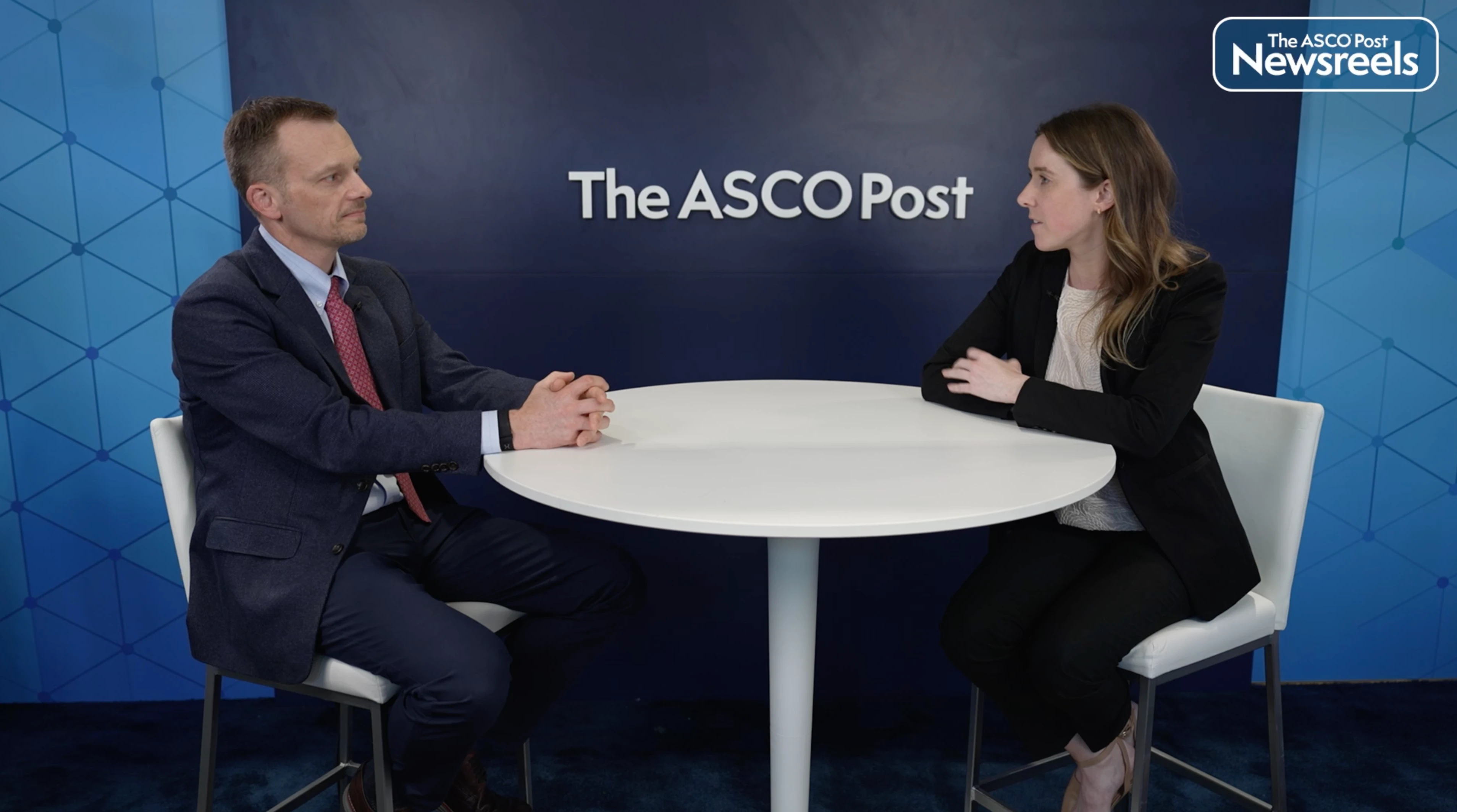
Dor Abelman, BS, on Multiple Myeloma: cfDNA WGS vs Plasma Proteomics for Minimally Invasive MRD Assessment
ASCO 2026
Dor Abelman, BS, of the University of Toronto, reviews results of a comparison of two minimally invasive measurable residual disease (MRD) assays—BM-informed cfDNA whole-genome sequencing (cfWGS) and plasma proteomic MRD (EasyM)—in patients with multiple myeloma (Abstract 7546).
Daneng Li, MD, of City of Hope, discusses dose-finding results from a phase I/II trial of tegavivint, a downstream Wnt/β-catenin inhibitor, in patients with advanced hepatocellular carcinoma (HCC) (Abstract 4015).
The ASCO Post Staff
Peter Schmid, MD, PhD, FRCP, of Queen Mary University of London, shares more data from the phase III lidERA BC clinical trial. This analysis focused on the efficacy and safety of giredestrant in patients with estrogen receptor (ER)-positive, HER2-negative early breast cancer, looking at both premenopausal and postmenopausal populations (Abstract 502).
The ASCO Post Staff
Brian M. Wolpin, MD, MPH, of Dana-Farber Cancer Institute, and Eileen M. O’Reilly, MD, of Memorial Sloan Kettering Cancer Center, describe results from the phase III RASolute 302 trial, which evaluated the RAS(ON) muliselective inhibitor daraxonrasib in previously treated patients with metastatic pancreatic adenocarcinoma (Abstract LBA5).
The ASCO Post Staff
Ghassan K. Abou-Alfa, MD, PhD, FASCO, of Memorial Sloan Kettering Cancer Center and Weill Medical College at Cornell University, presents efficacy and safety data from the randomized phase III EMERALD-3 trial, which evaluated tremelimumab plus durvalumab with or without lenvatinib combined with transarterial chemoembolization in patients with unresectable embolization-eligible hepatocellular carcinoma (LBA4000).
Hannah L. Kenny, MD, and Joseph M. Curry, MD, both of Thomas Jefferson University Hospital, discuss results of a phase II trial of neoadjuvant cemiplimab-rwlc in patients with hedgehog inhibitor–naive basal cell carcinoma (BCC) of the head and neck (Abstract 9515).