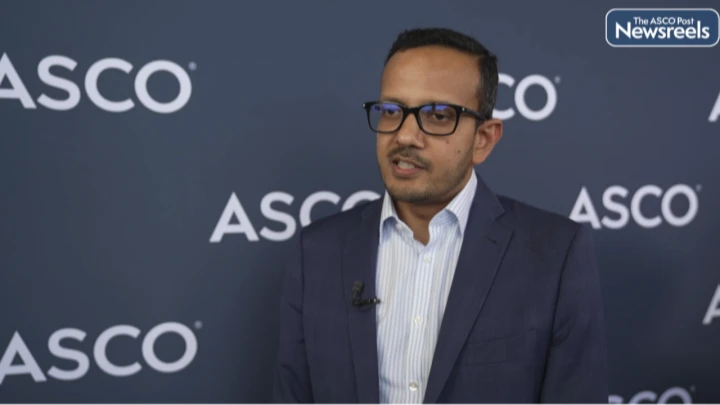
Jana de Boniface, MD, PhD, on Breast Cancer With Sentinel Lymph Node Macrometastases: Can Axillary Dissection Be Omitted?
ASCO 2026
Jana de Boniface, MD, PhD, of Capio Saint Göran's Hospital and Karolinska Institutet, reviews overall survival and patient-reported arm morbidity findings from the SENOMAC trial, which sought to determine if patients with breast cancer and sentinel lymph node macrometastases could omit complete axillary dissection (Abstract LBA503).
The ASCO Post Staff
Noelle Cloven, MD, of Texas Oncology, discusses the actively recruiting RAINFOL-03 (ENGOT-EN-31/GOG-3128) study, a global, phase III, open-label, randomized study of rinatabart sesutecan vs investigator’s choice of chemotherapy in patients with endometrial cancer after receipt of platinum-based chemotherapy and PD-L1 inhibition (Abstract TPS5646).
The ASCO Post Staff
Asaf Maoz, MD, of Dana-Farber Cancer Institute, Mass General Brigham, and Harvard Medical School, talks about whether prospective assessment of CA 19-9 has utility as part of pancreatic cancer surveillance among high-risk individuals (Abstract 10527).
The ASCO Post Staff
Evan T. Hall, MD, of Fred Hutchinson Cancer Center, discusses findings from the randomized phase II MATRiX trial, which evaluated the efficacy of the ATR inhibitor tuvusertib with or without avelumab in patients with anti–PD-(L)1–refractory Merkel cell carcinoma (Abstract LBA9514).
Walter Weber, MD, of University Hospital Basel, presents data from the international randomized phase III PREPEC trial (OPBC-02), which found prepectoral implant-based breast reconstruction (IBBR) significantly and relevantly improved long-term quality of life—at the cost of a higher risk of loss or replacement of expander or implant—compared to subpectoral IBBR (Abstract 504).
The ASCO Post Staff
Siddhartha Yadav, MBBS, MD, of Mayo Clinic Rochester, talks about a real-world evaluation of germline pathogenic variants in cancer predisposition genes in unselected South Asian women with breast or ovarian cancer (Abstract 10513).