Ramez N. Eskander, MD, on Endometrial Cancer: Pembrolizumab Plus Carboplatin/Paclitaxel
ASCO 2026Advertisement
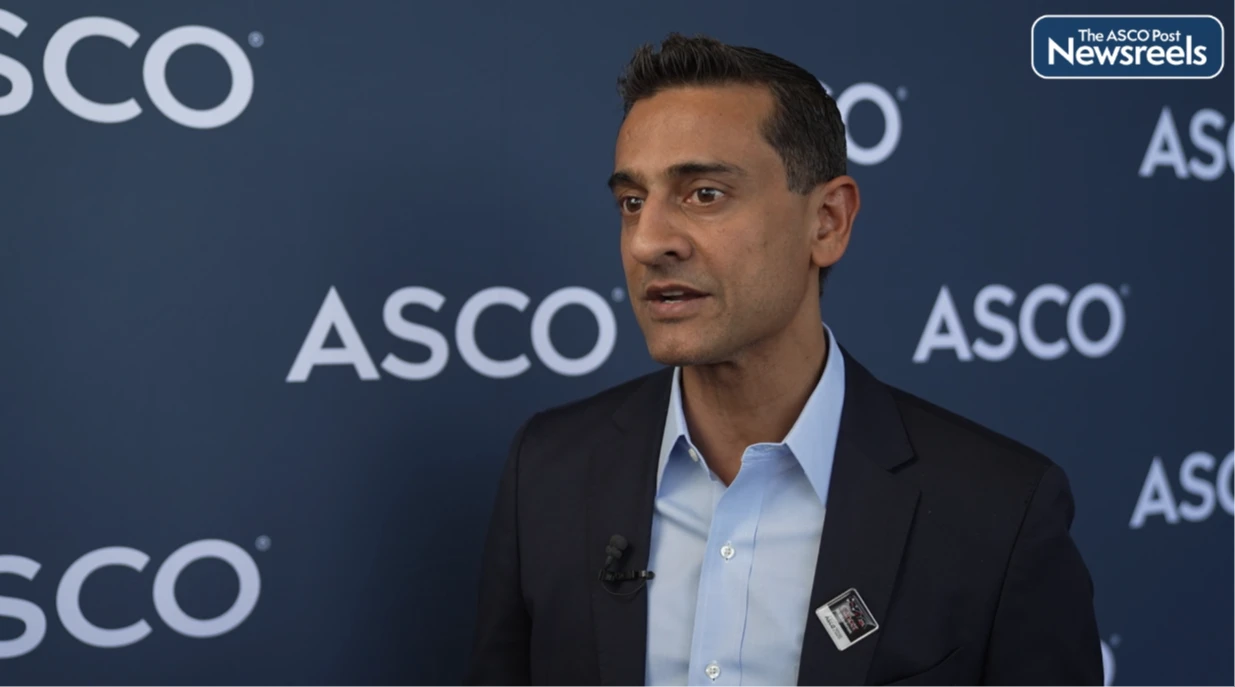
Ramez N. Eskander, MD, of UC San Diego Moores Cancer Center, presents an updated overall survival analysis and examination of subsequent therapy in patients with endometrial cancer treated with pembrolizumab plus carboplatin/paclitaxel as compared to carboplatin/paclitaxel plus placebo in the NRG-GY018 trial (Abstract 5502).
Transcript
Disclaimer: This video transcript has not been proofread or edited and may contain errors.
NRG-GY018 was a randomized phase III clinical trial that was sponsored by the National Cancer Institute that initially was presented and simultaneously published in March of 2023 and demonstrated a statistically significant and clinically meaningful improvement in median progression-free survival in patients with advanced-stage and recurrent endometrial cancer when pembrolizumab was added to carboplatin and paclitaxel and continued as maintenance irrespective of mismatch repair status in the primary efficacy endpoint. This was a 70% reduction in the risk of disease progression in the mismatch repair deficient population and a 46% reduction in the risk of disease progression in the mismatch repair proficient endometrial cancer cohort. At the time in which the primary efficacy analysis read out, overall survival assessment was immature but directionally favored the combination that added pembrolizumab to standard of care chemotherapy. What we're presenting at the ASCO meeting this year was long-term follow-up data from the study focusing on updated overall survival data as well as data on subsequent therapy, specifically subsequent immunotherapy in the patients treated on trial. In the mismatch repair deficient cohort with a median duration of follow-up now of 49 months and an information fraction of 43%, we saw a 44% reduction in the risk of death. The hazard ratio was 0.56. It's important to note though that NRG-GY018 was a randomized study that was an NCI-sponsored trial that enrolled patients predominantly in the U.S., although it was an international study with some accruals in Canada, Japan and South Korea. But because of the ubiquitous availability of both pembrolizumab as well as lenvatinib and pembrolizumab, the trial was designed with unblinding at progression. So what's really interesting about this overall survival data in the dMMR patients with a hazard ratio of 0.56 is that 93% of the patients in the placebo arm went on to receive post-study immunotherapy when they progressed. So even though there was that degree of post-study immunotherapy, that overall survival benefit persisted. It was a predefined secondary endpoint, but there was no hierarchical analysis intended. So there's no alpha allocated to that overall survival in the mismatch repair proficient cohort with a median duration of follow-up of 44 months and an information fraction of 82% that overall survival improvement was 14%. So the hazard ratio is 0.86 with the addition of pembrolizumab. And once again and importantly in the patients with mismatch repair proficient disease who are randomized to placebo, 81% of those patients who went on to receive the subsequent therapy received an immune checkpoint-containing regimen. And despite that substantial use, we still saw that hazard ratio of .86. And of note, when we think about the contemporary phase III trials in this clinical setting, this proportion of dMMR and pMMR placebo-treated patients who went on to receive subsequent therapy. This was the largest proportion of any of those contemporary randomized phase III trials. We did also look at what kind of immunotherapy these patients received. So in the mismatch repair deficient cohort of those patients who went on to receive a subsequent treatment, the most common immunotherapy strategy was single-agent immune checkpoint inhibition, 63 1/2 percent. Another 17% had combination of lenvatinib plus pembrolizumab. And in the mismatch repair proficient who received placebo, the proportion who received lenvatinib and pembrolizumab was approximately 60% with an additional 13% receiving single-agent checkpoint inhibition. To summarize a little bit too, we looked at the clinical benefit in the mismatch repair proficient population who went on to receive subsequent therapy, looking at both the pembrolizumab- and placebo-treated patients. And what was quite interesting is if you look at the clinical benefit of post-study immunotherapy in the pMMR patients, you could see that it was quite similar. This was heavily dominated by combination lenvatinib plus pembrolizumab, but the median, post median time on post-study immune checkpoint regimens was six months in the placebo-treated patients and 5 1/2 months in the pembrolizumab-treated patients. That's kind of thought provocative because those are patients who had prior immunotherapy and then went on to get a immunotherapy regimen again at retreatment. So really when we think about this in summary, we recognize that this data adds great confidence to the current approval of this regimen in the United States and internationally with the EMA in other countries for the use of pembrolizumab plus carboplatin paclitaxel followed by pembrolizumab maintenance in patients with advanced-stage and recurrent disease irrespective of their mismatch repair status. And really is something that we want to take into consideration in the context of this data showing that even when we gave those placebo patients post-study immunotherapy, it didn't abrogate, it didn't negate that benefit, it's still persistent.