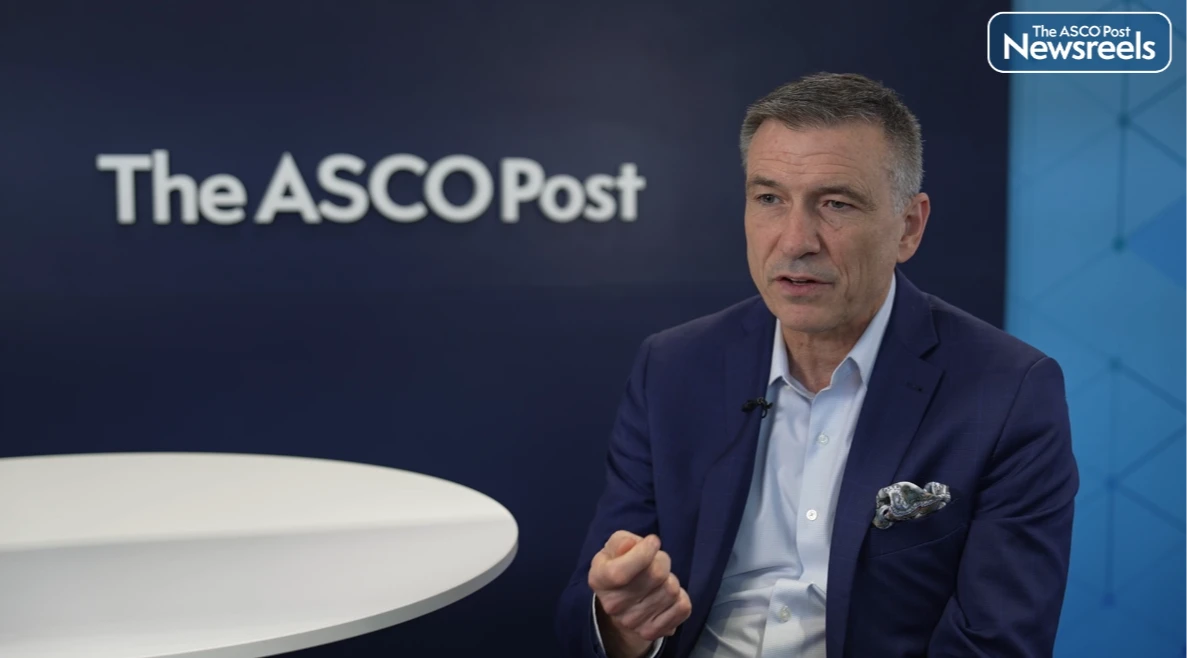
Jennifer A. Woyach, MD, on Pretreated Relapsed or Refractory CLL/SLL: Ongoing ROCKET-CLL Trial
ASCO 2026
Jennifer A. Woyach, MD, of The Arthur G. James Cancer Hospital and Richard J. Solove Research Institute at The Ohio State University, discusses the ongoing, actively recruiting ROCKET-CLL trial, which is a phase III study aiming to compare the efficacy of rocbrutinib vs pirtobrutinib in patients with relapsed or refractory chronic lymphocytic leukemia (CLL)/small lymphocytic lymphoma (SLL) who have been pretreated with Bruton tyrosine kinase covalent inhibitors (Abstract TPS7100).
For more information about the trial, visit ClinicalTrials.gov (identifier NCT07342478).
The ASCO Post Staff
Jame Abraham, MD, FACP, of Cleveland Clinic, offers his thoughts on findings from OPTIMA (Optimal Personalised Treatment of early breast cancer using Multi-parameter Analysis), an international randomized controlled trial comparing chemotherapy decisions made with the Prosigna (PAM50) gene expression test with standard treatment in mostly node-positive patients with high clinical risk ER-positive HER2-negative early breast cancer (Abstract 500).
The ASCO Post Staff
Colton Jones, MD, of The University of Texas at San Antonio, talks about the results of a global, multicenter analysis that sought to determine the safety and efficacy of glucagon-like peptide-1 receptor agonists (GLP-1 RAs) for the primary prevention of hepatocellular carcinoma (HCC) in a pan-etiology high-risk cohort (Abstract 10522).
Dai Chihara, MD, of The University of Texas MD Anderson Cancer Center, reviews results from an open-label, single-arm, phase II trial that investigated the combination of epcoritamab with R-miniCVP (rituximab, cyclophosphamide, vincristine, prednisone) in patients with newly diagnosed diffuse large B-cell lymphoma (DLBCL) classified as unfit or frail per geriatric assessment or not eligible for anthracycline chemotherapy due to reduced ejection function or prior exposure (Abstract 7002).
The ASCO Post Staff
Kevin Kalinsky, MD, MS, FASCO, of Winship Cancer Institute of Emory University, provides an update focusing on progression-free survival after next line of treatment and subsequent therapies among patients enrolled in the ASCENT-04 trial. The study compared sacituzumab govitecan plus pembrolizumab vs chemotherapy plus pembrolizumab in patients with previously untreated PD-L1–positive metastatic triple-negative breast cancer (Abstract LBA1000).
The ASCO Post Staff
John V. Heymach, MD, PhD, of The University of Texas MD Anderson Cancer Center, discusses results from the primary analysis of the multinational phase III WU-KONG28 trial, which looked at sunvozertinib monotherapy vs platinum-based therapy as first-line treatment for patients with advanced non–small cell lung cancer (NSCLC) and EGFR exon 20 insertions (Abstract LBA8500).