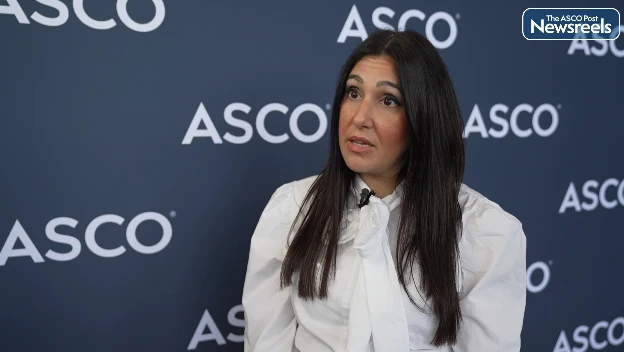
Adam Kibel, MD, on PROTEUS Trial in High-Risk Prostate Cancer: A Surgical Oncologist’s Perspective
ASCO 2026
Adam Kibel, MD, of Brigham and Women's Hospital, discusses findings from the phase III PROTEUS trial, which evaluated perioperative (neoadjuvant and adjuvant) apalutamide and androgen deprivation therapy vs placebo and ADT with radical prostatectomy in patients with high-risk localized or locally advanced prostate cancer. Dr. Kibel talks about how the regimen of apalutamide and ADT affects both the surgical procedure itself as well as patient outcomes postprocedure (Abstract LBA1).
The ASCO Post Staff
Jana de Boniface, MD, PhD, of Capio Saint Göran's Hospital and Karolinska Institutet, reviews overall survival and patient-reported arm morbidity findings from the SENOMAC trial, which sought to determine if patients with breast cancer and sentinel lymph node macrometastases could omit complete axillary dissection (Abstract LBA503).
The ASCO Post Staff
Ramaswamy Govindan, MD, FASCO, of Alvin J. Siteman Cancer Center at Washington University School of Medicine in St. Louis, presents the final overall survival results from the randomized phase III Alliance A081105 trial, which evaluated adjuvant erlotinib vs observation after complete resection of EGFR-mutant non–small cell lung cancer (NSCLC) (Abstract 8001).
The ASCO Post Staff
Christopher A. Barker, MD, of Memorial Sloan Kettering Cancer Center, reviews the results of the RAMPART study, a phase II, multicenter, single-arm clinical trial evaluating response-adapted definitive radiotherapy in combination with cemiplimab-rwlc for locally advanced, unresectable cutaneous squamous cell carcinoma (CSCC) (Abstract 9506).
The ASCO Post Staff
Evan T. Hall, MD, of Fred Hutchinson Cancer Center, discusses findings from the randomized phase II MATRiX trial, which evaluated the efficacy of the ATR inhibitor tuvusertib with or without avelumab in patients with anti–PD-(L)1–refractory Merkel cell carcinoma (Abstract LBA9514).
The ASCO Post Staff
Marlana M. Orloff, MD, of Thomas Jefferson University Hospital, reviews primary results from the OptimUM-02 trial, which investigated the doublet of darovasertib plus crizotinib vs investgator’s choice for first-line therapy among patients with HLA-A2–negative metastatic uveal melanoma (Abstract LBA9503).