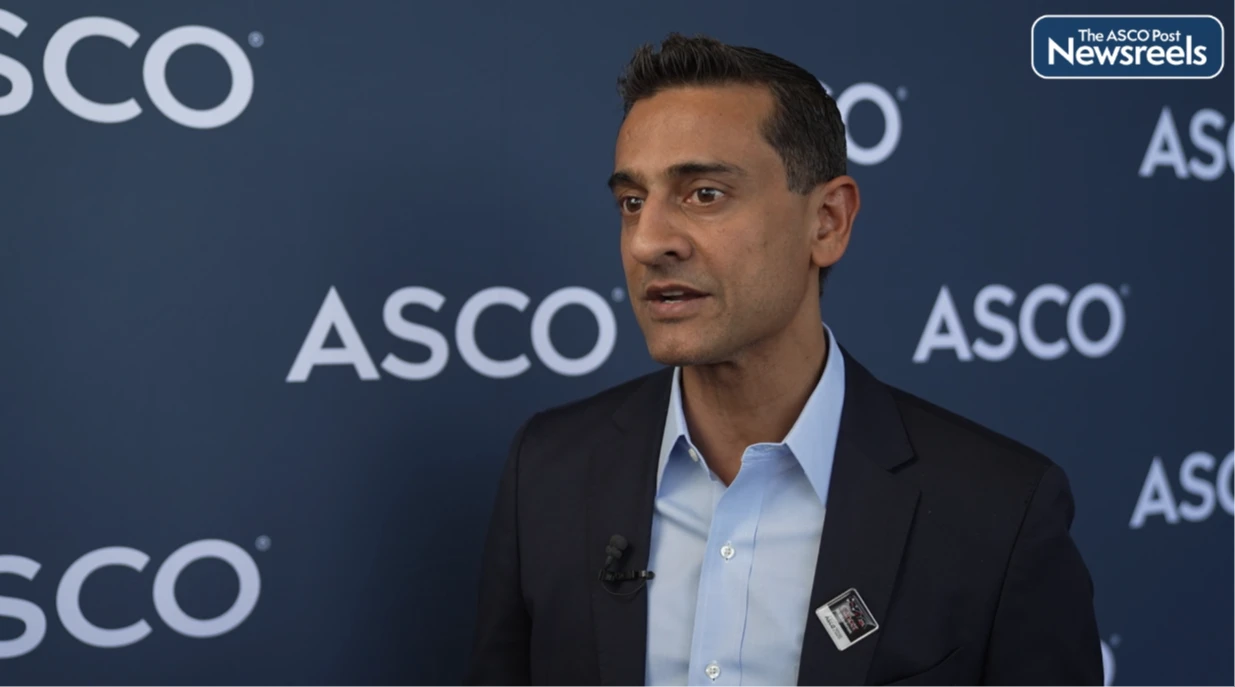
Lillian L. Siu, MD, on Liquid KRAS Mutation Screening in Patients With Advanced Pancreatic Cancer
ASCO 2026
Lillian L. Siu, MD, of Princess Margaret Cancer Centre, discusses the clinical utility of liquid biopsy testing for common KRAS variants to facilitate matching patients with pancreatic ductal adenocarcinoma to appropriate early-phase trials (Abstract 3049).
The ASCO Post Staff
Thomas A. Jandl, MD, PhD, of Stony Brook University Hospital, discusses data from part 1B of the OLYMPIA-3 trial, which showed that among patients with diffuse large B-cell lymphoma (DLBCL), the safety profile of the first-line combination of odronextamab and CHOP chemotherapy was generally manageable and preliminary efficacy was encouraging, with no meaningful differences between regimens. Additionally, combination with odronextamab did not impact the delivery of CHOP (Abstract 7009).
Antonio Llombart-Cussac, MD, PhD, of Medica Scientia Innovation Research (MEDSIR), discusses the ongoing ADELA study, a double-blind, placebo-controlled, randomized phase III trial of elacestrant plus everolimus vs elacestrant plus placebo in patients with estrogen receptor (ER)-positive HER2-negative advanced breast cancer with ESR1-mutated tumors who experienced disease progression on endocrine therapy plus CDK4/6 inhibition (Abstract TPS1154).
ClinicalTrials.gov identifier: NCT06382948
The ASCO Post Staff
Ghassan K. Abou-Alfa, MD, PhD, FASCO, of Memorial Sloan Kettering Cancer Center and Weill Medical College at Cornell University, presents efficacy and safety data from the randomized phase III EMERALD-3 trial, which evaluated tremelimumab plus durvalumab with or without lenvatinib combined with transarterial chemoembolization in patients with unresectable embolization-eligible hepatocellular carcinoma (LBA4000).
The ASCO Post Staff
Noelle Cloven, MD, of Texas Oncology, discusses the actively recruiting RAINFOL-03 (ENGOT-EN-31/GOG-3128) study, a global, phase III, open-label, randomized study of rinatabart sesutecan vs investigator’s choice of chemotherapy in patients with endometrial cancer after receipt of platinum-based chemotherapy and PD-L1 inhibition (Abstract TPS5646).
The ASCO Post Staff
Shubham Pant, MD, MBBS, of The University of Texas MD Anderson Cancer Center, discusses the practice-changing results of the phase III RASolute 302 study, which showed that daraxonrasib doubled median overall survival compared with standard chemotherapy in pretreated metastatic pancreatic cancer (Abstract LBA5).