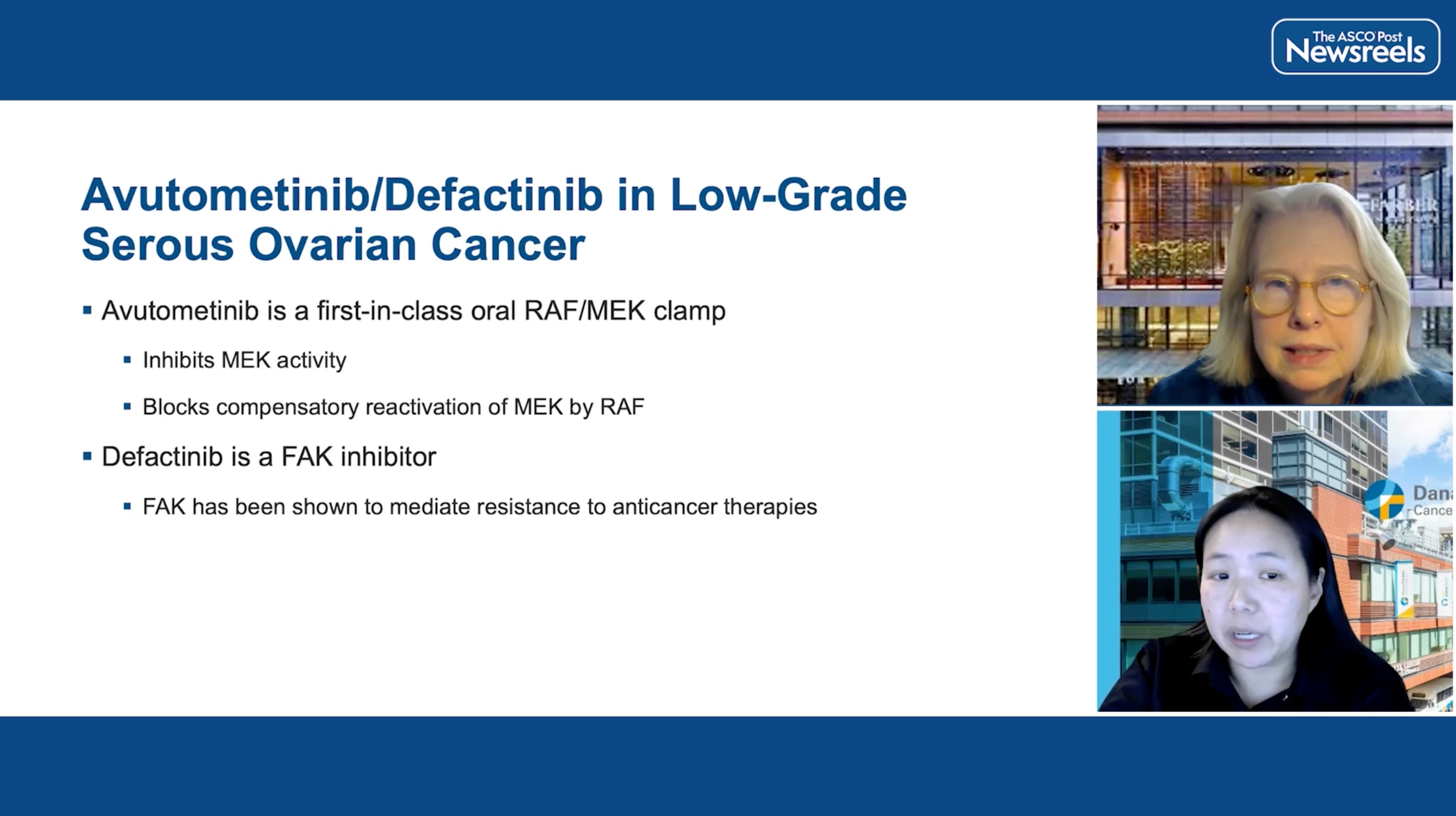
In this second installment of a two-part discussion about ovarian cancer advances for The ASCO Post Newsreels, Ursula A. Matulonis, MD, and Joyce F. Liu, MD, MPH, discuss low-grade serous ovarian carcinoma and an important recently published study. View part 1 of the program to hear them discuss antibody-drug conjugates and clinical trials including PRIMA and ATHENA.
Filmed November 22, 2024
The ASCO Post Staff
Atish D. Choudhury, MD, PhD, a medical oncologist and clinical/translational investigator at the Lank Center for Genitourinary Oncology at Dana-Farber Cancer Institute, discusses forms of hormonal therapy for patients with prostate cancer, with a focus on the HERO trial, which evaluated oral relugolix vs injectable leuprolide in patients with advanced hormone-sensitive disease. Dr. Choudhury touches on additional analyses from HERO as well, including the effects seen with relugolix on major cardiovascular events.
References
1. Shore ND, Saad F, Cookson MS, et al: Oral relugolix for androgen-deprivation therapy in advanced prostate cancer. N Engl J Med 382:2187-2196, 2020.
2. Saad F, George DJ, Cookson MS, et al: Relugolix vs leuprolide effects on castration resistance-free survival from the phase 3 HERO study in men with advanced prostate cancer. Cancers 15:4854, 2023.
3. Tombal B, Collins S, Morgans AK, et al: Impact of relugolix versus leuprolide on the quality of life of men with advanced prostate cancer: Results from the phase 3 HERO study. Eur Urol 6:579-57, 2023.
4. Spratt DE, George DJ, Shore ND, et al: Efficacy and safety of radiotherapy plus relugolix in men with localized or advanced prostate cancer. JAMA Oncol 5:594-602, 2024.
The ASCO Post Staff
Atish D. Choudhury, MD, PhD, a medical oncologist and clinical/translational investigator at the Lank Center for Genitourinary Oncology at Dana-Farber Cancer Institute, discusses current guideline recommendations for the use of relugolix and leuprolide, relugolix as a combination backbone, and important considerations when applying these data to clinical practice.
References
1. De La Cerda J, Dunshee C, Gervasi L, et al: A phase I clinical trial evaluating the safety and dosing of relugolix with novel hormonal therapy for the treatment of advanced prostate cancer. Target Oncol 3:383-390, 2023.
2. George DJ, Saad F, Cookson MS, et al: Impact of concomitant prostate cancer medications on efficacy and safety of relugolix versus leuprolide in men with advanced prostate cancer. Clin Genitourin Cancer 3:383-392, 2023.
3. Brown G, Belkoff L, Hafron JM, et al: Coadministration of apalutamide and relugolix in patients with localized prostate cancer at high risk for metastases. Target Oncol 1:95-103, 2023.
The ASCO Post Staff
Nikhil Khushalani, MD, Vice Chair for the Department of Cutaneous Oncology at Moffitt Cancer Center, reviews advances in the adjuvant and neoadjuvant treatment of cutaneous squamous cell carcinoma (CSCC). He discusses the possibility of de-escalating therapy for patients who respond positively to presurgical agents; how to best select postoperative regimens; and ongoing trials in both spaces.
References
- Gross ND, Miller DM, Khushalani NI, et al: Neoadjuvant cemiplimab for stage II to IV cutaneous squamous-cell carcinoma. N Eng J Med 387:1557-1568, 2022.
- Gross ND, Miller DM, Khushalani NI, et al: Neoadjuvant cemiplimab and surgery for stage II-IV cutaneous squamous-cell carcinoma: Follow-up and survival outcomes of a single-arm, multicentre, phase 2 study. Lancet Oncol 11:1196-1205, 2023.
- Breukers SE, Traets JJH, van Dijk SW, et al: Neoadjuvant ipilimumab and nivolumab in resectable cutaneous squamous cell carcinoma: A randomized phase 2 trial. Nature Medicine. October 8, 2025 (early release online).
- Ladwa R, Lee JH, McGrath M, et al: Response-adapted surgical and radiotherapy de-escalation in resectable cutaneous squamous cell cancer using pembrolizumab: The De-Squamate study. J Clin Oncol 26:2888-2986, 2025.
- Porceddu SV, Bressel M, Poulsen MG, et al: Postoperative concurrent chemoradiotherapy versus postoperative radiotherapy in high-risk cutaneous squamous cell carcinoma of the head and neck: The randomized phase III TROG 05.01 trial. J Clin Oncol 13:1275-1283, 2018.
- Rischin D, Porceddu S, Day F, et al: Adjuvant cemiplimab or placebo in high-risk cutaneous squamous-cell carcinoma. N Eng J Med 393:774-785, 2025.
- Koyfman SA, Lee JHJ, Mortier L, et al: Phase 3 randomized trial (KEYNOTE-630) of adjuvant pembrolizumab versus placebo for high-risk locally advanced cutaneous squamous cell carcinoma following surgery and radiation. 2025 ASCO Annual Meeting. Abstract 6000. Presented May 31, 2025.
Allison Betof Warner, MD, PhD, reviews important clinical research in the treatment of advanced melanoma, including tumor-infiltrating lymphocyte (TIL) therapy, the role of this innovative treatment in advanced melanoma, and relevant data, peer-reviewed literature, and FDA approvals in 2024. She also provides a look ahead at what is on the horizon in 2025 with regard to care for patients with advanced melanoma.