The ASCO Post Staff
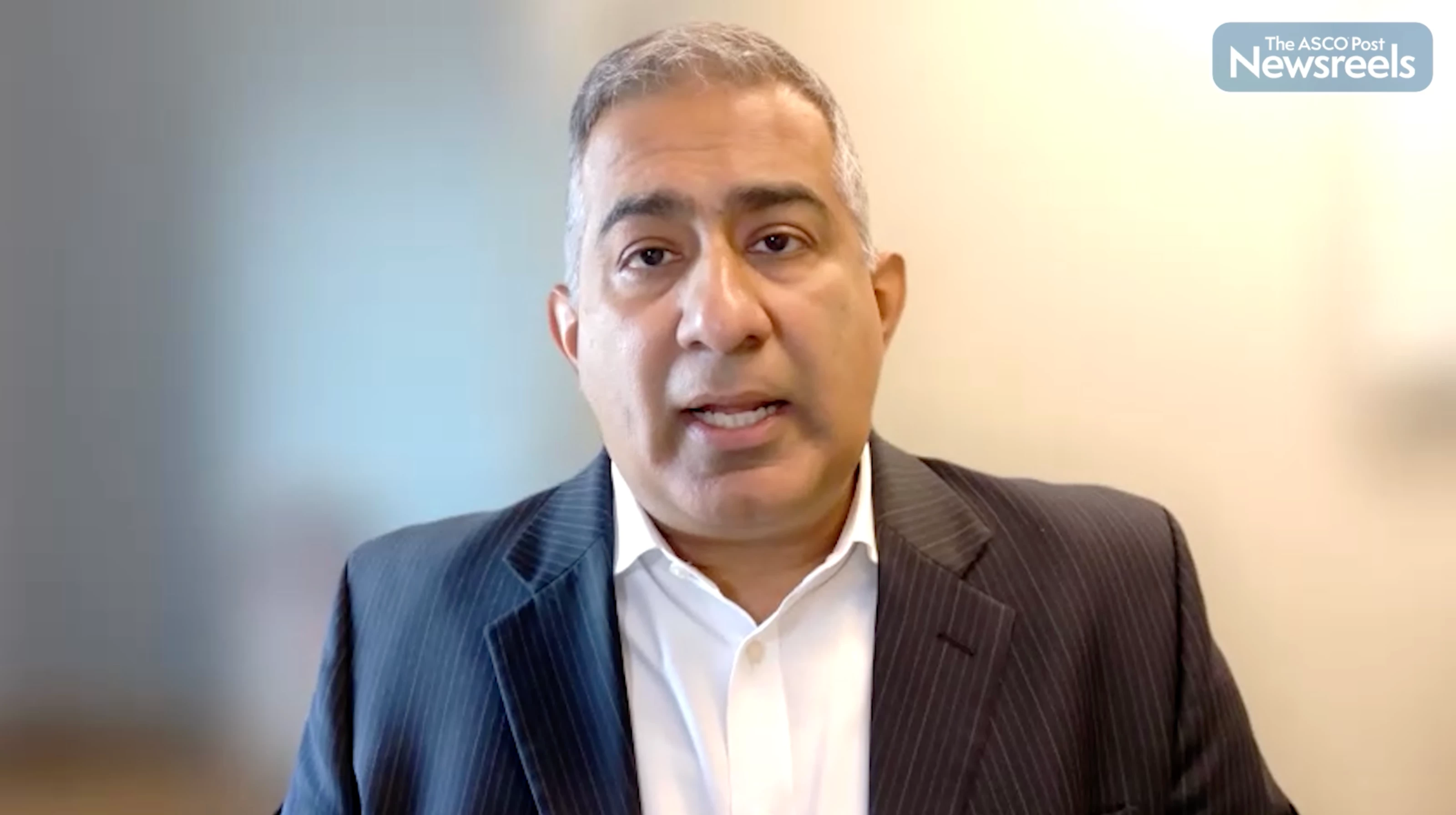
Circulating tumor DNA has many roles in cancer treatment: early diagnosis, tumor profiling, determining response to therapy, and tracking clinical dynamics. In this video, Arvind N. Dasari, MD, MS, of The University of Texas MD Anderson Cancer Center, focuses on it as a marker for measurable residual disease (MRD), which can help to determine risk of disease recurrence in patients with cancer. Dr. Dasari reviews the development of assays for MRD, both tumor-informed and tumor-agnostic, and provides top-level data from several clinical trials on the topic that have informed the role of MRD testing in both the colorectal cancer and general solid tumor space.
References
- Tie J, Wang Y, Lo SN, et al: Circulating tumor DNA analysis guiding adjuvant therapy in stage II colon cancer: Overall survival and updated 5-year results from the randomized DYNAMIC trial. 2024 ASCO Annual Meeting. Abstract 108.
- Lieu CH, Yu G, Kopetz S, et al: NRG-GI008: Colon adjuvant chemotherapy based on evaluation of residual disease (CIRCULATE-NORTH AMERICA). 2024 ASCO Gastrointestinal Cancers Symposium. Abstract TPS243.
- Tie J, Wang Y, Loree J, et al: ctDNA-guided adjuvant chemotherapy escalation in stage III colon cancer: Primary analysis of the ctDNA-positive cohort from the randomized AGITG dynamic-III trial (intergroup study of AGITG and CCTG). 2025 ASCO Annual Meeting. Abstract 3505.
- Lumish MA, Jayakumaran G, Fox M, et al: Frequency of minimal residual disease as measured by ctDNA in mismatch repair deficient tumors following curative resection. 2021 ASCO Annual Meeting. Abstract e14520.
- Kotani D, Oki E, Nakamura Y, et al: Molecular residual disease and efficacy of adjuvant chemotherapy in patients with colorectal cancer. Nature Medicine 29:127-134, 2023.
- Kasi PM, Aushev VN, Ensor J, et al: Circulating tumor DNA (ctDNA) for informing adjuvant chemotherapy (ACT) in stage II/III colorectal cancer (CRC): Interim analysis of BESPOKE CRC study. 2024 ASCO Gastrointestinal Cancers Symposium. Abstract 9.
- Maddalena G, Pellatt AJ, Eluri M, et al: INTERCEPT Program of circulating tumor DNA (ctDNA) testing for minimal residual disease (MRD) in colorectal cancer (CRC): Results from a prospective clinical cohort. 2024 ASCO Gastrointestinal Cancers Symposium. Abstract 27.
- Meyerhardt JA, Shi Q, Fuchs CS, et al: Effect of celecoxib vs placebo added to standard adjuvant therapy on disease-free survival among patients with stage III colon cancer. JAMA 13:1277-1286, 2021.
- Nowak JA, Shi Q, Twombly T, et al: Prognostic and predictive role of circulating tumor DNA (ctDNA) in stage III colon cancer treated with celecoxib: Findings from CALGB (Alliance)/SWOG 80702. 2025 ASCO Gastrointestinal Cancers Symposium. Abstract LBA14.
The ASCO Post Staff
Raajit K. Rampal, MD, PhD, Director of the Center for Hematologic Malignancies and the Myeloproliferative Neoplasms Program at Memorial Sloan Kettering Cancer Center, reviews the four FDA-approved Janus kinase (JAK) inhibitors for patients with myelofibrosis, touching upon differences in their mechanisms of action and toxicity profiles. He also discusses clinical trials of add-on drugs to the currently approved JAK inhibitors, which may increase their efficacy and durability, as well as trials of novel JAK inhibitors and immunotherapies targeting CALR.
The ASCO Post Staff
Atish D. Choudhury, MD, PhD, a medical oncologist and clinical/translational investigator at the Lank Center for Genitourinary Oncology at Dana-Farber Cancer Institute, discusses forms of hormonal therapy for patients with prostate cancer, with a focus on the HERO trial, which evaluated oral relugolix vs injectable leuprolide in patients with advanced hormone-sensitive disease. Dr. Choudhury touches on additional analyses from HERO as well, including the effects seen with relugolix on major cardiovascular events.
References
1. Shore ND, Saad F, Cookson MS, et al: Oral relugolix for androgen-deprivation therapy in advanced prostate cancer. N Engl J Med 382:2187-2196, 2020.
2. Saad F, George DJ, Cookson MS, et al: Relugolix vs leuprolide effects on castration resistance-free survival from the phase 3 HERO study in men with advanced prostate cancer. Cancers 15:4854, 2023.
3. Tombal B, Collins S, Morgans AK, et al: Impact of relugolix versus leuprolide on the quality of life of men with advanced prostate cancer: Results from the phase 3 HERO study. Eur Urol 6:579-57, 2023.
4. Spratt DE, George DJ, Shore ND, et al: Efficacy and safety of radiotherapy plus relugolix in men with localized or advanced prostate cancer. JAMA Oncol 5:594-602, 2024.
The ASCO Post Staff
Nikhil Khushalani, MD, Vice Chair for the Department of Cutaneous Oncology at Moffitt Cancer Center, offers his thoughts on the role of immunotherapy in the treatment of advanced cutaneous squamous cell carcinoma (CSCC). Dr. Khushalani discusses the three currently approved immunotherapeutic agents for this disease—cemiplimab-rwlc, pembrolizumab, and cosibelimab-ipdl—and their confirmatory trials as well as adverse event profiles. He also talks about choosing optimal treatment strategies for patients, and studies currently exploring monotherapy vs combination therapy regimens.
References
1. Migden MR, Rischin D, Schmults CD, et al: PD-1 blockade with cemiplimab in advanced cutaneous squamous-cell carcinoma. N Eng J Med 379:341-351, 2018.
2. Hughes BGM, Guminski A, Bowyer S, et al: A phase 2 open-label study of cemiplimab in patients with advanced cutaneous squamous cell carcinoma (EMPOWER-CSCC-1): Final long-term analysis of groups 1, 2, and 3, and primary analysis of fixed-dose treatment group 6. J Am Acad Dermatol 1:68-77, 2025.
3. Grob JJ, Gonzalez R, Bassett-Seguin N, et al: Pembrolizumab monotherapy for recurrent or metastatic cutaneous squamous cell carcinoma: A single-arm phase II trial (KEYNOTE-629). J Clin Oncol 25:2916-2925, 2020.
4. Maubec E, Boubaya M, Petrow P, et al: Phase II study of pembrolizumab as first-line, single-drug therapy for patients with unresectable cutaneous squamous cell carcinomas. J Clin Oncol 26:3051-3061, 2020.
5. Clingan P, Ladwa R, Brungs D, et al: Efficacy and safety of cosibelimab, an anti-PD-L1 antibody, in metastatic cutaneous squamous cell carcinoma. J Immunother Cancer 10:e007637, 2023.
6. Zandberg DP, Allred JB, Rosenberg AJ, et al: Phase II (Alliance A091802) randomized trial of avelumab plus cetuximab versus avelumab alone in advanced cutaneous squamous cell carcinoma. J Clin Oncol 43:2398-2408, 2025.
The ASCO Post Staff
Raajit K. Rampal, MD, PhD, Director of the Center for Hematologic Malignancies and the Myeloproliferative Neoplasms Program at Memorial Sloan Kettering Cancer Center, discusses management strategies for these two conditions often associated with myelofibrosis. He discusses the role of Janus kinase inhibitors; using older therapies in novel ways; how stem cell transplantation is considered; and more.
References
- Marrone M, Morere L, Oladapo A, et al: Hematologic improvement experienced by pacritinib-treated patients with myelofibrosis in real-world clinical settings. Blood 144 (suppl 1):3814, 2024.
- Rampal RK, Verstovsek S, Devlin SM, et al: Safety and efficacy of combined ruxolitinib and thalidomide in patients with myelofibrosis: A phase II study. Blood 134 (suppl 1):4163, 2019.