Advertisement


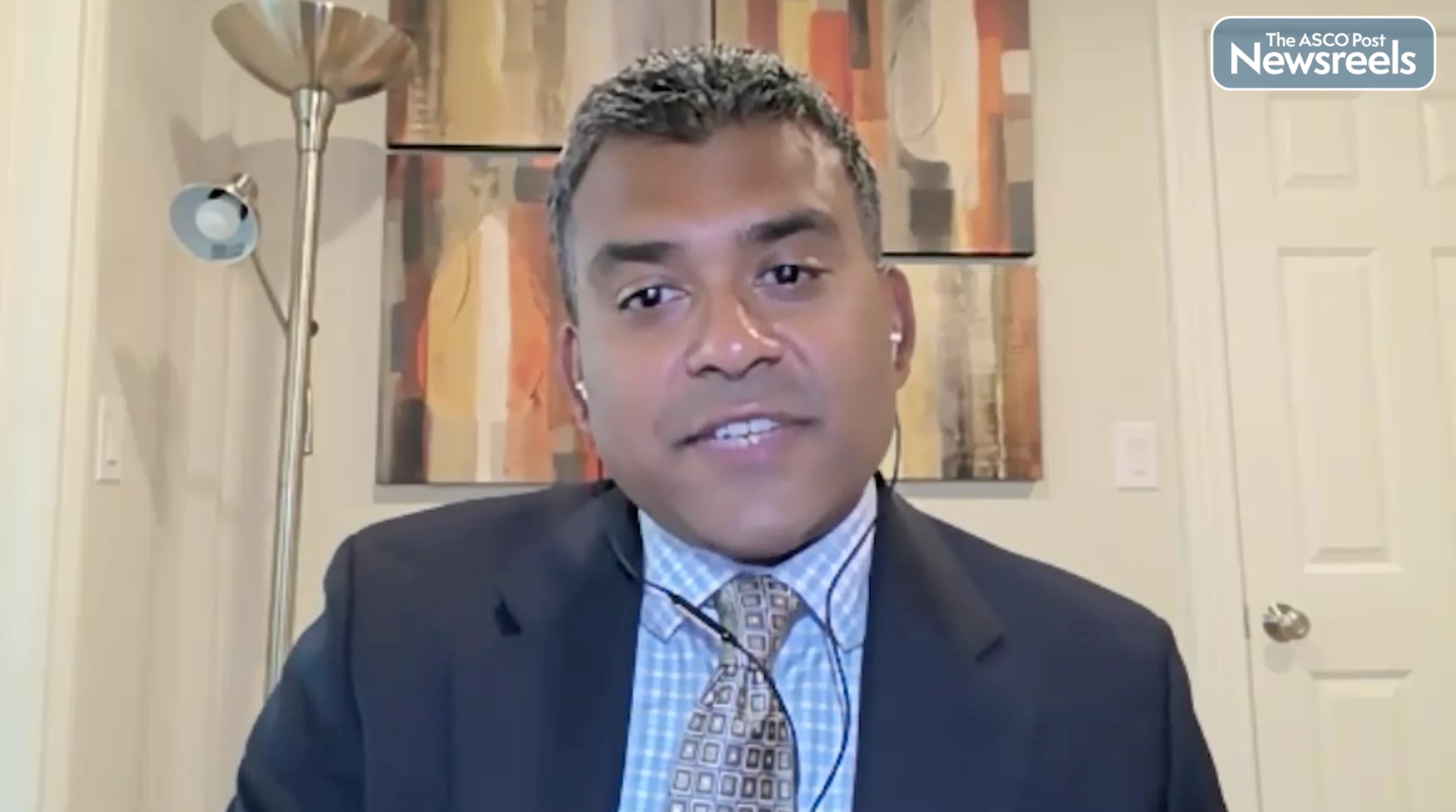
Nikhil Khushalani, MD, on Neoadjuvant and Adjuvant Treatment in CSCC

Thematic Newsreels

Advertisement

Nikhil Khushalani, MD, Vice Chair for the Department of Cutaneous Oncology at Moffitt Cancer Center, reviews advances in the adjuvant and neoadjuvant treatment of cutaneous squamous cell carcinoma (CSCC). He discusses the possibility of de-escalating therapy for patients who respond positively to presurgical agents; how to best select postoperative regimens; and ongoing trials in both spaces. 

References 

  1. Gross ND, Miller DM, Khushalani NI, et al: Neoadjuvant cemiplimab for stage II to IV cutaneous squamous-cell carcinoma. N Eng J Med 387:1557-1568, 2022.
  2. Gross ND, Miller DM, Khushalani NI, et al: Neoadjuvant cemiplimab and surgery for stage II-IV cutaneous squamous-cell carcinoma: Follow-up and survival outcomes of a single-arm, multicentre, phase 2 study. Lancet Oncol 11:1196-1205, 2023.
  3. Breukers SE, Traets JJH, van Dijk SW, et al: Neoadjuvant ipilimumab and nivolumab in resectable cutaneous squamous cell carcinoma: A randomized phase 2 trial. Nature Medicine. October 8, 2025 (early release online).
  4. Ladwa R, Lee JH, McGrath M, et al: Response-adapted surgical and radiotherapy de-escalation in resectable cutaneous squamous cell cancer using pembrolizumab: The De-Squamate study. J Clin Oncol 26:2888-2986, 2025.
  5. Porceddu SV, Bressel M, Poulsen MG, et al: Postoperative concurrent chemoradiotherapy versus postoperative radiotherapy in high-risk cutaneous squamous cell carcinoma of the head and neck: The randomized phase III TROG 05.01 trial. J Clin Oncol 13:1275-1283, 2018.
  6. Rischin D, Porceddu S, Day F, et al: Adjuvant cemiplimab or placebo in high-risk cutaneous squamous-cell carcinoma. N Eng J Med 393:774-785, 2025.
  7. Koyfman SA, Lee JHJ, Mortier L, et al: Phase 3 randomized trial (KEYNOTE-630) of adjuvant pembrolizumab versus placebo for high-risk locally advanced cutaneous squamous cell carcinoma following surgery and radiation. 2025 ASCO Annual Meeting. Abstract 6000. Presented May 31, 2025. 


Related Videos

Lymphoma

Jennifer Gile, MD, on High-Risk DLBCL: frontMIND and POLARIX Regimens

Jennifer Gile, MD, of Willamette Valley Cancer Institute, talks about the first positive phase III trials in the high-risk diffuse large B-cell lymphoma (DLBCL) space—POLARIX and frontMIND. POLARIX established the superiority of a modified regimen of rituximab, cyclophosphamide, doxorubicin, vincristine, and prednisone (R-CHOP) called pola-R-CHP, in which vincristine was replaced with polatuzumab vedotin, over standard R-CHOP; frontMIND showed that the addition of the CD19 monoclonal antibody tafasitamab plus the immunomodulatory drug lenalidomide to R-CHOP also improved outcomes over standard R-CHOP. Dr. Gile discusses current considerations when choosing between these regimens and how future research may lead to even more refined patient selection. 

Skin Cancer
Genomics/Genetics

Kent Shih, MD, on Adjuvant Therapy in Melanoma: How Does GEP Testing Factor In?

Kent Shih, MD, of Tennessee Oncology, presents three patients cases that show how the use of gene-expression profile testing guides patient and practitioner decision-making when choosing the appropriate path of adjuvant treatment among individuals with melanoma.

Skin Cancer
Genomics/Genetics

Kent Shih, MD, on Use of GEP for SLNB and Follow-up Planning in Melanoma

Kent Shih, MD, of Tennessee Oncology, shares three patient cases that illustrate how gene-expression profiling (GEP) in patients with melanoma helps shape the decision to proceed to sentinel lymph node biopsy (SLNB) and how often and thorough follow-up should be with medical oncology.

Lung Cancer

Benjamin P. Levy, MD, on KRAS G12C–Mutated NSCLC: Current Treatment Landscape

Benjamin P. Levy, MD, of Johns Hopkins Sidney Kimmel Cancer Center, reviews currently available therapies for patients with KRAS G12C–mutated non–small cell lung cancer (NSCLC), noting the importance of genomic testing to identify individuals eligible for treatment with these agents. He discusses the two FDA-approved second-line drugs in this space—sotorasib and adagrasib—touching on their efficacy and associated adverse events. He also mentions divarasib, an investigational next-generation KRAS G12C inhibitor, which showed superiority over both sotorasib and adagrasib in a recent head-to-head phase III trial.  

Skin Cancer

Allison Betof Warner, MD, PhD, on TIL Therapy for Advanced Melanoma: Innovative Clinical Advances in Treatment

Allison Betof Warner, MD, PhD, reviews important clinical research in the treatment of advanced melanoma, including tumor-infiltrating lymphocyte (TIL) therapy, the role of this innovative treatment in advanced melanoma, and relevant data, peer-reviewed literature, and FDA approvals in 2024. She also provides a look ahead at what is on the horizon in 2025 with regard to care for patients with advanced melanoma.

Advertisement

Advertisement


Advertisement