Matthew Lunning, DO, FACP: How Does CAR T-Cell Therapy Factor in With Tafasitamab in DLBCL?
Thematic NewsreelsAdvertisement
Access to second-line chimeric antigen receptor (CAR) T-cell therapy remains suboptimal in relapsed/refractory diffuse large B-cell lymphoma (DLBCL). Matthew Lunning, DO, FACP, of the University of Nebraska Medical Center, explains that prior tafasitamab exposure may theoretically affect CD19 detection or antigen persistence, but clinical evidence demonstrating impaired subsequent CAR T-cell efficacy is lacking. Real-world data have not established CD19 loss, supporting continued consideration of CAR T-cell therapy following tafasitamab-based treatment.
Transcript
Disclaimer: This video transcript has not been proofread or edited and may contain errors.
We all know that people are not getting access to CAR T-cell that potentially could get CAR T-cell. I think the data's very clear that we have a breakdown in the system somewhere. Still trying to figure it out. I don't have all the answers on this. But if patients aren't getting CAR T-cell in the second line, what could they potentially be getting? Are they getting tafasitamab-lenalidomide based upon the L-9 data which did allow second-line relapse refractory large B-cell lymphoma patients? And what does that mean that if patients are now being pushed to the third line and beyond to get CAR T-cell, what potentially could that CD19 antibody exposure do to the future state of the efficacy of the CAR T-cell?
I can tell you there wasn't very many patients, if any, in the third line trials that had prior exposure to tafasitamab because guess what? TRANSCEND and ZUMA-1 and JULIET, they all came before tafasitamab-lenalidomide was even really being thought of. I can remember where I was at ASH when we were talking about tafasitamab before it even had a name of tafasitamab. And we were already talking about liso-cel, axi-cel, and tisa-cel in relapsed refractory large B-cell lymphoma. So if patients aren't getting to CAR T-cell second-line that could, and they may be receiving tafa-len or tafa-len combinations that are going through clinical trials right now, what do we know about that CD19 exposure and its potential impact? Well, it's still pretty darn theoretical, right?
I mean, it's theoretical that if you expose a patient to CD19 antibodies that you could have CD19 antibody loss as one of the escape mechanisms. One of the things that I think has been looked at in the literature already is if that tafasitamab is just occupying the antibody. So when you go to stain for a CD19 expression, it's not seen because it's kind of cloaking or masking that antigen. And by just doing some fancy laboratory assessment, you unmask that CD19 antigen and actually the tafasitamab may be covering it up, but the CAR T-cell may still be able to bind. And what is that downstream impact of that? Maybe it might be different. Maybe it might be in the positive direction in allowing efficacy, but maybe reducing toxicity.
But guess what? We're only going to figure that out through the lens of clinical trials. And right now, I don't see any clinical trials happening that are looking at tafasitamab prior to CAR T-cell. Really, all we have is real world experiences, which has not shown us necessarily that you're seeing CD19 loss. And so should we be penalizing people if they've had prior tafasitamab before CAR T-cell and saying, "No, no, no, no, no, you can't go to your CD19 CAR T?" I would argue differently. Half the battle right now is getting to CAR T-cell, and we are getting the people to that battle. So let's not penalize them for something that we don't have good data to say that we shouldn't do.
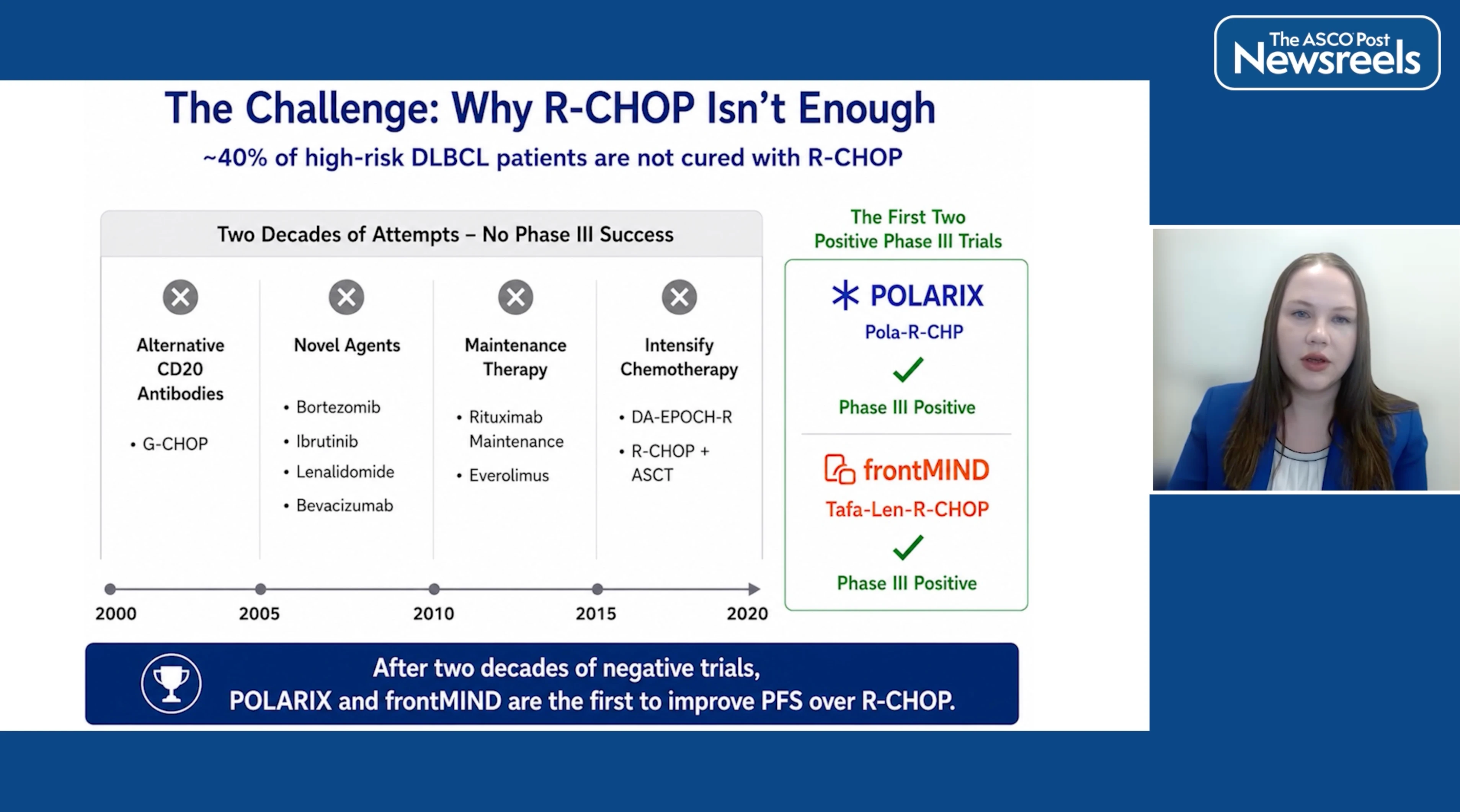
If people have been exposed to tafusitumab, we should still be trying to get them to their CAR T-cell, regardless if it's in the frontline because they've gotten frontMIND-like treatment or if it's in the second line and beyond because they've received L-9 treatment. At least if we're doing that and having CAR T-cell as part of the iterative discussion, I think that's still the best care for our patients.