Benjamin P. Levy, MD, on KRAS G12C–Mutated NSCLC: Current Treatment Landscape
Thematic Newsreels
Benjamin P. Levy, MD, of Johns Hopkins Sidney Kimmel Cancer Center, reviews currently available therapies for patients with KRAS G12C–mutated non–small cell lung cancer (NSCLC), noting the importance of genomic testing to identify individuals eligible for treatment with these agents. He discusses the two FDA-approved second-line drugs in this space—sotorasib and adagrasib—touching on their efficacy and associated adverse events. He also mentions divarasib, an investigational next-generation KRAS G12C inhibitor, which showed superiority over both sotorasib and adagrasib in a recent head-to-head phase III trial.
The ASCO Post Staff
Erika Hamilton, MD, Director, Breast Cancer Research at Sarah Cannon Research Institute, provides a look at “where we stand in 2025” in the field of oral selective estrogen receptor degraders (SERDs) for patients with estrogen receptor–positive, HER2-negative breast cancer. She discusses the first and only FDA-approved oral SERD, elacestrant, indicated for use after CDK4/6 inhibitor therapy in patients with ESR1 mutations; reviews agents still being tested in clinical trials, such as imlunestrant and camizestrant; and highlights the role of oral SERDs as both monotherapies and in novel combinations. As Dr. Hamilton explains, “there haven’t been novel endocrine backbones [for these patients] since fulvestrant.”
Benjamin P. Levy, MD, of Johns Hopkins Sidney Kimmel Cancer Center, discusses research into moving KRAS G12C inhibitors from the second to the first line, as well as combining them with immunotherapies and EGFR antibodies. Some potential combinations under investigation include KRAS G12C inhibitors (such as olomorasib, fulzerasib, divarasib, and adagrasib) and single-agent immunotherapy (pembrolizumab) or EGFR-targeting therapies (cetuximab).
The ASCO Post Staff
Circulating tumor DNA has many roles in cancer treatment: early diagnosis, tumor profiling, determining response to therapy, and tracking clinical dynamics. In this video, Arvind N. Dasari, MD, MS, of The University of Texas MD Anderson Cancer Center, focuses on it as a marker for measurable residual disease (MRD), which can help to determine risk of disease recurrence in patients with cancer. Dr. Dasari reviews the development of assays for MRD, both tumor-informed and tumor-agnostic, and provides top-level data from several clinical trials on the topic that have informed the role of MRD testing in both the colorectal cancer and general solid tumor space.
References
- Tie J, Wang Y, Lo SN, et al: Circulating tumor DNA analysis guiding adjuvant therapy in stage II colon cancer: Overall survival and updated 5-year results from the randomized DYNAMIC trial. 2024 ASCO Annual Meeting. Abstract 108.
- Lieu CH, Yu G, Kopetz S, et al: NRG-GI008: Colon adjuvant chemotherapy based on evaluation of residual disease (CIRCULATE-NORTH AMERICA). 2024 ASCO Gastrointestinal Cancers Symposium. Abstract TPS243.
- Tie J, Wang Y, Loree J, et al: ctDNA-guided adjuvant chemotherapy escalation in stage III colon cancer: Primary analysis of the ctDNA-positive cohort from the randomized AGITG dynamic-III trial (intergroup study of AGITG and CCTG). 2025 ASCO Annual Meeting. Abstract 3505.
- Lumish MA, Jayakumaran G, Fox M, et al: Frequency of minimal residual disease as measured by ctDNA in mismatch repair deficient tumors following curative resection. 2021 ASCO Annual Meeting. Abstract e14520.
- Kotani D, Oki E, Nakamura Y, et al: Molecular residual disease and efficacy of adjuvant chemotherapy in patients with colorectal cancer. Nature Medicine 29:127-134, 2023.
- Kasi PM, Aushev VN, Ensor J, et al: Circulating tumor DNA (ctDNA) for informing adjuvant chemotherapy (ACT) in stage II/III colorectal cancer (CRC): Interim analysis of BESPOKE CRC study. 2024 ASCO Gastrointestinal Cancers Symposium. Abstract 9.
- Maddalena G, Pellatt AJ, Eluri M, et al: INTERCEPT Program of circulating tumor DNA (ctDNA) testing for minimal residual disease (MRD) in colorectal cancer (CRC): Results from a prospective clinical cohort. 2024 ASCO Gastrointestinal Cancers Symposium. Abstract 27.
- Meyerhardt JA, Shi Q, Fuchs CS, et al: Effect of celecoxib vs placebo added to standard adjuvant therapy on disease-free survival among patients with stage III colon cancer. JAMA 13:1277-1286, 2021.
- Nowak JA, Shi Q, Twombly T, et al: Prognostic and predictive role of circulating tumor DNA (ctDNA) in stage III colon cancer treated with celecoxib: Findings from CALGB (Alliance)/SWOG 80702. 2025 ASCO Gastrointestinal Cancers Symposium. Abstract LBA14.
The ASCO Post Staff
Nikhil Khushalani, MD, Vice Chair for the Department of Cutaneous Oncology at Moffitt Cancer Center, reviews advances in the adjuvant and neoadjuvant treatment of cutaneous squamous cell carcinoma (CSCC). He discusses the possibility of de-escalating therapy for patients who respond positively to presurgical agents; how to best select postoperative regimens; and ongoing trials in both spaces.
References
- Gross ND, Miller DM, Khushalani NI, et al: Neoadjuvant cemiplimab for stage II to IV cutaneous squamous-cell carcinoma. N Eng J Med 387:1557-1568, 2022.
- Gross ND, Miller DM, Khushalani NI, et al: Neoadjuvant cemiplimab and surgery for stage II-IV cutaneous squamous-cell carcinoma: Follow-up and survival outcomes of a single-arm, multicentre, phase 2 study. Lancet Oncol 11:1196-1205, 2023.
- Breukers SE, Traets JJH, van Dijk SW, et al: Neoadjuvant ipilimumab and nivolumab in resectable cutaneous squamous cell carcinoma: A randomized phase 2 trial. Nature Medicine. October 8, 2025 (early release online).
- Ladwa R, Lee JH, McGrath M, et al: Response-adapted surgical and radiotherapy de-escalation in resectable cutaneous squamous cell cancer using pembrolizumab: The De-Squamate study. J Clin Oncol 26:2888-2986, 2025.
- Porceddu SV, Bressel M, Poulsen MG, et al: Postoperative concurrent chemoradiotherapy versus postoperative radiotherapy in high-risk cutaneous squamous cell carcinoma of the head and neck: The randomized phase III TROG 05.01 trial. J Clin Oncol 13:1275-1283, 2018.
- Rischin D, Porceddu S, Day F, et al: Adjuvant cemiplimab or placebo in high-risk cutaneous squamous-cell carcinoma. N Eng J Med 393:774-785, 2025.
- Koyfman SA, Lee JHJ, Mortier L, et al: Phase 3 randomized trial (KEYNOTE-630) of adjuvant pembrolizumab versus placebo for high-risk locally advanced cutaneous squamous cell carcinoma following surgery and radiation. 2025 ASCO Annual Meeting. Abstract 6000. Presented May 31, 2025.
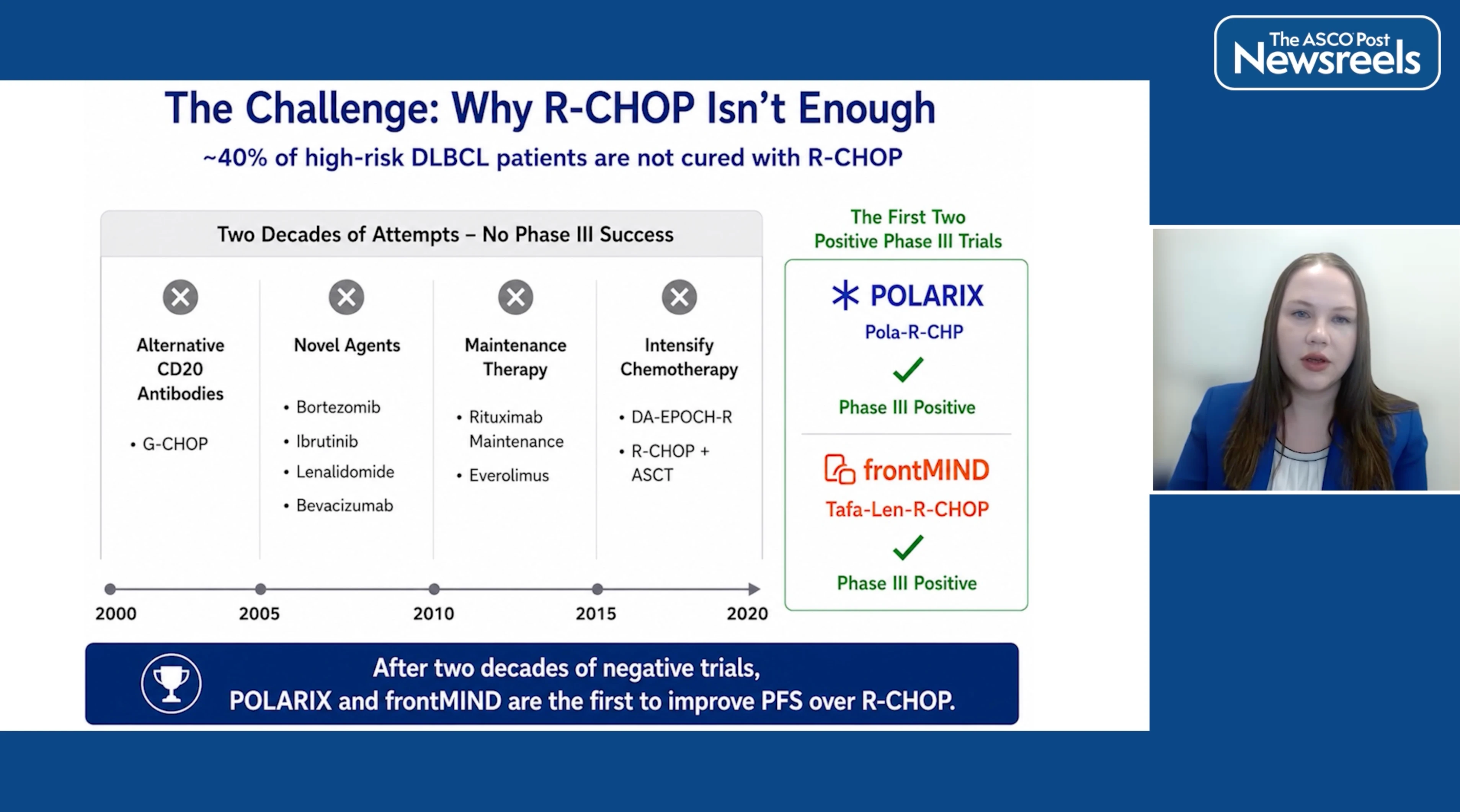
Jennifer Gile, MD, of Willamette Valley Cancer Institute, talks about the first positive phase III trials in the high-risk diffuse large B-cell lymphoma (DLBCL) space—POLARIX and frontMIND. POLARIX established the superiority of a modified regimen of rituximab, cyclophosphamide, doxorubicin, vincristine, and prednisone (R-CHOP) called pola-R-CHP, in which vincristine was replaced with polatuzumab vedotin, over standard R-CHOP; frontMIND showed that the addition of the CD19 monoclonal antibody tafasitamab plus the immunomodulatory drug lenalidomide to R-CHOP also improved outcomes over standard R-CHOP. Dr. Gile discusses current considerations when choosing between these regimens and how future research may lead to even more refined patient selection.