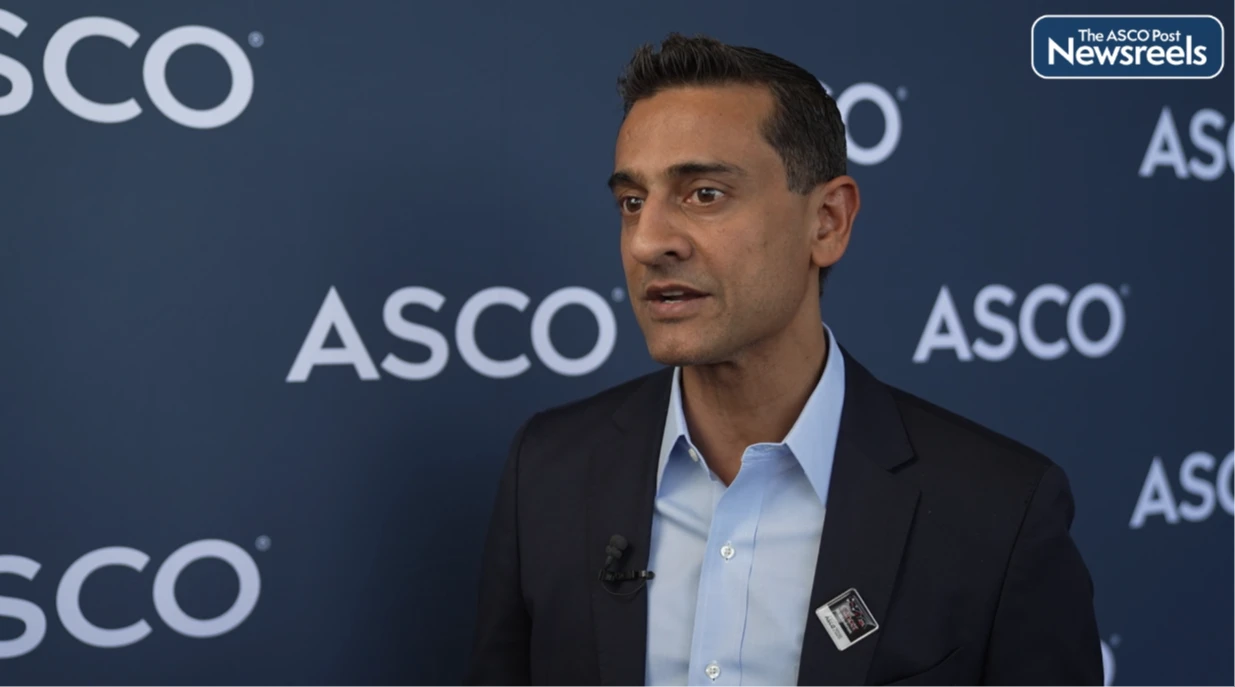
Veronica Diermayr, PhD, on AI-Driven Prediction of N256-Glycosylated CEACAM5/6 Expression in Gastric and Esophageal Cancer
ASCO 2026
Veronica Diermayr, PhD, of EDDC and A*STAR, discusses the use of artificial intelligence (AI) driven strategy called H&E 2.0 in gastric and esophageal cancer. Researchers tested the feasibility of training deep-learning models on hematoxylin and eosin images of gastroesophageal carcinomas and their ability to predict EBC-129 antigen expression directly from these images. EBC-129 is an experimental antibody-drug conjugate that targets N256-glycosylated CEACAM5/6, which is highly expressed on solid tumors, including gastroesophageal cancers (Abstract 4018).
The ASCO Post Staff
Lauren Averett Byers, MD, of The University of Texas MD Anderson Cancer Center, describes data on ABBV-706—an investigational antibody-drug conjugate targeting SEZ6—alone or in combination with the anti–PD-1 monoclonal antibody budigalimab in patients with relapsed or refractory small cell lung cancer (SCLC) (Abstract 8008).
The ASCO Post Staff
Ramaswamy Govindan, MD, FASCO, of Alvin J. Siteman Cancer Center at Washington University School of Medicine in St. Louis, presents the final overall survival results from the randomized phase III Alliance A081105 trial, which evaluated adjuvant erlotinib vs observation after complete resection of EGFR-mutant non–small cell lung cancer (NSCLC) (Abstract 8001).
The ASCO Post Staff
Elizabeth McDonald, MD, PhD, of the University of Pennsylvania, discusses results from a retrospective cohort study that showed that the use of GLP-1 treatment was associated with a significantly lower incidence of breast cancer, after accounting for age, race, ethnicity, BMI, breast density, and type 2 diabetes status (Abstract 10506).
Gerneiva Parkinson, MD, of Stanford Cancer Institute, discusses time on treatment for systemic therapies among women with hormone receptor (HR)-positive breast cancer and a pathogenic variant in BRCA1, BRCA2, or PALB2 (Abstract 1096).
The ASCO Post Staff
Shubham Pant, MD, MBBS, of The University of Texas MD Anderson Cancer Center, discusses the practice-changing results of the phase III RASolute 302 study, which showed that daraxonrasib doubled median overall survival compared with standard chemotherapy in pretreated metastatic pancreatic cancer (Abstract LBA5).