Jason R. Westin, MD, FASCO, on Updated Safety and Efficacy From the SUNMO Trial in LBCL
ASCO 2026Advertisement
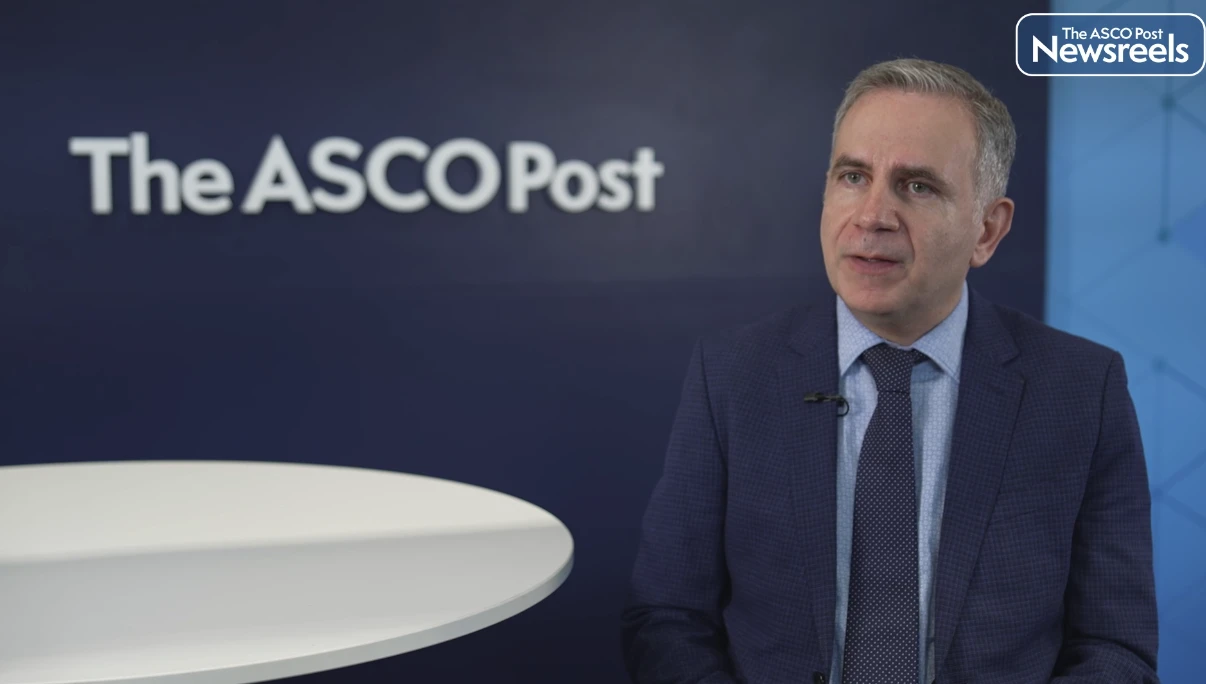
Jason R. Westin, MD, FASCO, of The University of Texas MD Anderson Cancer Center, provides an update on the safety and efficacy data from the phase III SUNMO trial, which compared mosunetuzumab and polatuzumab vedotin vs rituximab, gemcitabine, and oxaliplatin in patients with relapsed or refractory large B-cell lymphoma (LBCL) (Abstract 7007).
Transcript
Disclaimer: This video transcript has not been proofread or edited and may contain errors.
SUNMO is a study comparing a new combination called mosunetuzumab and polatuzumab, or Mosun-Pola. Mosun-Pola is a combination of a bispecific antibody and an antibody-drug conjugate. That combination has looked very promising in patients with relapsed/refractory large B-cell lymphoma, and the SUNMO trial evaluated it in a randomized fashion against R-GemOx, a chemotherapy backbone that's used commonly around the world for patients with relapsed large cell lymphoma. We presented last year the initial results and published them in the Journal of Clinical Oncology, the initial primary analysis. But at this ASCO meeting, we're now presenting an important update to those results. What we've shown with longer follow-up is that Mosun-Pola is still superior to R-GemOx, and we're hopeful this will translate into approvals for Mosun-Pola so that this treatment can be available to patients both within the United States as well as globally if they have relapsed/refractory large B-cell lymphoma. Specifically, what we found in this trial was that in patients who have relapsed large cell lymphoma and are transplant ineligible, the combination of Mosun-Pola had an improvement in overall response rate, complete response rate, progression-free survival, and quality of life for the patients. Patients actually felt better and did better receiving this novel treatment versus chemotherapy. Mosun-Pola is given as an outpatient. The mosunetuzumab part can be given subcutaneously, the polatuzumab part is given intravenously, and it's a fixed-duration treatment. It's not something that has to go on for a long time. It's given for a prescribed number of cycles, and then that stops. And what we found is that it doubled the complete response rate and had a massive improvement in progression-free survival. The interim analysis of overall survival is presented as well, and those data need to mature a bit more to see if there's a true difference in overall survival. But thus far, the results show a very significant improvement in patient outcomes for Mosun-Pola. An important point about the SUNMO trial, as we look at the toxicity profile for Mosun-Pola, is that bispecific antibodies and CAR T-cell therapies have a toxicity called cytokine release syndrome, which can be quite difficult to manage in sites that don't have experience managing this. What we saw for Mosun-Pola was that more than 95% of patients did not have significant cytokine release syndrome, which is a major difference from other bispecific antibodies in the same space. So if community oncologists are looking to choose whether they should use treatment A or treatment B for their patient, the lack of significant toxicities for Mosun-Pola could be a significant advantage for using this regimen over other regimens. That very low rate of cytokine release syndrome will be favorable for patients. So the message that oncologists should take away from this video is that if they're looking for treatments for patients who are ineligible for standard-of-care stem cell transplant with relapsed large cell lymphoma, the bispecific antibody mosunetuzumab and the antibody-drug conjugate polatuzumab, Mosun-Pola, should be an option they should consider for their patients, especially when comparing it to chemotherapy like R-GemOx.