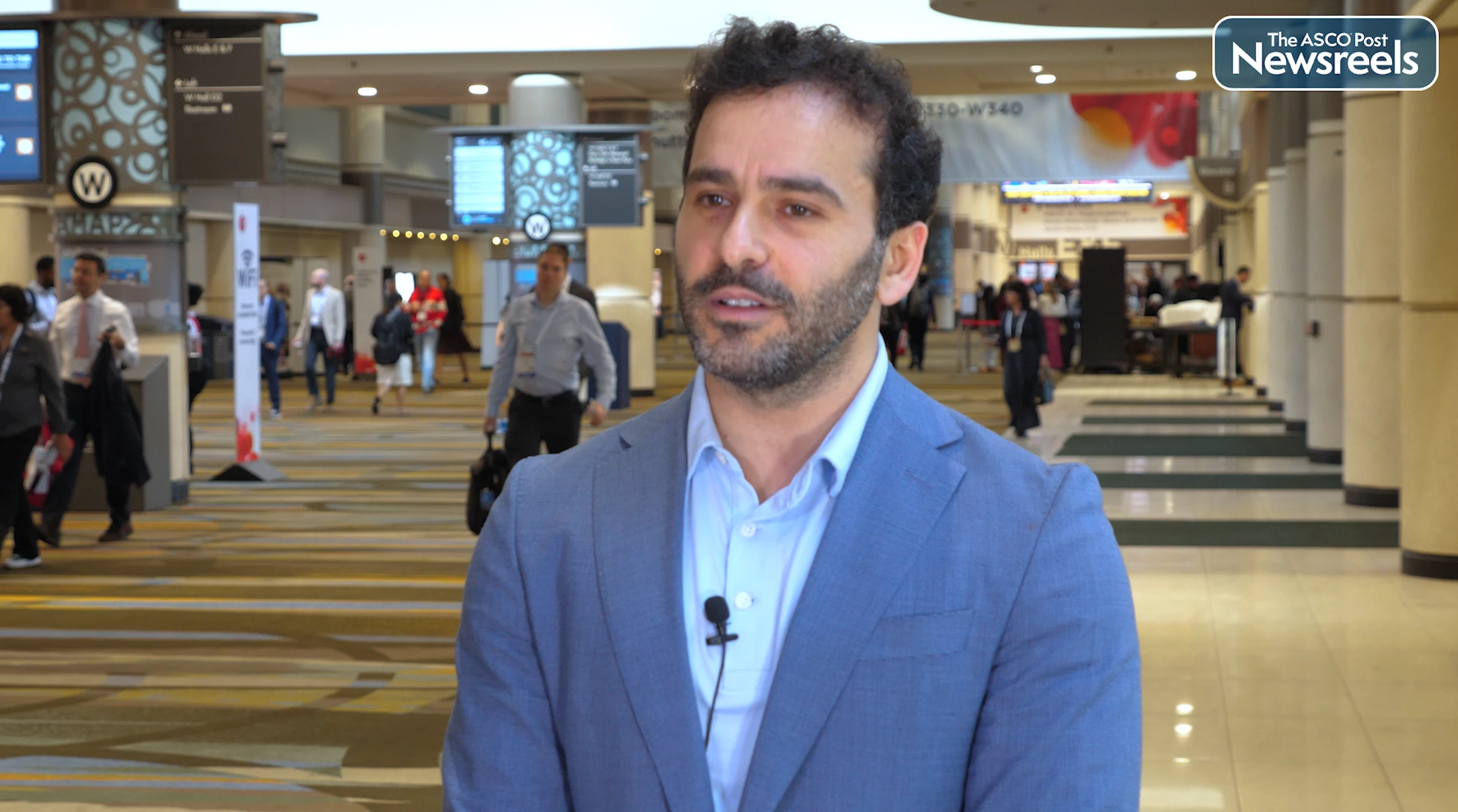
Anand Patel, MD, on Ph-Positive ALL: TKI Plus Inotuzumab Ozogamicin–Based Therapy
ASH 2025
Anand Patel, MD, of the University of Chicago, discusses results from a phase II trial that showed tyrosine kinase inhibitor plus inotuzumab ozogamicin–based therapy resulted in major molecular response in patients newly diagnosed with Philadelphia chromosome (Ph)-positive acute lymphoblastic leukemia (ALL) (Abstract 441).
The ASCO Post Staff
Ibrahim Aldoss, MD, of City of Hope, presents findings from a small, single-center study of patients aged 55 years and older with B-cell acute lymphoblastic leukemia (ALL) in first complete remission who were treated with CD19-directed CAR T-cell therapy. Researchers found the therapy was safe, resulted in low-grade adverse events, and led to preliminary durable measurable residual disease response (Abstract 443).
The ASCO Post Staff
Amer Zeidan, MBBS, of Yale School of Medicine, discusses findings from an analysis of the IMerge trial, which explored the possible association between imetelstat-related cytopenias and hemoglobin increase—a measure linked to red blood cell transfusion independence achievement—in patients with lower-risk myelodysplastic syndromes (MDS) (Abstract 490).
The ASCO Post Staff
Aaron Logan, MD, PhD, of UCSF Health, discusses research examining the effect of transplant before or after treatment with brexucabtagene autoleucel in the real world for adult patients with relapsed or refractory Philadelphia chromosome–negative B-cell acute lymphoblastic leukemia (ALL) (Abstract 516).
The ASCO Post Staff
Shahzad Raza, MD, of Cleveland Clinic, presents updated phase II results of the RedirecTT-1 trial, focusing on the efficacy and safety of talquetamab combined with teclistamab in patients with relapsed/refractory multiple myeloma and extramedullary disease (Abstract 698). The study also received simultaneous publication in The New England Journal of Medicine.
The ASCO Post Staff
Jack Khouri, MD, of Cleveland Clinic, describes the findings of a phase II trial which investigated the safety and efficacy of burixafor (GPC-100), a potent and selective small -molecule antagonist of CXCR4, and propranolol with granulocyte colony-stimulating factor (G-CSF) for the mobilization of hematopoietic progenitor cells (HPC) in patients with multiple myeloma. Researchers aimed to boost the bone marrow HPC niche and optimize mobilization in patients with multiple myeloma eligible for autologous hematopoietic cell transplant (Abstract 1050).