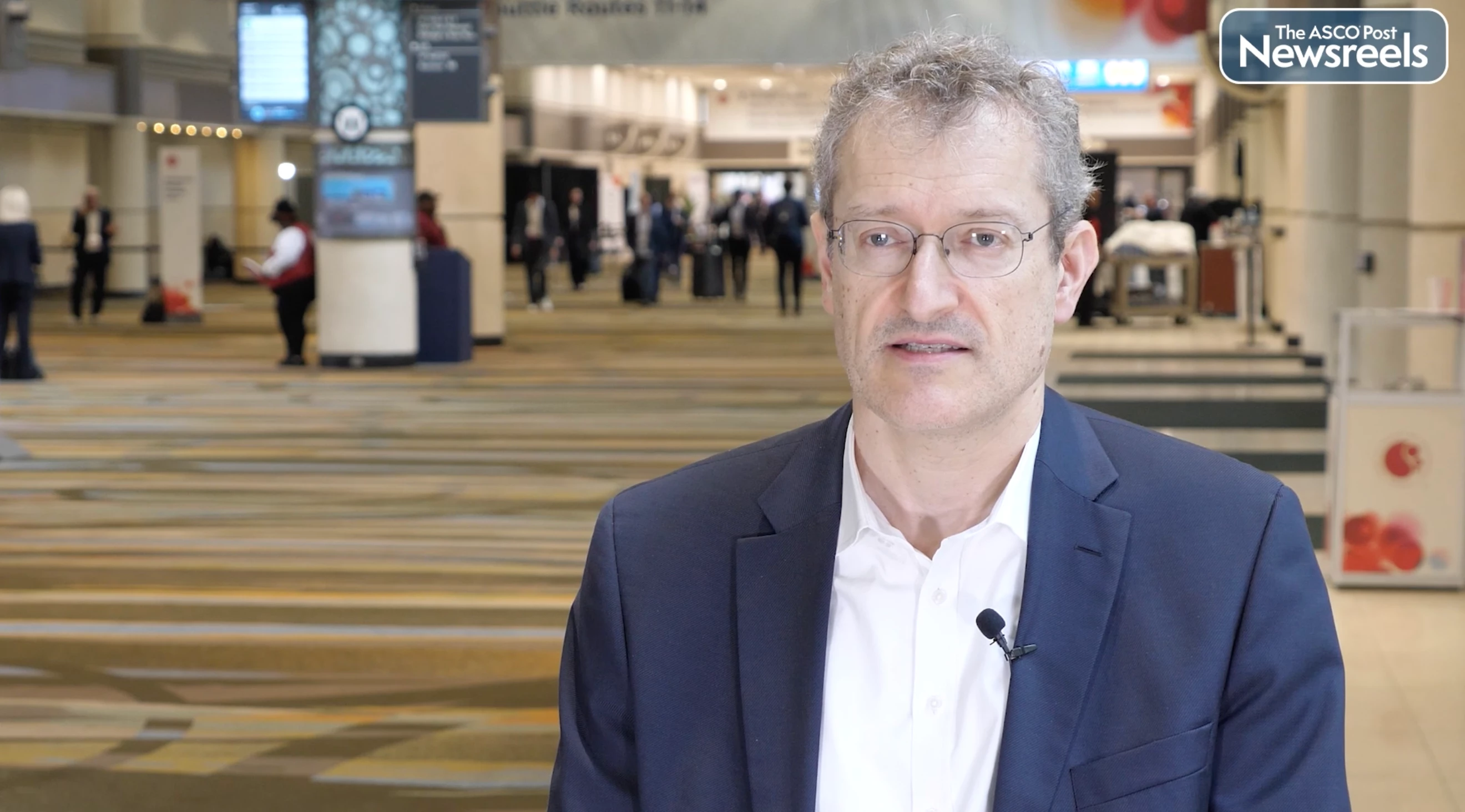
Dory Abelman, PhD(c), HBHSc, on Newly Diagnosed Multiple Myeloma: Ultradeep Whole-Genome Sequencing of cfDNA
ASH 2025
Dory Abelman, PhD(c), HBHSc, of the University of Toronto, discusses findings that support the feasibility of ultradeep cell-free DNA whole-genome sequencing for comprehensive genomic profiling in patients with multiple myeloma, which may be a less invasive alternative to bone marrow biopsy (Abstract 495).
The ASCO Post Staff
Brian Ball, MD, of City of Hope, presents updated results from the phase I/II BEXMAB study. They showed that the doublet had encouraging activity in patients with TP53-mutant, higher-risk MDS; translational data support the combination regimen’s potential for altering immune dysregulation in this subtype (Abstract 236).
The ASCO Post Staff
Karthik Ramasamy, MBBS, FRCP, FRCPath, PhD, of the University of Oxford, discusses initial results of the phase II/III UK-based RADAR trial. The study evaluated isatuximab, bortezomib, lenalidomide, dexamethasone, and cyclophosphamide induction, followed by single autologous stem cell transplant, consolidation with isatuximab plus bortezomib, lenalidomide, and dexamethasone, and isatuximab plus lenalidomide maintenance, in patients with double-hit multiple myeloma (Abstract 98).
The ASCO Post Staff
Jack Khouri, MD, of Cleveland Clinic, describes the findings of a phase II trial which investigated the safety and efficacy of burixafor (GPC-100), a potent and selective small -molecule antagonist of CXCR4, and propranolol with granulocyte colony-stimulating factor (G-CSF) for the mobilization of hematopoietic progenitor cells (HPC) in patients with multiple myeloma. Researchers aimed to boost the bone marrow HPC niche and optimize mobilization in patients with multiple myeloma eligible for autologous hematopoietic cell transplant (Abstract 1050).
The ASCO Post Staff
Amer Zeidan, MBBS, of Yale School of Medicine, discusses findings from an analysis of the IMerge trial, which explored the possible association between imetelstat-related cytopenias and hemoglobin increase—a measure linked to red blood cell transfusion independence achievement—in patients with lower-risk myelodysplastic syndromes (MDS) (Abstract 490).
The ASCO Post Staff
Alexander Lesokhin, MD, of Memorial Sloan Kettering Cancer Center, discusses results of a retrospective analysis from the phase II MagnetisMM-3 trial. A post hoc analysis was conducted of the subgroup of patients enrolled in the study who had a prolonged treatment interruption or who permanently discontinued elranatamab and maintained their responses for 6 months or longer (Abstract 2269).