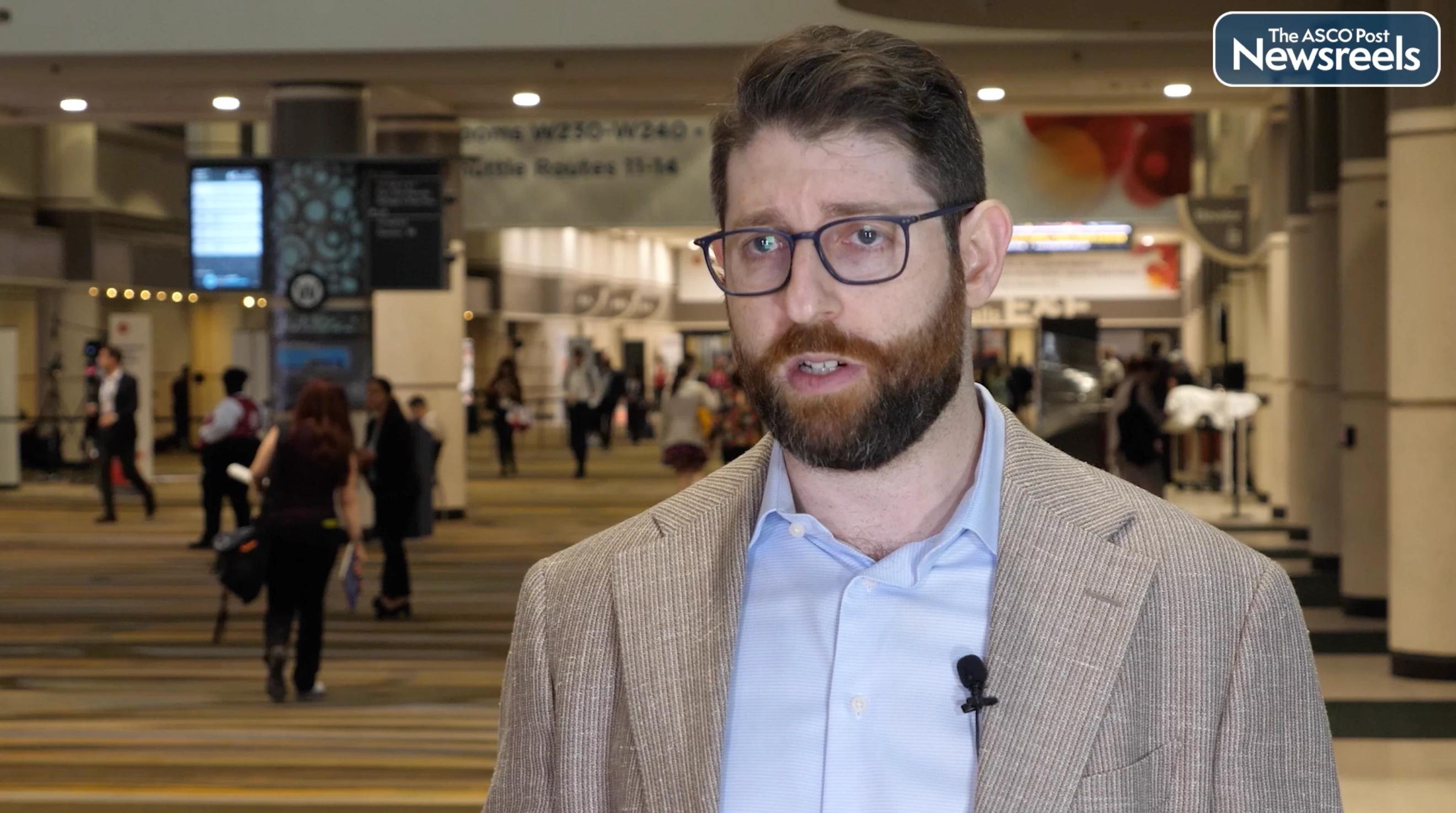
Krina Patel, MD, MSc, on Anitocabtagene Autoleucel for Relapsed/Refractory Multiple Myeloma
ASH 2025
Krina Patel, MD, MSc, of The University of Texas MD Anderson Cancer Center, provides updated results from the fully enrolled, ongoing iMMagine-1 phase II registrational trial of anitocabtagene autoleucel, an autologous anti-BCMA CAR T-cell therapy with a novel D-domain binder. The agent is under development for patients with relapsed and/or refractory multiple myeloma (Abstract 256).
The ASCO Post Staff
Amer Zeidan, MBBS, of Yale School of Medicine, shares results from the phase I/II BEXMAB study, which examined the safety, tolerability and preliminary efficacy of bexmarilimab—a novel macrophage checkpoint inhibitor targeting Clever-1—in combination with the standard of care, azacitidine, in patients with higher-risk myelodysplastic syndromes (MDS), including those with TP53-mutated disease. (Abstract 236).
The ASCO Post Staff
Amer Zeidan, MBBS, of Yale School of Medicine, discusses findings from an analysis of the IMerge trial, which explored the possible association between imetelstat-related cytopenias and hemoglobin increase—a measure linked to red blood cell transfusion independence achievement—in patients with lower-risk myelodysplastic syndromes (MDS) (Abstract 490).
The ASCO Post Staff
Karthik Ramasamy, MBBS, FRCP, FRCPath, PhD, of the University of Oxford, discusses initial results of the phase II/III UK-based RADAR trial. The study evaluated isatuximab, bortezomib, lenalidomide, dexamethasone, and cyclophosphamide induction, followed by single autologous stem cell transplant, consolidation with isatuximab plus bortezomib, lenalidomide, and dexamethasone, and isatuximab plus lenalidomide maintenance, in patients with double-hit multiple myeloma (Abstract 98).
The ASCO Post Staff
Alexander Lesokhin, MD, of Memorial Sloan Kettering Cancer Center, discusses results of a retrospective analysis from the phase II MagnetisMM-3 trial. A post hoc analysis was conducted of the subgroup of patients enrolled in the study who had a prolonged treatment interruption or who permanently discontinued elranatamab and maintained their responses for 6 months or longer (Abstract 2269).
The ASCO Post Staff
Benjamin Diamond, MD, of the University of Miami, describes findings from the single-center phase II REKINDLE trial, which looked at the combination regimen of iberdomide, carfilzomib, daratumumab, and dexamethasone in patients with early relapsed/refractory multiple myeloma (Abstract 251).