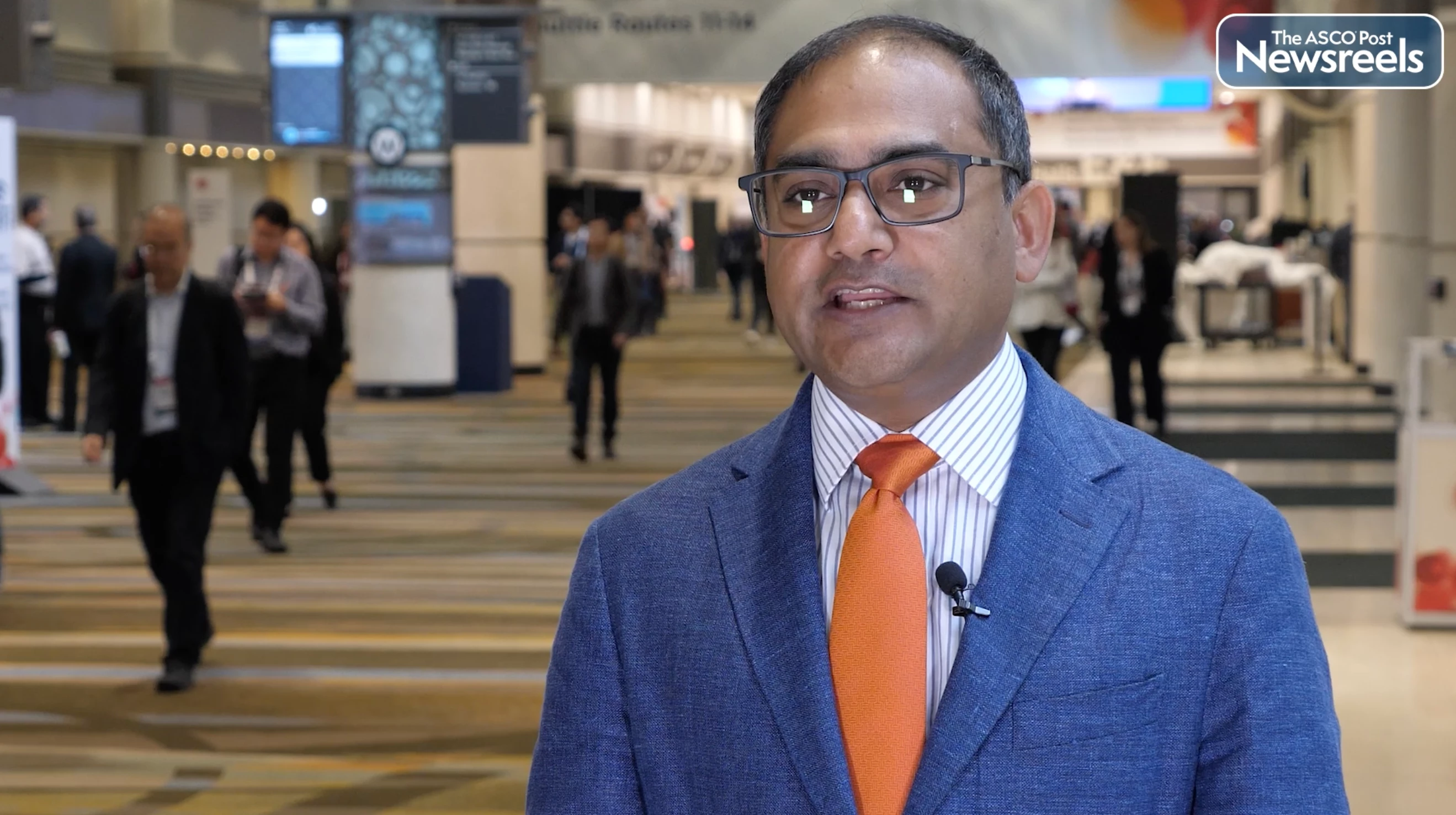
Valeria Santini, MD, on Imetelstat for Lower-Risk MDS: Long-Term Outcomes From the IMerge Trial
ASH 2025
The telomerase inhibitor imetelstat was approved for the treatment of certain patients with lower-risk myelodysplastic syndromes (MDS) based on the results of the phase III IMerge trial. Valeria Santini, MD, of the University of Florence, provides updates on secondary endpoints, including overall and progression-free survival; progression to acute myeloid leukemia; safety; and long-term outcomes by subgroups of interest in IMerge, as well as ad hoc outcomes, including overall survival by response (Abstract 2074).
The ASCO Post Staff
Benjamin Diamond, MD, of the University of Miami, describes findings from the single-center phase II REKINDLE trial, which looked at the combination regimen of iberdomide, carfilzomib, daratumumab, and dexamethasone in patients with early relapsed/refractory multiple myeloma (Abstract 251).
The ASCO Post Staff
Jack Khouri, MD, of Cleveland Clinic, describes the findings of a phase II trial which investigated the safety and efficacy of burixafor (GPC-100), a potent and selective small -molecule antagonist of CXCR4, and propranolol with granulocyte colony-stimulating factor (G-CSF) for the mobilization of hematopoietic progenitor cells (HPC) in patients with multiple myeloma. Researchers aimed to boost the bone marrow HPC niche and optimize mobilization in patients with multiple myeloma eligible for autologous hematopoietic cell transplant (Abstract 1050).
The ASCO Post Staff
Shahzad Raza, MD, of Cleveland Clinic, presents updated phase II results of the RedirecTT-1 trial, focusing on the efficacy and safety of talquetamab combined with teclistamab in patients with relapsed/refractory multiple myeloma and extramedullary disease (Abstract 698). The study also received simultaneous publication in The New England Journal of Medicine.
The ASCO Post Staff
Ibrahim Aldoss, MD, of City of Hope, presents findings from a small, single-center study of patients aged 55 years and older with B-cell acute lymphoblastic leukemia (ALL) in first complete remission who were treated with CD19-directed CAR T-cell therapy. Researchers found the therapy was safe, resulted in low-grade adverse events, and led to preliminary durable measurable residual disease response (Abstract 443).
The ASCO Post Staff
Karthik Ramasamy, MBBS, FRCP, FRCPath, PhD, of the University of Oxford, discusses initial results of the phase II/III UK-based RADAR trial. The study evaluated isatuximab, bortezomib, lenalidomide, dexamethasone, and cyclophosphamide induction, followed by single autologous stem cell transplant, consolidation with isatuximab plus bortezomib, lenalidomide, and dexamethasone, and isatuximab plus lenalidomide maintenance, in patients with double-hit multiple myeloma (Abstract 98).