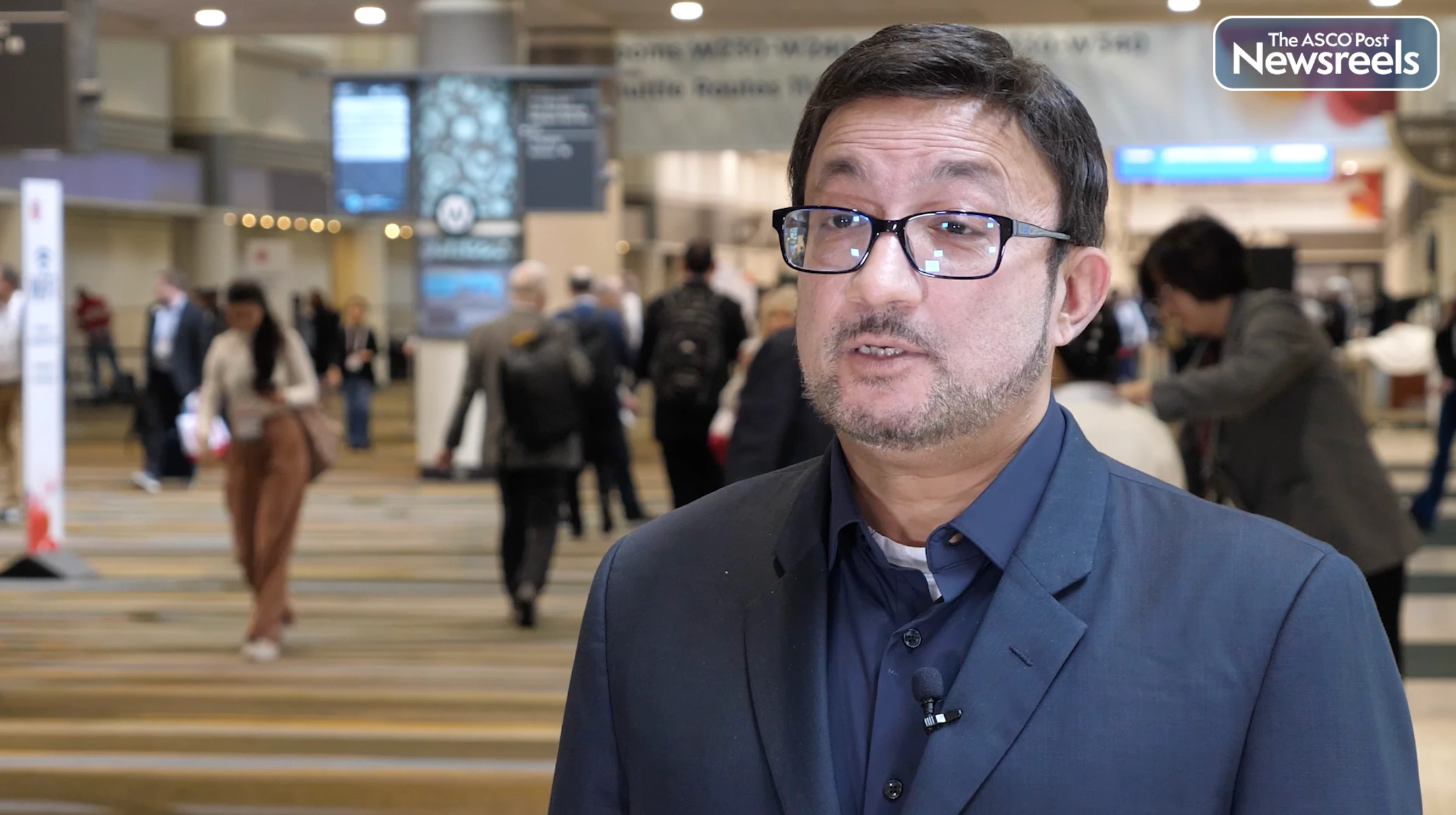
Othman Al-Sawaf, MD, PhD, on Previously Untreated CLL: Fixed-Duration vs Continuous Targeted Treatment
ASH 2025
Othman Al-Sawaf, MD, PhD, of the University Hospital of Cologne, presents results from the phase III CLL17 trial, which compared continuous ibrutinib monotherapy to fixed-duration venetoclax plus obinutuzumab to fixed-duration venetoclax plus ibrutinib for previously untreated patients with chronic lymphocytic leukemia (CLL) (Abstract 1).
The ASCO Post Staff
Jayastu Senapati, MBBS, of The University of Texas MD Anderson Cancer Center, presents initial results from a phase II trial of brexucabtagene autoleucel as consolidation therapy in front-line high-risk B-cell acute lymphoblastic leukemia (B-ALL) or relapsed/refractory B-ALL after cytoreduction (Abstract 1573).
The ASCO Post Staff
Guillermo Garcia-Manero, MD, of The University of Texas MD Anderson Cancer Center, reviews data from three abstracts in myelodysplastic syndromes (MDS) presented at this year’s meeting: outcomes from the phase III VERONA trial of venetoclax with azacitidine vs placebo with azacitidine in patients with treatment-naive intermediate- and higher-risk MDS (Abstract 235); safety and efficacy results from a phase Ib trial of a dual IRAK1/4 inhibitor in patients with relapsed/refractory lower-risk MDS (Abstract 489); and results from the phase II ASTX030-01 trial, showing pharmacokinetic, efficacy, and safety data of oral ASTX030 in patients with MDS (Abstract 491).
The ASCO Post Staff
Amer Zeidan, MBBS, of Yale School of Medicine, shares results from the phase I/II BEXMAB study, which examined the safety, tolerability and preliminary efficacy of bexmarilimab—a novel macrophage checkpoint inhibitor targeting Clever-1—in combination with the standard of care, azacitidine, in patients with higher-risk myelodysplastic syndromes (MDS), including those with TP53-mutated disease. (Abstract 236).
The ASCO Post Staff
Jennifer Woyach, MD, of The Ohio State University Comprehensive Cancer Center, reviews phase I data on rocbrutinib, a new selective next-generation inhibitor of Bruton’s tyrosine kinase (BTK), in patients with relapsed/refractory chronic lymphocytic leukemia (CLL) and prior exposure to BTK and/or BCL-2 inhibitors (Abstract 87).
The ASCO Post Staff
Shahzad Raza, MD, of Cleveland Clinic, presents updated phase II results of the RedirecTT-1 trial, focusing on the efficacy and safety of talquetamab combined with teclistamab in patients with relapsed/refractory multiple myeloma and extramedullary disease (Abstract 698). The study also received simultaneous publication in The New England Journal of Medicine.