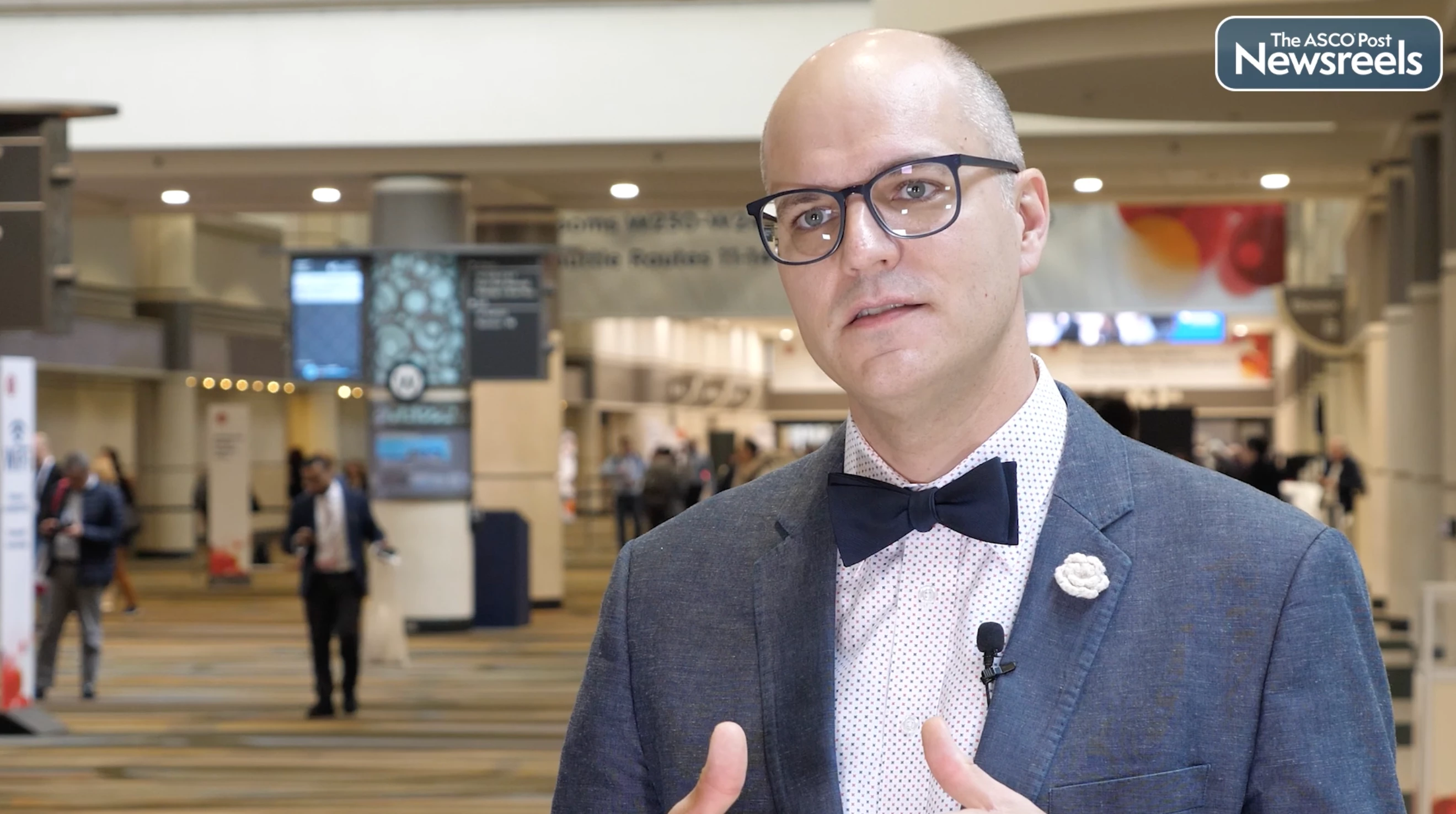
Mikkael Sekeres, MD, MS, on MDS and Exposure to Agent Orange
ASH 2025
Mikkael Sekeres, MD, MS, Chief, Division of Hematology and Professor of Medicine at Sylvester Comprehensive Cancer Center, part of the University of Miami Miller School of Medicine, presents findings from a new study that connects exposure to the herbicide Agent Orange to earlier and more severe cases of myelodysplastic syndromes (MDS). Researchers concluded that exposure is associated with younger age at MDS diagnosis, ultimate MDS diagnosis, genetic complexity of MDS, increased risk of disease progression, and with Black race (Abstract 5626).
The ASCO Post Staff
Jayastu Senapati, MBBS, of The University of Texas MD Anderson Cancer Center, presents initial results from a phase II trial of brexucabtagene autoleucel as consolidation therapy in front-line high-risk B-cell acute lymphoblastic leukemia (B-ALL) or relapsed/refractory B-ALL after cytoreduction (Abstract 1573).
The ASCO Post Staff
Amer Zeidan, MBBS, of Yale School of Medicine, discusses findings from an analysis of the IMerge trial, which explored the possible association between imetelstat-related cytopenias and hemoglobin increase—a measure linked to red blood cell transfusion independence achievement—in patients with lower-risk myelodysplastic syndromes (MDS) (Abstract 490).
The ASCO Post Staff
Krina Patel, MD, MSc, of The University of Texas MD Anderson Cancer Center, provides updated results from the fully enrolled, ongoing iMMagine-1 phase II registrational trial of anitocabtagene autoleucel, an autologous anti-BCMA CAR T-cell therapy with a novel D-domain binder. The agent is under development for patients with relapsed and/or refractory multiple myeloma (Abstract 256).
The ASCO Post Staff
Guillermo Garcia-Manero, MD, of The University of Texas MD Anderson Cancer Center, reviews data from three abstracts in myelodysplastic syndromes (MDS) presented at this year’s meeting: outcomes from the phase III VERONA trial of venetoclax with azacitidine vs placebo with azacitidine in patients with treatment-naive intermediate- and higher-risk MDS (Abstract 235); safety and efficacy results from a phase Ib trial of a dual IRAK1/4 inhibitor in patients with relapsed/refractory lower-risk MDS (Abstract 489); and results from the phase II ASTX030-01 trial, showing pharmacokinetic, efficacy, and safety data of oral ASTX030 in patients with MDS (Abstract 491).
The ASCO Post Staff
Aaron Gerds, MD, of Cleveland Clinic, reviews results of an evaluation of Synapsis AI, a medically trained, large language model–based end-to-end system, focusing on its accuracy and efficiency in identifying eligible patients for an active phase III polycythemia vera clinical trial (Abstract 4340).