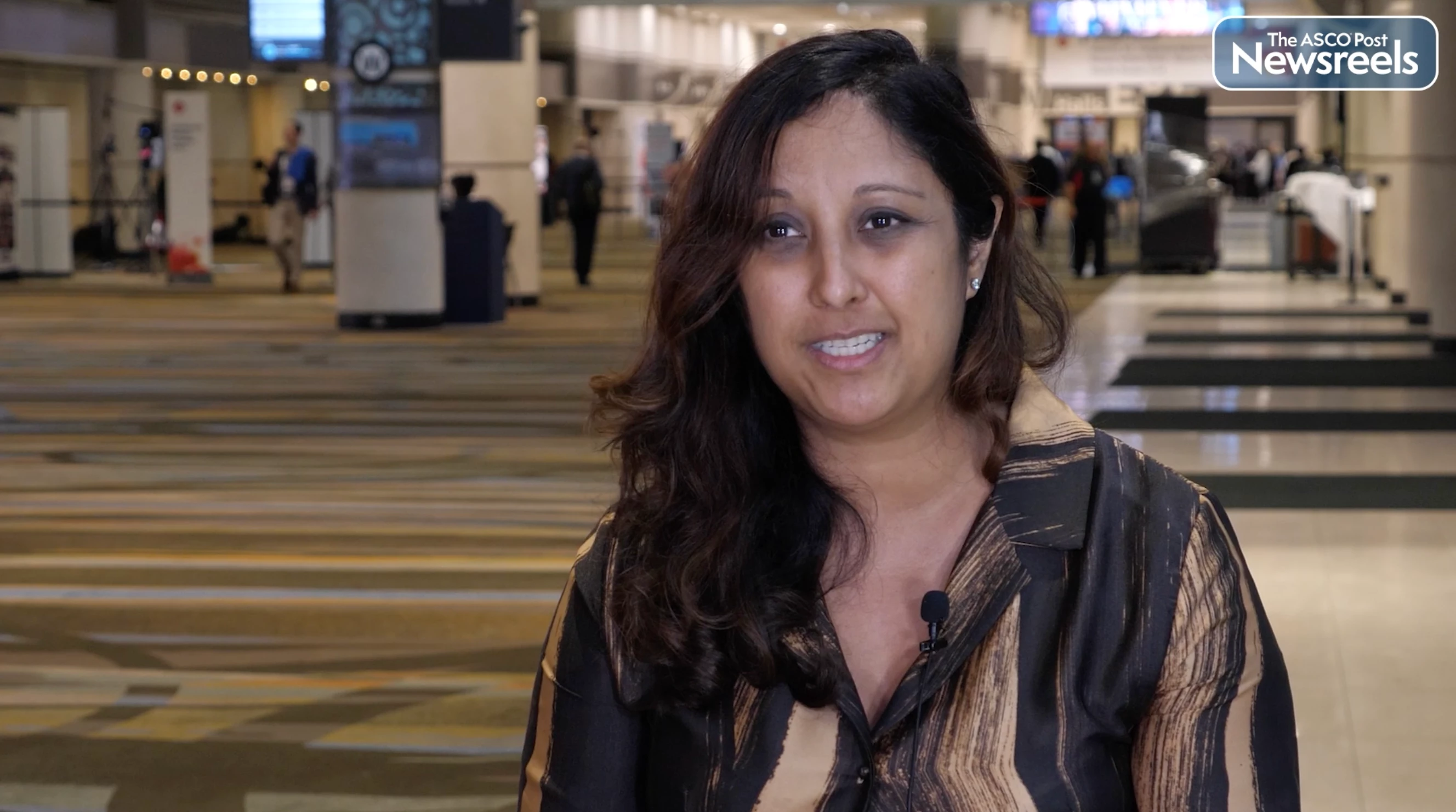
Jayastu Senapati, MBBS, on B-Cell ALL: Brexucabtagene Autoleucel as Consolidation Therapy
ASH 2025
Jayastu Senapati, MBBS, of The University of Texas MD Anderson Cancer Center, presents initial results from a phase II trial of brexucabtagene autoleucel as consolidation therapy in front-line high-risk B-cell acute lymphoblastic leukemia (B-ALL) or relapsed/refractory B-ALL after cytoreduction (Abstract 1573).
The ASCO Post Staff
Anand Patel, MD, of the University of Chicago, discusses results from a phase II trial that showed tyrosine kinase inhibitor plus inotuzumab ozogamicin–based therapy resulted in major molecular response in patients newly diagnosed with Philadelphia chromosome (Ph)-positive acute lymphoblastic leukemia (ALL) (Abstract 441).
The ASCO Post Staff
Amer Zeidan, MBBS, of Yale School of Medicine, shares results from the phase I/II BEXMAB study, which examined the safety, tolerability and preliminary efficacy of bexmarilimab—a novel macrophage checkpoint inhibitor targeting Clever-1—in combination with the standard of care, azacitidine, in patients with higher-risk myelodysplastic syndromes (MDS), including those with TP53-mutated disease. (Abstract 236).
The ASCO Post Staff
Ibrahim Aldoss, MD, of City of Hope, presents findings from a small, single-center study of patients aged 55 years and older with B-cell acute lymphoblastic leukemia (ALL) in first complete remission who were treated with CD19-directed CAR T-cell therapy. Researchers found the therapy was safe, resulted in low-grade adverse events, and led to preliminary durable measurable residual disease response (Abstract 443).
The ASCO Post Staff
Othman Al-Sawaf, MD, PhD, of the University Hospital of Cologne, presents results from the phase III CLL17 trial, which compared continuous ibrutinib monotherapy to fixed-duration venetoclax plus obinutuzumab to fixed-duration venetoclax plus ibrutinib for previously untreated patients with chronic lymphocytic leukemia (CLL) (Abstract 1).
The ASCO Post Staff
Krina Patel, MD, MSc, of The University of Texas MD Anderson Cancer Center, provides updated results from the fully enrolled, ongoing iMMagine-1 phase II registrational trial of anitocabtagene autoleucel, an autologous anti-BCMA CAR T-cell therapy with a novel D-domain binder. The agent is under development for patients with relapsed and/or refractory multiple myeloma (Abstract 256).