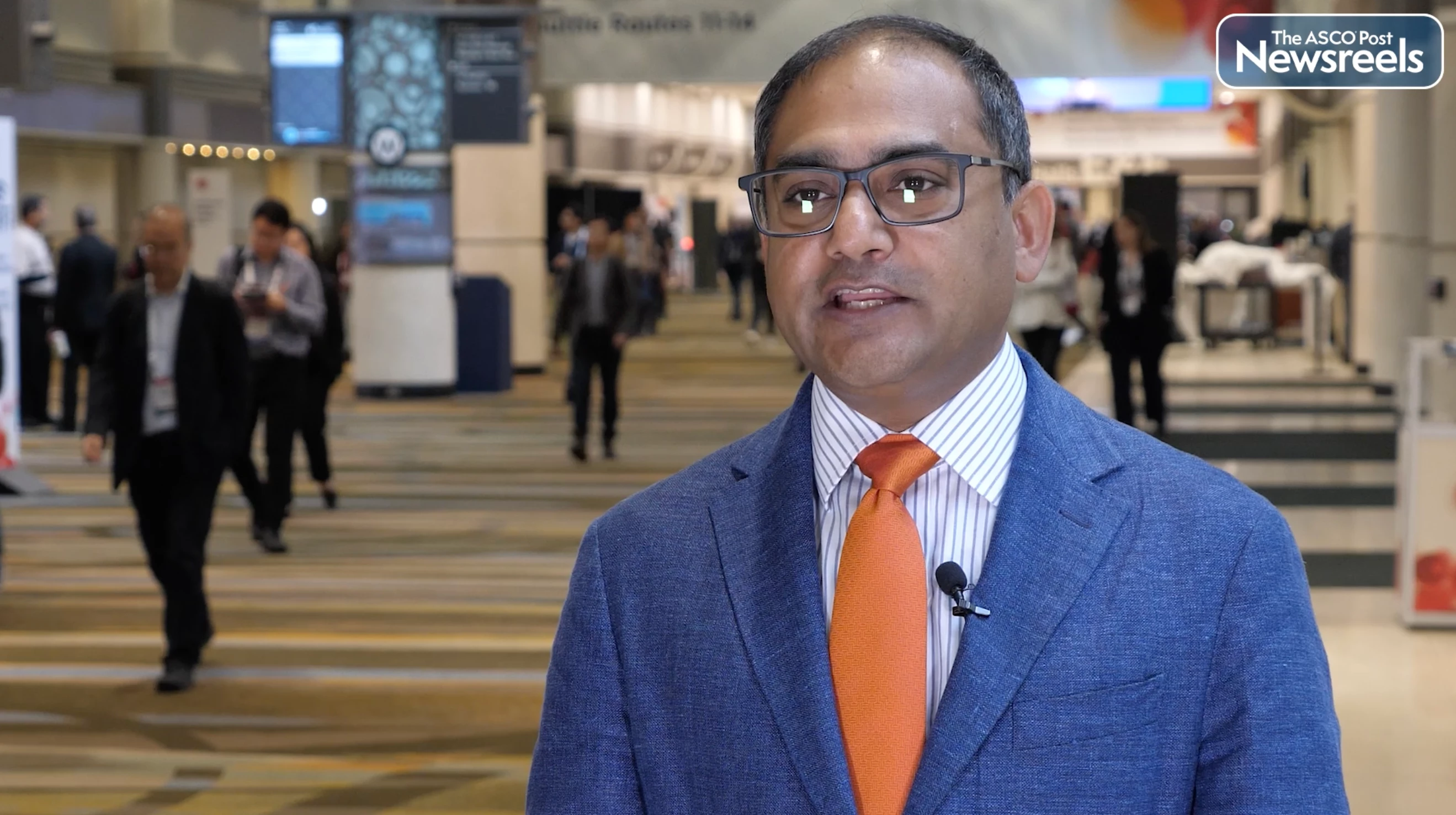
Guillermo Garcia-Manero, MD, on MDS: Research Highlights From ASH 2025
ASH 2025
Guillermo Garcia-Manero, MD, of The University of Texas MD Anderson Cancer Center, reviews data from three abstracts in myelodysplastic syndromes (MDS) presented at this year’s meeting: outcomes from the phase III VERONA trial of venetoclax with azacitidine vs placebo with azacitidine in patients with treatment-naive intermediate- and higher-risk MDS (Abstract 235); safety and efficacy results from a phase Ib trial of a dual IRAK1/4 inhibitor in patients with relapsed/refractory lower-risk MDS (Abstract 489); and results from the phase II ASTX030-01 trial, showing pharmacokinetic, efficacy, and safety data of oral ASTX030 in patients with MDS (Abstract 491).
The ASCO Post Staff
Nitin Jain, MD, of The University of Texas MD Anderson Cancer Center, reviews findings from a phase II trial of pirtobrutinib, venetoclax, and obinutuzumab for patients with Richter transformation (Abstract 89).
The ASCO Post Staff
Alexander Lesokhin, MD, of Memorial Sloan Kettering Cancer Center, discusses results of a retrospective analysis from the phase II MagnetisMM-3 trial. A post hoc analysis was conducted of the subgroup of patients enrolled in the study who had a prolonged treatment interruption or who permanently discontinued elranatamab and maintained their responses for 6 months or longer (Abstract 2269).
The ASCO Post Staff
Shahzad Raza, MD, of Cleveland Clinic, presents updated phase II results of the RedirecTT-1 trial, focusing on the efficacy and safety of talquetamab combined with teclistamab in patients with relapsed/refractory multiple myeloma and extramedullary disease (Abstract 698). The study also received simultaneous publication in The New England Journal of Medicine.
The ASCO Post Staff
Krina Patel, MD, MSc, of The University of Texas MD Anderson Cancer Center, provides updated results from the fully enrolled, ongoing iMMagine-1 phase II registrational trial of anitocabtagene autoleucel, an autologous anti-BCMA CAR T-cell therapy with a novel D-domain binder. The agent is under development for patients with relapsed and/or refractory multiple myeloma (Abstract 256).
The ASCO Post Staff
Karthik Ramasamy, MBBS, FRCP, FRCPath, PhD, of the University of Oxford, discusses initial results of the phase II/III UK-based RADAR trial. The study evaluated isatuximab, bortezomib, lenalidomide, dexamethasone, and cyclophosphamide induction, followed by single autologous stem cell transplant, consolidation with isatuximab plus bortezomib, lenalidomide, and dexamethasone, and isatuximab plus lenalidomide maintenance, in patients with double-hit multiple myeloma (Abstract 98).