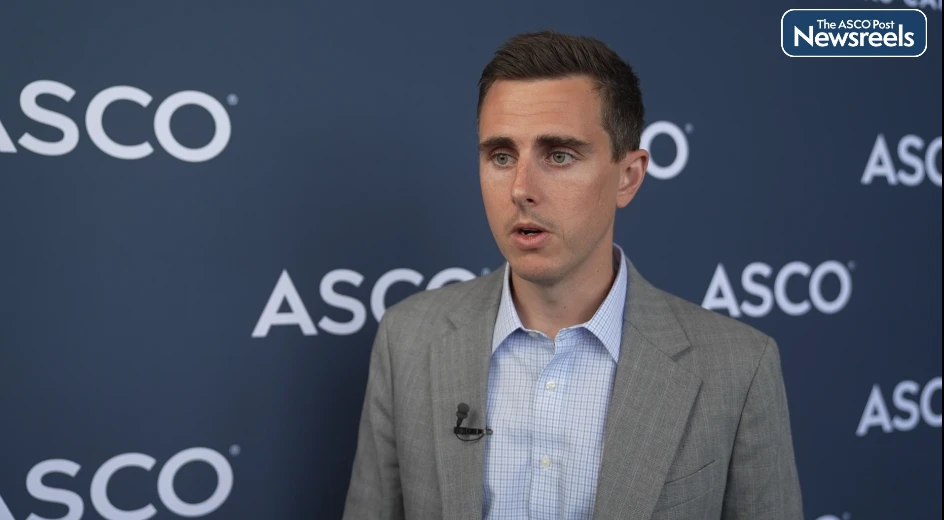
François-Clément Bidard, MD, PhD, on Advanced Breast Cancer With Emergent ESR1 Mutations: First-Line Option
ASCO 2026
François-Clément Bidard, MD, PhD, of Institut Curie, presents final progression-free survival 2 findings from the phase III SERENA-6 trial, which investigated the efficacy of camizestrant, a selective estrogen receptor degrader (SERD), vs continued aromatase inhibition in patients with advanced breast cancer with emergent ESR1 mutations. Earlier reports from the trial showed improved progression-free survival with the SERD (Abstract LBA1007).
The ASCO Post Staff
Samuel J. Klempner, MD, FASCO, of Mass General Brigham Cancer Institute, discusses a single-arm phase II study—which is currently open and enrolling (ClinicalTrials.gov identifier NCT07070466)—evaluating ivonescimab in combination with FOLFOX as front-line therapy in locally advanced, unresectable, or metastatic HER2-negative gastroesophageal adenocarcinoma (Abstract TPS4246).
Daneng Li, MD, of City of Hope, discusses dose-finding results from a phase I/II trial of tegavivint, a downstream Wnt/β-catenin inhibitor, in patients with advanced hepatocellular carcinoma (HCC) (Abstract 4015).
Rami Manochakian, MD, FASCO, of Mayo Clinic Florida, summarizes an educational session at ASCO that reviewed the state of the field of small cell lung cancer (SCLC) treatment. After decades of limited treatment progress, advances are being seen in immunotherapies, radiation therapy, bispecific T-cell engagers, antibody-drug conjugates, and radionuclide therapies.
The ASCO Post Staff
Jason R. Westin, MD, FASCO, of The University of Texas MD Anderson Cancer Center, provides an update on the safety and efficacy data from the phase III SUNMO trial, which compared mosunetuzumab and polatuzumab vedotin vs rituximab, gemcitabine, and oxaliplatin in patients with relapsed or refractory large B-cell lymphoma (LBCL) (Abstract 7007).
The ASCO Post Staff
Brendan Heiden, MD, of Washington University School of Medicine, discusses data from a unique real-world cohort of nearly 1 million patients in the Veterans Health Administration; researchers evaluated whether tobacco smoking duration improves lung cancer risk prediction compared with tobacco pack-years (Abstract 8004).