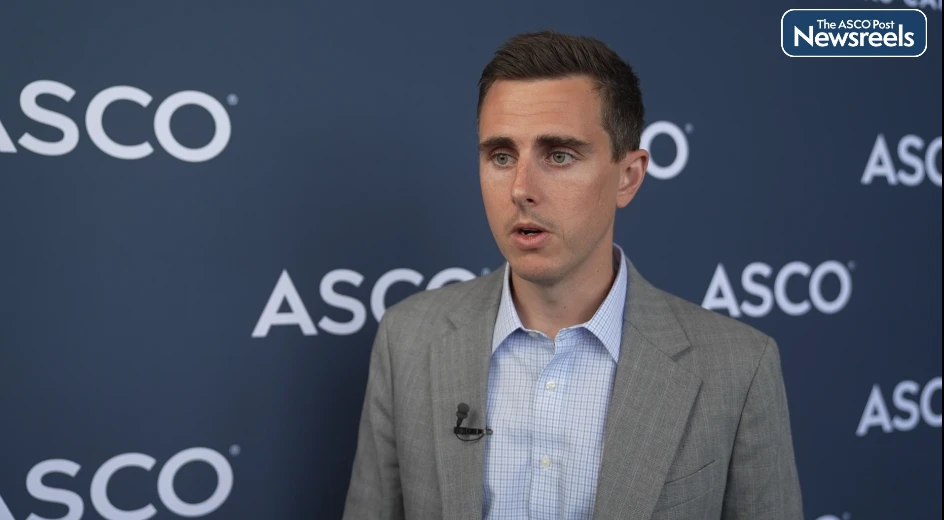
Shubham Pant, MD, MBBS, on Novel RAS-Targeting Therapy Daraxonrasib Doubles Overall Survival in Metastatic Pancreatic Cancer
ASCO 2026
Shubham Pant, MD, MBBS, of The University of Texas MD Anderson Cancer Center, discusses the practice-changing results of the phase III RASolute 302 study, which showed that daraxonrasib doubled median overall survival compared with standard chemotherapy in pretreated metastatic pancreatic cancer (Abstract LBA5).
The ASCO Post Staff
Katharina C. Kaehler, MD, of University Hospital (UKSH), Campus Kiel, presents an update on the primary outcome and sensitivity analyses from the PIVOTAL phase III trial of daromun, a combination of two fibronectin-targeting immunocytokines (L19IL2 and L19TNF), as a neoadjuvant intralesional therapy in patients with resectable, locally advanced stage III melanoma (Abstract LBA9517).
The ASCO Post Staff
Jessica J. Lin, MD, Mass General Brigham Cancer Institute, presents data from the ALKOVE-1 study, which is looking at the investigational ALK tyrosine kinase inhibitor (TKI) neladalkib among patients with ALK-positive non–small cell lung cancer (NSCLC); Dr. Lin discusses the first analyses of phase II TKI-pretreated patients and preliminary data in TKI-naive patients (Abstract 8503).
The ASCO Post Staff
Lauren Averett Byers, MD, of The University of Texas MD Anderson Cancer Center, describes data on ABBV-706—an investigational antibody-drug conjugate targeting SEZ6—alone or in combination with the anti–PD-1 monoclonal antibody budigalimab in patients with relapsed or refractory small cell lung cancer (SCLC) (Abstract 8008).
Gerneiva Parkinson, MD, of Stanford Cancer Institute, discusses time on treatment for systemic therapies among women with hormone receptor (HR)-positive breast cancer and a pathogenic variant in BRCA1, BRCA2, or PALB2 (Abstract 1096).
The ASCO Post Staff
Brendan Heiden, MD, of Washington University School of Medicine, discusses data from a unique real-world cohort of nearly 1 million patients in the Veterans Health Administration; researchers evaluated whether tobacco smoking duration improves lung cancer risk prediction compared with tobacco pack-years (Abstract 8004).