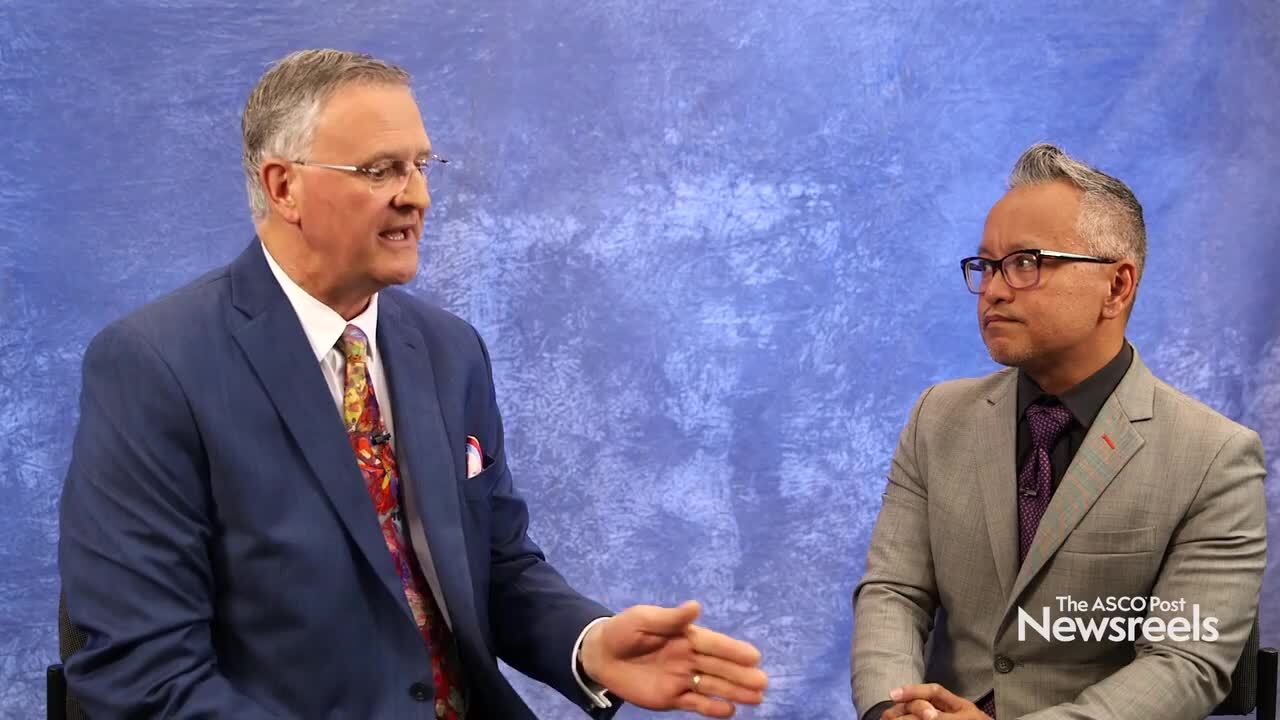
Matthew A. Powell, MD, and Don S. Dizon, MD, on Uterine or Ovarian Cancer: Paclitaxel Plus Carboplatin vs Ifosfamide in Chemotherapy-Naive Patients
2019 ASCO Annual Meeting
Don S. Dizon, MD, of the Lifespan Cancer Institute, and Matthew A. Powell, MD, of Washington University School of Medicine, discuss phase III findings on paclitaxel plus carboplatin vs paclitaxel plus ifosfamide in chemotherapy-naive patients with stages I to IV, persistent or recurrent carcinosarcoma of the uterus or ovaries (Abstract 5500).
Don S. Dizon, MD, of the Lifespan Cancer Institute, and Richard T. Penson, MD, of Massachusetts General Hospital Cancer Center, discuss phase III study findings on the PARP inhibitor olaparib, which showed a significantly higher objective response rate vs nonplatinum chemotherapy for patients with ovarian cancer who relapsed, are platinum-sensitive, and have BRCA-mutant disease (Abstract 5506).
Josep Tabernero, MD, PhD, of the Vall d’Hebron Institute of Oncology, discusses phase III findings of the KEYNOTE-062 study showing that, for some patients with advanced gastric or gastroesophageal junction cancer, pembrolizumab may improve survival and may be an effective alternative to chemotherapy, with fewer side effects (Abstract LBA4007).
Patricia A. Ganz, MD, of NRG Oncology and Jonsson Comprehensive Cancer Center at UCLA, discusses the NRG/NSABP phase III findings, which showed that partial-breast irradiation was more convenient and resulted in less fatigue but slightly poorer cosmesis at 36 months in patients who did not receive chemotherapy (Abstract 508).
Sara A. Hurvitz, MD, of the UCLA Jonsson Comprehensive Cancer Center, discusses the first study of ribociclib plus endocrine therapy vs endocrine therapy alone to demonstrate significantly longer overall survival in peri- and premenopausal women with advanced breast cancer (Abstract LBA1008).
Justin F. Gainor, MD, of Massachusetts General Hospital, discusses updated findings from the ARROW study in which BLU-667, a selective RET inhibitor, demonstrated clinical activity and tolerability in patients with advanced RET fusion–positive non–small cell lung cancer (Abstract 9008).