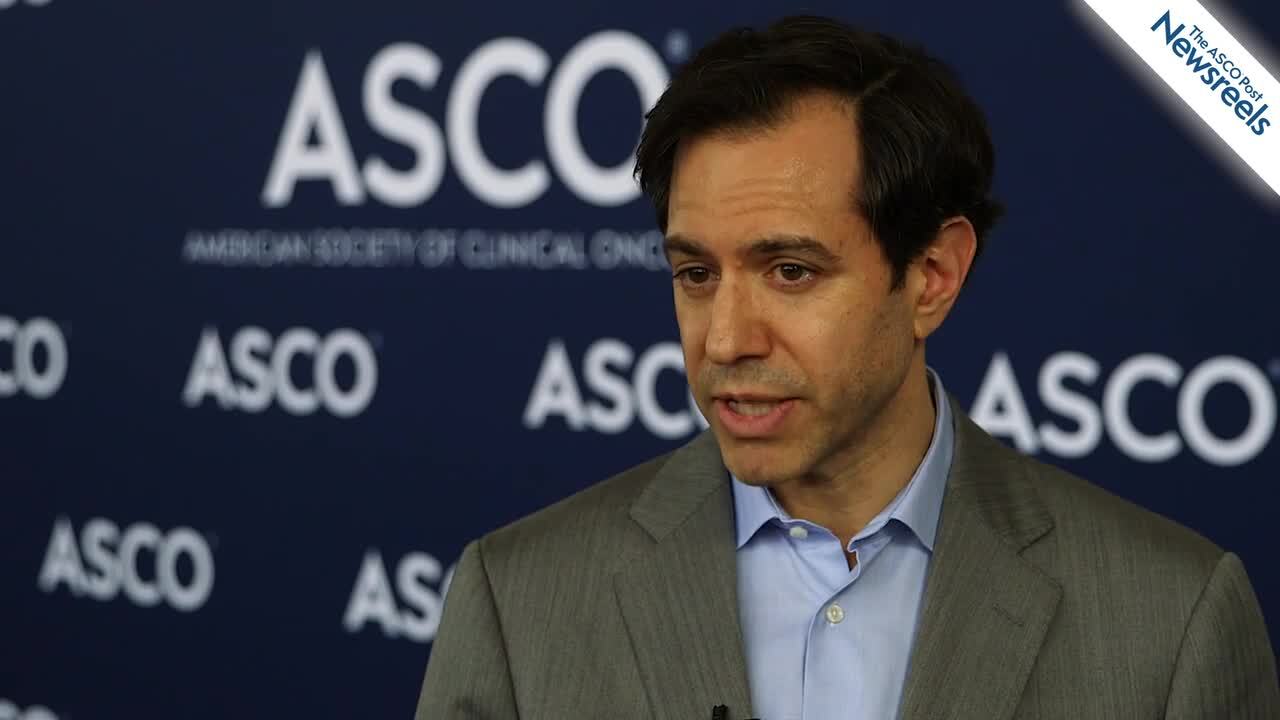
Sagar Lonial, MD, on Smoldering Multiple Myeloma: Delaying Disease Progression With an Immunomodulatory Agent
2019 ASCO Annual Meeting
Sagar Lonial, MD, of Winship Cancer Institute of Emory University, discusses the potentially practice-changing phase III findings showing that lenalidomide substantially delayed progression of smoldering multiple myeloma to aggressive disease when compared with observation alone (Abstract 8001).
Ahmad A. Tarhini, MD, PhD, of Emory University and Winship Cancer Institute, discusses phase III findings from the U.S. Intergroup E1609 trial, which showed survival benefits for patients with resected high-risk melanoma—for the first time in the history of melanoma adjuvant therapy (Abstract 9504).
Alok A. Khorana, MD, of the Cleveland Clinic, and Hedy L. Kindler, MD, of The University of Chicago, discuss phase III findings on olaparib as maintenance treatment following first-line platinum-based chemotherapy in patients with metastatic pancreatic cancer and a germline BRCA mutation (Abstract LBA4).
Neeraj Agarwal, MD, of Huntsman Cancer Institute, University of Utah Health Care, and Thomas W. Flaig, MD, of the University of Colorado, discuss phase II findings on a novel predictive biomarker of response to the two accepted neoadjuvant regimens for muscle-invasive bladder cancer: methotrexate/vinblastine/doxorubicin/cisplatin and gemcitabine/cisplatin (Abstract 4506).
Sara A. Hurvitz, MD, of the David Geffen School of Medicine, University of California Los Angeles, discusses 3-year outcomes from the first phase III study to test a non-conventional regimen for the neoadjuvant and adjuvant treatment of HER2-positive breast cancer (Abstract 500).
Matt D. Galsky, MD, of The Tisch Cancer Institute at Icahn School of Medicine at Mount Sinai, discusses phase II study findings that show switch maintenance with pembrolizumab significantly improves progression-free survival in the metastatic setting (Abstract 4504).