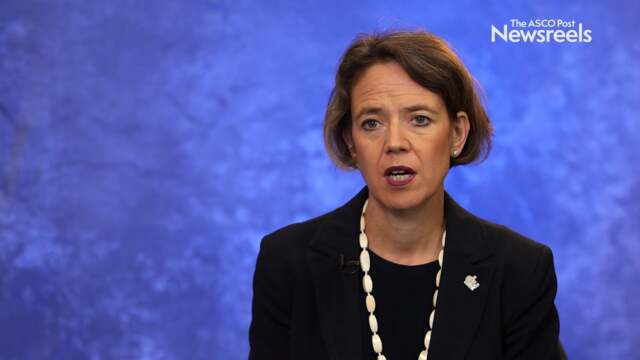
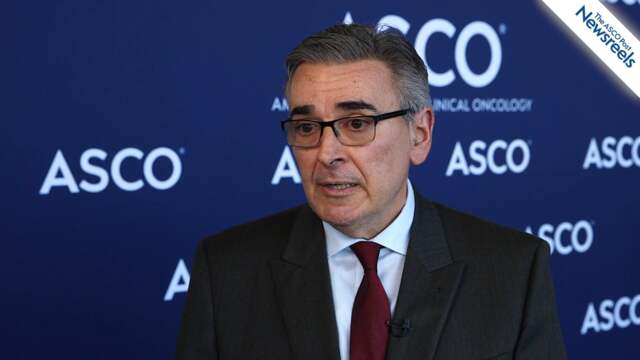
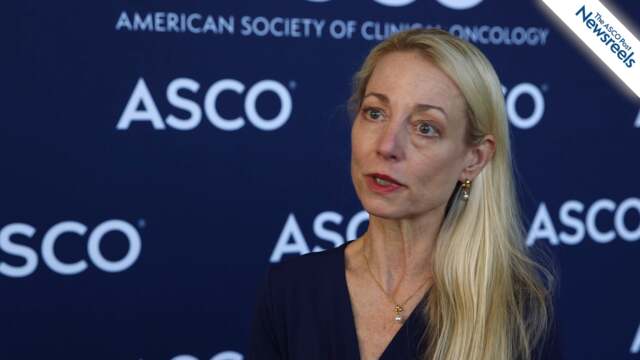
Bruce E. Johnson, MD, and Monica M. Bertagnolli, MD, on The ASCO Presidency: Passing the Torch
2018 ASCO Annual Meeting
Bruce E. Johnson, MD, of the Lowe Center for Thoracic Oncology and ASCO’s outgoing President, talks with Monica M. Bertagnolli, MD, of Brigham and Women’s Hospital and the incoming President, about what has been achieved in the past year and what lies ahead.
Sibylle Loibl, MD, PhD, of the German Breast Group, discusses phase II study findings on the addition of durvalumab to a taxane-anthracycline–containing chemotherapy in triple-negative breast cancer (Abstract 104).
Joseph A. Sparano, MD, of Montefiore Medical Center, discusses phase III study results on chemoendocrine treatment vs endocrine treatment alone in hormone receptor–positive, HER2-negative, node-negative breast cancer and an intermediate prognosis 21-gene recurrence score (Abstract LBA1).
Meletios A. Dimopoulos, MD, of the National and Kapodistrian University of Athens, discusses phase III findings on ibrutinib/rituximab vs placebo/rituximab in Waldenström’s macroglobulinemia (Abstract 8003).
Naoki Furuya, MD, PhD, of the St. Marianna University School of Medicine, discusses phase III study findings on a comparison of bevacizumab plus erlotinib to erlotinib in patients with untreated non–small cell lung cancer with activating EGFR mutations (Abstract 9006).
Martee L. Hensley, MD, of Memorial Sloan Kettering Cancer Center, discusses phase III study findings on adjuvant gemcitabine plus docetaxel followed by doxorubicin vs observation for uterus-limited, high-grade leiomyosarcoma (Abstract 5505).