Michael Pfreundschuh, MD, on Treating Lymphoid Malignancies in Children and Adults With the Same Protocols
2015 European Cancer Congress
Michael Pfreundschuh, MD, of Universitaetsklinikum des Saarlandes, summarizes a session he chaired on this topic, which covered Burkitt’s lymphoma as well as lymphoblastic leukemia in children and adults.
Brian I. Rini, MD
Brian I. Rini, MD, of the Cleveland Clinic Taussig Cancer Institute, discusses the results from a phase III study investigating a multipeptide cancer vaccine in patients receiving sunitinib as first-line therapy for advanced/metastatic renal cell carcinoma (Abstract 17LBA).
Martine Frouws, MSc, PhD
Martine Frouws, MD, PhD Candidate, of Leiden University Medical Centre discusses her study, which showed a significant increase in overall survival among patients with GI cancers who took aspirin compared to those who did not (Abstract 2306).
Matti S. Aapro, MD
Matti S. Aapro, MD, of IMO Clinique de Genolier, offered a case presentation and a cross-disciplinary approach to finding the best way to effect a cure with minimal impact on quality of life.
Frederic Amant, MD, PhD
Frederic Amant, MD, PhD, of the Katholieke Universiteit Leuven, discusses the important decisions that must be made when a woman is diagnosed with cancer while pregnant: Should treatment be delayed or the pregnancy terminated?
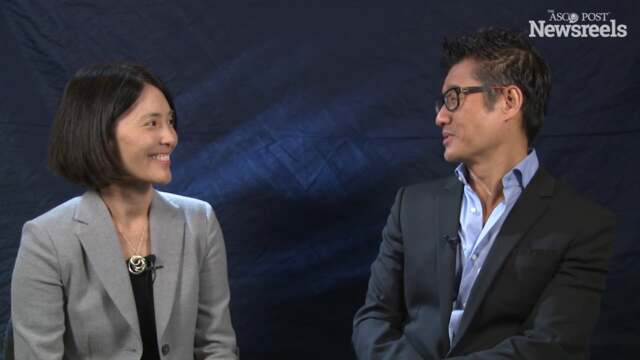
Tony Mok, MD, and Alice Shaw, MD, PhD
Tony Mok, MD, of The Chinese University of Hong Kong, and Alice Shaw, MD, PhD, of Massachusetts General Hospital, discuss the current status and future outlook of ALK inhibition, and an assessment of brigatinib CNS activity in patients with ALK-positive non-small cell lung cancer and intracranial metastases (Abstract 3061).