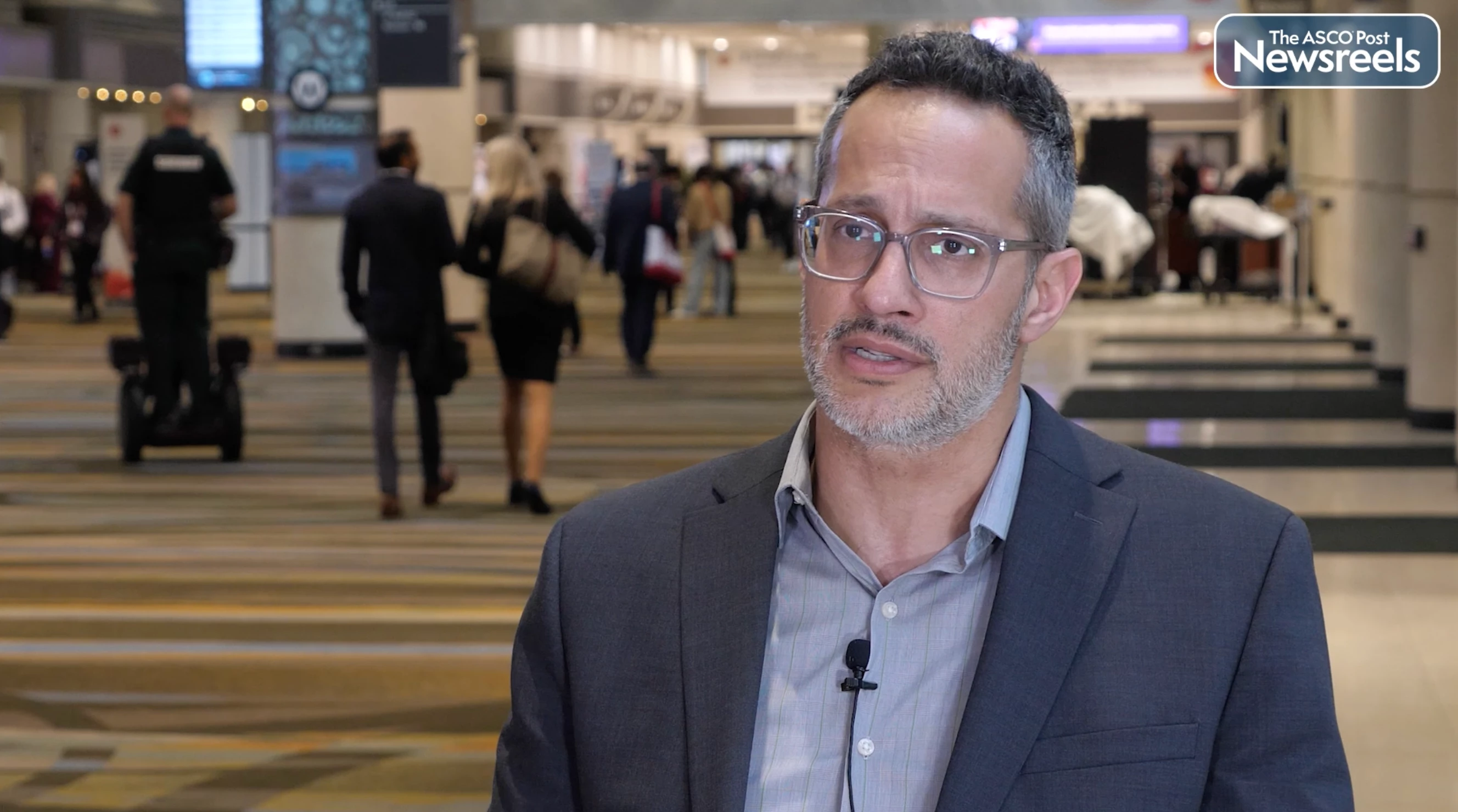
Karthik Ramasamy, MBBS, FRCP, FRCPath, PhD, on Ultra–High-Risk Multiple Myeloma: RADAR Trial in Newly Diagnosed Transplant-Eligible Patients
ASH 2025
Karthik Ramasamy, MBBS, FRCP, FRCPath, PhD, of the University of Oxford, discusses initial results of the phase II/III UK-based RADAR trial. The study evaluated isatuximab, bortezomib, lenalidomide, dexamethasone, and cyclophosphamide induction, followed by single autologous stem cell transplant, consolidation with isatuximab plus bortezomib, lenalidomide, and dexamethasone, and isatuximab plus lenalidomide maintenance, in patients with double-hit multiple myeloma (Abstract 98).
The ASCO Post Staff
Andrew Portuguese, MD, of Fred Hutchinson Cancer Center, discusses findings from a multicenter analysis from the U.S. Multiple Myeloma Immunotherapy Consortium looking at the real-world safety and efficacy of the BCMA-CD3 bispecific antibody elranatamab (Abstract 136).
The ASCO Post Staff
Alexander Lesokhin, MD, of Memorial Sloan Kettering Cancer Center, discusses results of a retrospective analysis from the phase II MagnetisMM-3 trial. A post hoc analysis was conducted of the subgroup of patients enrolled in the study who had a prolonged treatment interruption or who permanently discontinued elranatamab and maintained their responses for 6 months or longer (Abstract 2269).
The ASCO Post Staff
Anand Patel, MD, of the University of Chicago, discusses results from a phase II trial that showed tyrosine kinase inhibitor plus inotuzumab ozogamicin–based therapy resulted in major molecular response in patients newly diagnosed with Philadelphia chromosome (Ph)-positive acute lymphoblastic leukemia (ALL) (Abstract 441).
The ASCO Post Staff
Aaron Logan, MD, PhD, of UCSF Health, discusses research examining the effect of transplant before or after treatment with brexucabtagene autoleucel in the real world for adult patients with relapsed or refractory Philadelphia chromosome–negative B-cell acute lymphoblastic leukemia (ALL) (Abstract 516).
The ASCO Post Staff
Ibrahim Aldoss, MD, of City of Hope, presents findings from a small, single-center study of patients aged 55 years and older with B-cell acute lymphoblastic leukemia (ALL) in first complete remission who were treated with CD19-directed CAR T-cell therapy. Researchers found the therapy was safe, resulted in low-grade adverse events, and led to preliminary durable measurable residual disease response (Abstract 443).