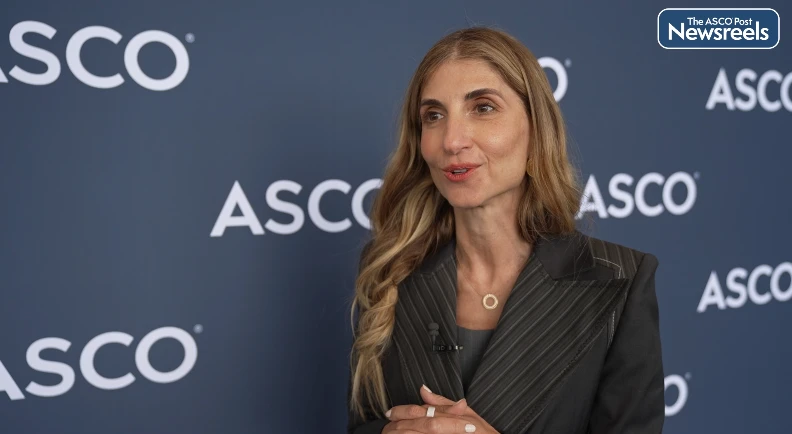
Daneng Li, MD, on Tegavivint in Advanced HCC
ASCO 2026
Daneng Li, MD, of City of Hope, discusses dose-finding results from a phase I/II trial of tegavivint, a downstream Wnt/β-catenin inhibitor, in patients with advanced hepatocellular carcinoma (HCC) (Abstract 4015).
The ASCO Post Staff
Shubham Pant, MD, MBBS, of The University of Texas MD Anderson Cancer Center, discusses the practice-changing results of the phase III RASolute 302 study, which showed that daraxonrasib doubled median overall survival compared with standard chemotherapy in pretreated metastatic pancreatic cancer (Abstract LBA5).
The ASCO Post Staff
Christopher A. Barker, MD, of Memorial Sloan Kettering Cancer Center, reviews the results of the RAMPART study, a phase II, multicenter, single-arm clinical trial evaluating response-adapted definitive radiotherapy in combination with cemiplimab-rwlc for locally advanced, unresectable cutaneous squamous cell carcinoma (CSCC) (Abstract 9506).
The ASCO Post Staff
John M. Burke, MD, of SCRI at Rocky Mountain Cancer Centers I The US Oncology Network, presents findings from the phase III frontMIND trial, which evaluated tafasitamab plus lenalidomide and R-CHOP in patients newly diagnosed with diffuse large B-cell lymphoma (Abstract LBA7000).
The ASCO Post Staff
Jason R. Westin, MD, FASCO, of The University of Texas MD Anderson Cancer Center, provides an update on the safety and efficacy data from the phase III SUNMO trial, which compared mosunetuzumab and polatuzumab vedotin vs rituximab, gemcitabine, and oxaliplatin in patients with relapsed or refractory large B-cell lymphoma (LBCL) (Abstract 7007).
The ASCO Post Staff
Yelena Y. Janjigian, MD, FASCO, of Memorial Sloan Kettering Cancer Center, discusses safety results for DESTINY-Gastric03 Part 2 (arms D and F) and Part 4. The trial evaluated first-line fam-trastuzumab deruxtecan-nxki–based regimens in advanced HER2-expressing gastric cancer, gastroesophageal adenocarcinoma, and esophageal carcinoma (Abstract 4002).