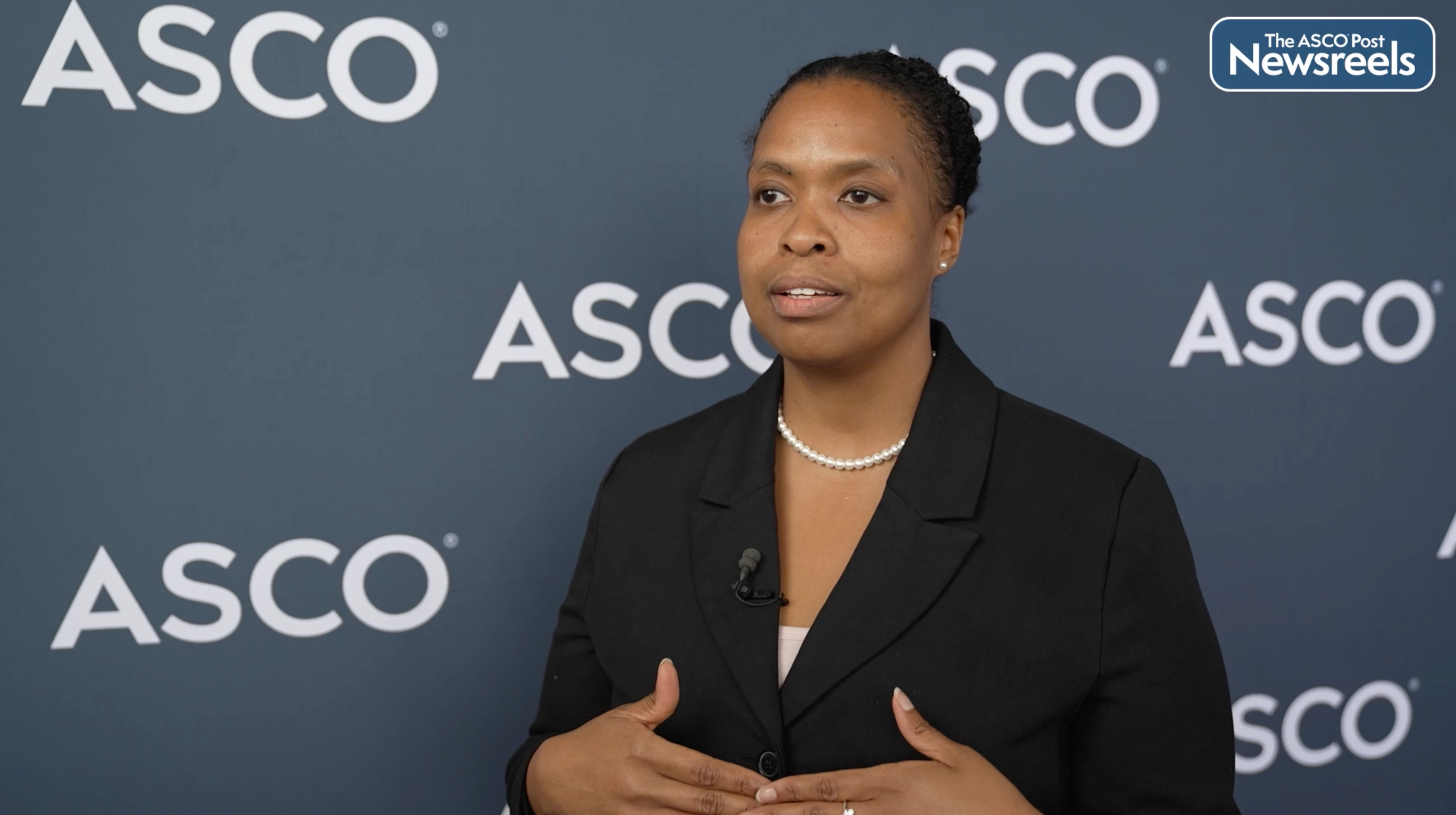
Elizabeth McDonald, MD, PhD, on GLP-1 Agonists and Breast Cancer Incidence
ASCO 2026
Elizabeth McDonald, MD, PhD, of the University of Pennsylvania, discusses results from a retrospective cohort study that showed that the use of GLP-1 treatment was associated with a significantly lower incidence of breast cancer, after accounting for age, race, ethnicity, BMI, breast density, and type 2 diabetes status (Abstract 10506).
The ASCO Post Staff
Julie R. Gralow, MD, FACP, FASCO, Chief Medical Officer and Executive Vice President of ASCO, provides an overview of the highlights of this year’s meeting, including practice-changing data included in the Plenary Session.
The ASCO Post Staff
Katharina C. Kaehler, MD, of University Hospital (UKSH), Campus Kiel, presents an update on the primary outcome and sensitivity analyses from the PIVOTAL phase III trial of daromun, a combination of two fibronectin-targeting immunocytokines (L19IL2 and L19TNF), as a neoadjuvant intralesional therapy in patients with resectable, locally advanced stage III melanoma (Abstract LBA9517).
The ASCO Post Staff
Ghassan K. Abou-Alfa, MD, PhD, FASCO, of Memorial Sloan Kettering Cancer Center and Weill Medical College at Cornell University, presents efficacy and safety data from the randomized phase III EMERALD-3 trial, which evaluated tremelimumab plus durvalumab with or without lenvatinib combined with transarterial chemoembolization in patients with unresectable embolization-eligible hepatocellular carcinoma (LBA4000).
Dor Abelman, BS, of the University of Toronto, reviews results of a comparison of two minimally invasive measurable residual disease (MRD) assays—BM-informed cfDNA whole-genome sequencing (cfWGS) and plasma proteomic MRD (EasyM)—in patients with multiple myeloma (Abstract 7546).
Gerneiva Parkinson, MD, of Stanford Cancer Institute, discusses time on treatment for systemic therapies among women with hormone receptor (HR)-positive breast cancer and a pathogenic variant in BRCA1, BRCA2, or PALB2 (Abstract 1096).