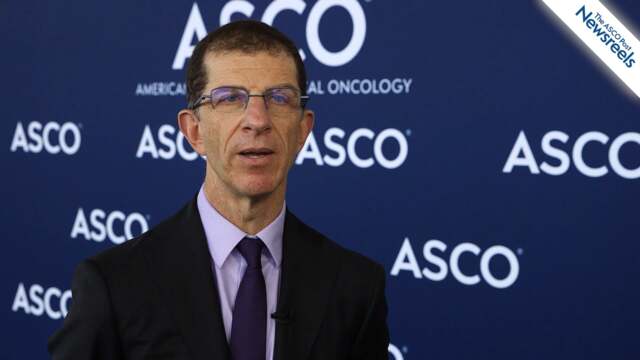
Danh Pham, MD: Lung Cancer Screening Rates Still Too Low
2018 ASCO Annual Meeting
Danh Pham, MD, of the James Graham Brown Cancer Center, University of Louisville, discusses his findings using a registry on the low rates of screening with low-dose computed tomography, despite its potential to prevent thousands of lung cancer deaths each year (Abstract 6504).
Allen S. Lichter, MD, ASCO’s former Chief Executive Officer, talks with Nancy E. Davidson, MD, of Fred Hutchinson Cancer Research Center, the 2018 recipient of the Visionary Leader Award, named for Dr. Lichter.
Toni K. Choueiri, MD, and Lauren C. Harshman, MD, both of Dana-Farber Cancer Institute, discuss phase III study findings on perioperative nivolumab vs observation in patients with localized renal cell carcinoma undergoing nephrectomy (Abstract TPS4597).
Courtney Denton Dinardo, MD, of The University of Texas MD Anderson Cancer Center, discusses findings on the durable response with venetoclax in combination with decitabine or azacitidine in elderly patients with acute myeloid leukemia (Abstract 7010).
Julie M. Vose, MD, MBA, of the University of Nebraska Medical Center, and William G. Wierda, MD, PhD, of The University of Texas MD Anderson Cancer Center, discuss phase II findings on ibrutinib plus venetoclax in first-line treatment of chronic lymphocytic leukemia (Abstract 7502).
Danny Rischin, MD, of Peter MacCallum Cancer Centre, discusses phase II study findings on cemiplimab, a human monoclonal anti–PD-1 antibody, in patients with metastatic cutaneous squamous cell carcinoma (Abstract 9519).