Luis G. Paz-Ares, MD, PhD, on NSCLC: Results From the LUX-Lung 7 Trial (Spanish Language Version) 
2016 ESMO Congress
Luis G. Paz-Ares, MD, PhD, of the Hospital Universitario 12 De Octubre, discusses in Spanish overall survival data on afatinib vs gefitinib in patients with EGFR mutation–positive non–small cell lung cancer. (Abstract LBA43)
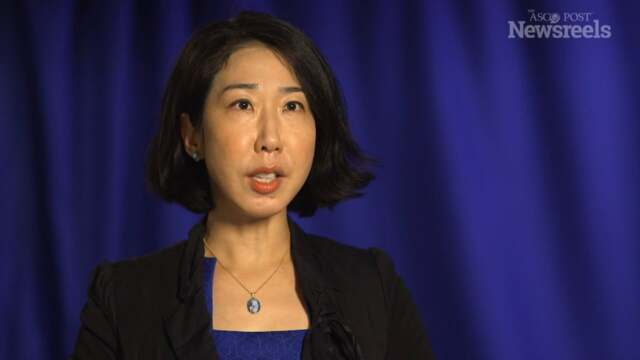
Jung-min Lee, MD, of the National Cancer Institute, discusses findings of a phase II study of the cell cycle checkpoint kinase inhibitors LY2606368 and prexasertib monomesylate monohydrate in sporadic high-grade serous and germline BRCA mutation-associated ovarian cancer. (Abstract 855O)
Alain Ravaud, MD, PhD, of Bordeaux University Hospital, discusses phase III findings on sunitinib vs placebo as adjuvant treatment for high-risk renal cell carcinoma after nephrectomy. (Abstract LBA11)
Judith Balmaña, MD, PhD, of Vall d’Hebron University Hospital, discusses the findings of a single-agent phase II trial on the antitumor activity of lurbinectedin in BRCA1/2-associated metastatic breast cancer patients. (Abstract 223O)
Tony Mok, MD, of The Chinese University of Hong Kong, discusses the final overall survival analysis from this trial on gefitinib/chemotherapy vs chemotherapy in EGFR mutation-positive non-small cell lung cancer after progression on first-line gefitinib. (Abstr 1201O)
Luis G. Paz-Ares, MD, PhD, of the Hospital Universitario 12 De Octubre, discusses overall survival data on afatinib vs gefitinib in patients with EGFR mutation-positive non-small cell lung cancer. (Abstract LBA43)