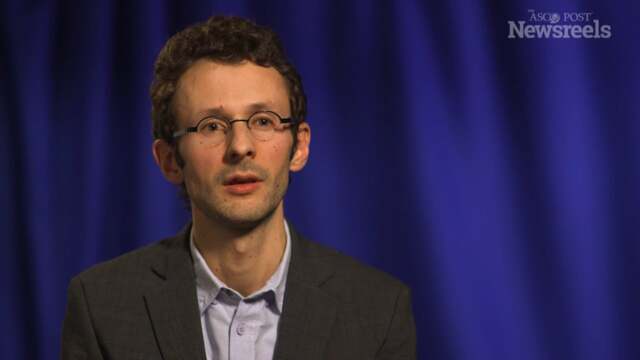
Fabrice Barlesi, MD, PhD, on NSCLC: Results From the OAK Trial (French Language Version) 
2016 ESMO Congress
Fabrice Barlesi, MD, PhD, of Aix Marseille University and Assistance Publique Hopitaux De Marseille, discusses in French phase III findings on a comparison of atezolizumab with docetaxel in patients with advanced non-small cell lung cancer. (Abstract LBA44)
Giorgio V. Scagliotti, MD, PhD, of the University of Torino, discusses study findings on ceritinib vs chemotherapy in patients with advanced ALK-rearranged non-small cell lung cancer previously treated with chemotherapy and crizotinib. (Abstract LBA42)
Matthew J. Ellis, PhD, MB, BCh, of the Baylor College of Medicine, discusses phase III study findings on fulvestrant 500 mg vs anastrozole for hormone receptor-positive advanced disease. (Abstract LBA14)
Judith Balmaña, MD, PhD, of Vall d’Hebron University Hospital, discusses in Spanish the findings of a single-agent phase II trial on the antitumor activity of lurbinectedin in BRCA1/2-associated metastatic breast cancer patients. (Abstract 223O)
Yung-Jue Bang, MD, PhD, of Seoul National University Hospital, discusses phase III study findings on olaparib and paclitaxel in patients with advanced gastric cancer who have progressed following first-line therapy. (Abstract LBA25)
Philippe Rochigneux, MD, of the Paoli Calmettes Institute, Marseille Cancer Center, discusses in French his findings on the high rates of chemotherapy used at the end of life for metastatic solid cancer, especially in young patients treated in high-volume centers without a palliative care unit. (Abstract 1300O)