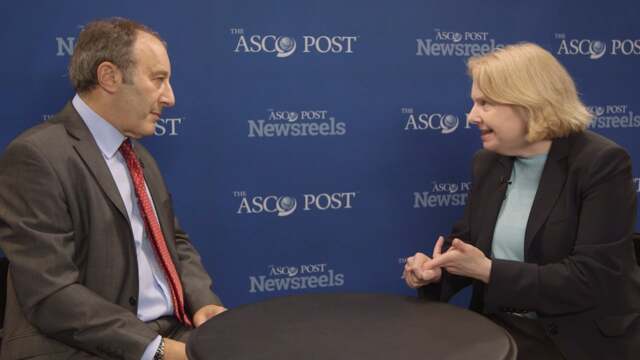
Paul E. Goss, MD, PhD, on Postmenopausal Early-Stage Breast Cancer: Extending Letrozole Treatment
2016 ASCO Annual Meeting
Paul E. Goss, MD, PhD, of Massachusetts General Hospital Cancer Center and Harvard Medical School, discusses disease-free survival results from a study extending adjuvant letrozole for 5 years after completing an initial 5 years of aromatase inhibitor therapy alone or preceded by tamoxifen (Abstract LBA1).
Eric Roeland, MD, of the University of California, San Diego, and Linda Van Le, MD, of the University of North Carolina discuss ways to manage symptoms that affect up to 80% of postmenopausal women, diminishing their quality of life.
David F. McDermott, MD, of Beth Israel Deaconess Medical Center, and Toni K. Choueiri, MD, of the Dana-Farber Cancer Institute, discuss an update on data from phase I and II studies of nivolumab given to patients with metastatic renal cell carcinoma, including long-term overall survival and potential predictors of benefit (Abstract 4507).
Hope S. Rugo, MD, of the University of California, San Francisco, discusses phase III study results on a new possible alternative to trastuzumab for HER2-positive metastatic breast cancer: the biosimilar known as Myl-1401O (Abstract LBA503).
Ghassan K. Abou-Alfa, MD, of Memorial Sloan Kettering Cancer Center, discusses findings of this phase III study of sorafenib plus doxorubicin versus sorafenib in patients with advanced hepatocellular carcinoma (Abstract 4003).
The
Jonathan A. Ledermann, MD, of Cancer Research UK and University College London Cancer Trials Centre, and Ursula A. Matulonis, MD, of the Dana-Farber Cancer Institute, discuss findings on overall survival in patients with platinum-sensitive relapsed serous ovarian cancer receiving olaparib maintenance monotherapy (Abstract 5501).