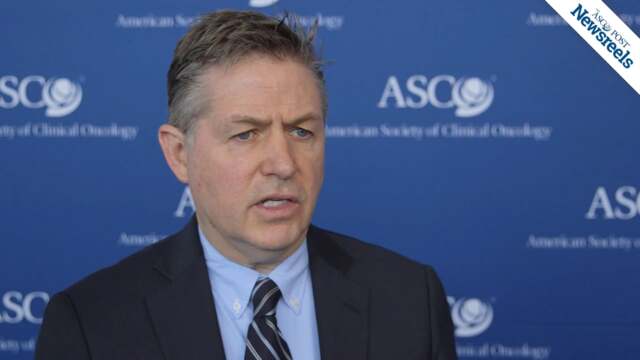
Heinz-Josef Lenz, MD, and Marc Ychou, MD, on Treating mCRC With Initially Nonresectable Liver Metastases
2016 ASCO Annual Meeting
Heinz-Josef Lenz, MD, of the University of Southern California, and Marc Ychou, MD, of the Centre Régional de Lutte Contre Le Cancer, discuss study findings on FOLFIRINOX combined with targeted therapy according to RAS status for colorectal cancer patients with initially nonresectable liver metastases (Abstract 3512).
The
Jonathan A. Ledermann, MD, of Cancer Research UK and University College London Cancer Trials Centre, and Ursula A. Matulonis, MD, of the Dana-Farber Cancer Institute, discuss findings on overall survival in patients with platinum-sensitive relapsed serous ovarian cancer receiving olaparib maintenance monotherapy (Abstract 5501).
Nagi S. El-Saghir, MD, of the American University of Beirut, and Mary Gospodarowicz, MD, of the Princess Margaret Hospital, discuss oncology from an international point of view.
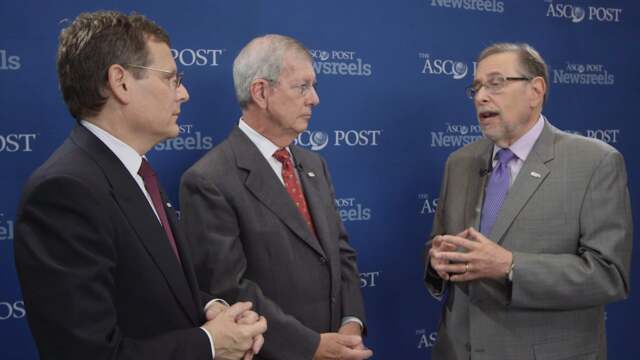
Richard L. Schilsky, MD (right), Chief Medical Officer of ASCO, talks with incoming ASCO CEO Clifford A. Hudis, MD (left) and outgoing CEO Allen S. Lichter, MD (center) about the passing of the torch and their perspectives on past accomplishments and future goals of the society.
Lawrence N. Shulman, MD, of Abramson Cancer Center at the University of Pennsylvania, and Daniel A. Goldstein, MD, of the Rabin Medical Center, discuss global challenges in cancer care, including treating patients in areas lacking resources, and cancer drug price disparities (Abstract LBA6500).
Paul E. Goss, MD, PhD, of Massachusetts General Hospital Cancer Center and Harvard Medical School, discusses disease-free survival results from a study extending adjuvant letrozole for 5 years after completing an initial 5 years of aromatase inhibitor therapy alone or preceded by tamoxifen (Abstract LBA1).