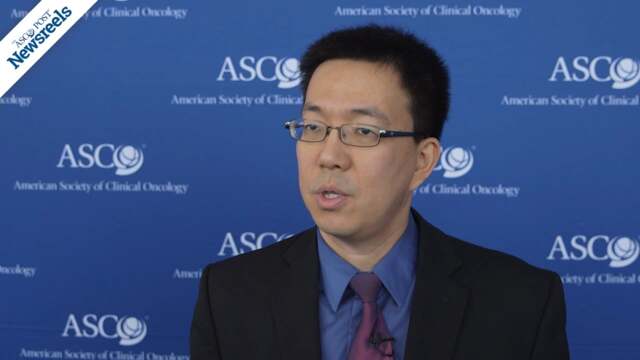
Nikhil Wagle, MD, on The Metastatic Breast Cancer Project: Progress Report
2016 ASCO Annual Meeting
Nikhil Wagle, MD, of the Dana-Farber Cancer Institute, discusses the strides made in this national direct-to-patient initiative to accelerate genomics research (Abstract LBA1519).
Julie Lemieux, MD, of Centre Hospitalier Universitaire de Québec, discusses patient-reported outcomes from a study extending adjuvant letrozole for 5 years after completing an initial 5 years of aromatase inhibitor therapy alone or preceded by tamoxifen (Abstract LBA506). To see the French language version of this discussion, click here.
Antonio Palumbo, MD, of the University of Torino, discusses this phase III study of daratumumab, bortezomib, and dexamethasone versus bortezomib and dexamethasone in patients with relapsed or refractory multiple myeloma (Abstract LBA4).
Vali A. Papadimitrakopoulou, MD, of MD Anderson Cancer Center, and Heather A. Wakelee, MD, of Stanford University, discuss findings on adjuvant chemotherapy with or without bevacizumab for early-stage non–small cell lung cancer, with outcomes based on chemotherapy subsets (Abstract 8507).
Alan Venook, MD, of the University of California, San Francisco, and John Marshall, MD, of the Lombardi Cancer Center at Georgetown University, discuss the impact of primary tumor location on overall survival and progression-free survival in patients with advanced disease (Abstract 3504).
Ronald C. Chen, MD, MPH, of the University of North Carolina at Chapel Hill, discusses the substantial overuse of aggressive medical care for younger patients at the end of life, despite ASCO recommendations (Abstract LBA10033).