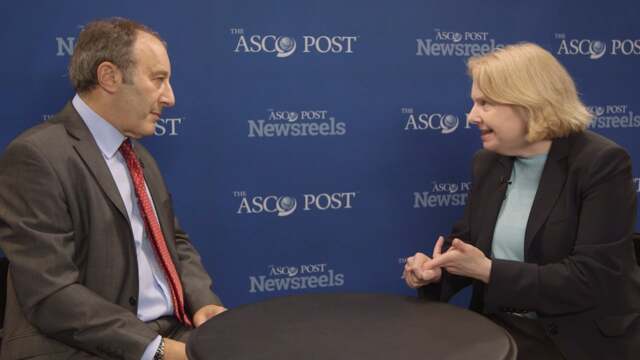
Lisa A. Carey, MD, and Julie Gralow, MD: Top Breast Cancer Papers Presented at the 2016 ASCO Annual Meeting
2016 ASCO Annual Meeting
Lisa A. Carey, MD, of the University of North Carolina, and Julie Gralow, MD, of the University of Washington, discuss the most important data presented this year on treating breast malignancies (Abstracts LBA1, 500, and 507).
Arjun Vasant Balar, MD, of the Perlmutter Cancer Center at NYU Langone Medical Center, discusses findings on atezolizumab as first-line therapy in cisplatin-ineligible locally advanced/metastatic disease (Abstract LBA4500).
Michael J. Overman, MD, of the University of Texas MD Anderson Cancer Center, and John Marshall, MD, of Georgetown University Lombardi Comprehensive Cancer Center, discuss interim findings on nivolumab with or without ipilimumab in the treatment of patients with metastatic colorectal cancer with and without high microsatellite instability (Abstract 3501).
Lee S. Schwartzberg, MD, of The West Clinic, reports on progress of the now year-old ACCC initiative to speed adoption of immunotherapeutics in community practices.
Eric Roeland, MD, of the University of California, San Diego, and Linda Van Le, MD, of the University of North Carolina discuss ways to manage symptoms that affect up to 80% of postmenopausal women, diminishing their quality of life.
The
Jonathan A. Ledermann, MD, of Cancer Research UK and University College London Cancer Trials Centre, and Ursula A. Matulonis, MD, of the Dana-Farber Cancer Institute, discuss findings on overall survival in patients with platinum-sensitive relapsed serous ovarian cancer receiving olaparib maintenance monotherapy (Abstract 5501).