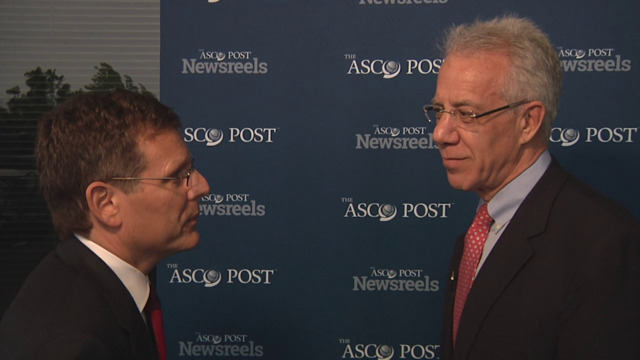
Ruben A. Mesa, MD, and James O. Armitage, MD, Results of the PERSIST-1 Study on Myelofibrosis
2015 ASCO Annual Meeting
James O. Armitage, MD, of The University of Nebraska Medical Center, and Ruben A. Mesa, MD, of the Mayo Clinic, discuss pacritinib and its significant efficacy in myelofibrosis (Abstract LBA7006).
Richard G. Margolese, MD, and Robert W. Carlson, MD
Robert W. Carlson, MD, of the National Comprehensive Cancer Network, and Richard G. Margolese, MD, of McGill University, discuss the improvement in breast cancer–free interval with anastrozole vs tamoxifen in patients with ductal carcinoma in situ undergoing lumpectomy plus radiotherapy (Abstract LBA500).
Nicholas David James, MD, PhD, and Celestia S. Higano, MD
Celestia S. Higano, MD, of the University of Washington, and Nicholas David James, MD, PhD, of Warwick Medical School, discuss data showing improvements in survival from adding docetaxel in men starting long-term hormone therapy for the first time (Abstract 5001).
Claus Garbe, MD, and Anthony J. Olszanski, RPh, MD
Claus Garbe, MD, of the University of Tuebingen, and Anthony J. Olszanski, RPh, MD, of Fox Chase Cancer Center, discuss the survival of sentinel lymph node-positive melanoma patients with and without complete lymph node dissection (Abstract LBA9002).
John Smyth, MD
John Smyth, MD, of the University of Edinburgh, discusses oncology from an international point of view.
Lawrence N. Shulman, MD and Clifford A. Hudis, MD
Lawrence N. Shulman, MD, of Dana-Farber Cancer Institute, and Clifford A. Hudis, MD, of Memorial Sloan Kettering Cancer Center, discuss the delivery of cancer care in resource-constrained settings such as Rwanda and Haiti, and plans to conduct research in basic tumor biology of patients in these areas.