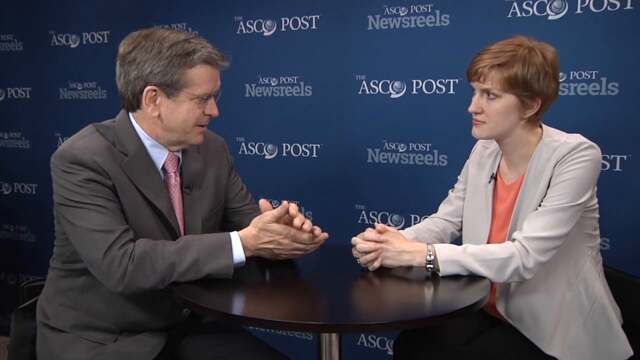
Maura N. Dickler, MD, and Clifford A. Hudis, MD, on Results From the CALGB Alliance Trial on Hormone Receptor–Positive Advanced Breast Cancer
2015 ASCO Annual Meeting
Clifford A. Hudis, MD, and Maura N. Dickler, MD, of Memorial Sloan Kettering Cancer Center, discuss adding bevacizumab to letrozole as a first-line endocrine therapy for treatment of hormone receptor–positive advanced breast cancer (Abstract 501).
Related Videos
John L. Marshall, MD
John L. Marshall, MD, of Georgetown University, discusses how the cost of care affects behavior and decision-making on the part of patients and oncologists.
Claus Garbe, MD, and Anthony J. Olszanski, RPh, MD
Claus Garbe, MD, of the University of Tuebingen, and Anthony J. Olszanski, RPh, MD, of Fox Chase Cancer Center, discuss the survival of sentinel lymph node-positive melanoma patients with and without complete lymph node dissection (Abstract LBA9002).
Eric Van Cutsem, MD, PhD, and Axel Grothey, MD
Eric Van Cutsem, MD, PhD, of University Hospitals Gasthuisberg/Leuven, and Axel Grothey, MD, of the Mayo Clinic, discuss the Italian-led study on trastuzumab and lapatinib in HER2-amplified metastatic colorectal as well as other colorectal cancer findings discussed at ASCO (Abstract 3508).
Andrew D. Seidman, MD, and Clifford A. Hudis, MD
Clifford A. Hudis, MD, and Andrew D. Seidman, MD, of Memorial Sloan Kettering Cancer Center, discuss the use of the decision support system Watson for Oncology and results of the iCanCare study on second opinions (Abstracts 566 and 6508).
Carolyn Jean Presley, MD, and James L. Mulshine, MD
James L. Mulshine, MD, of Rush University Medical Center, and Carolyn Jean Presley, MD, of Yale Cancer Center/Yale School of Medicine, discuss the burden on patients and the Medicare system as new lung cancer CT guidelines are put into effect and treatment of early-stage NSCLC increases (Abstract 7533).