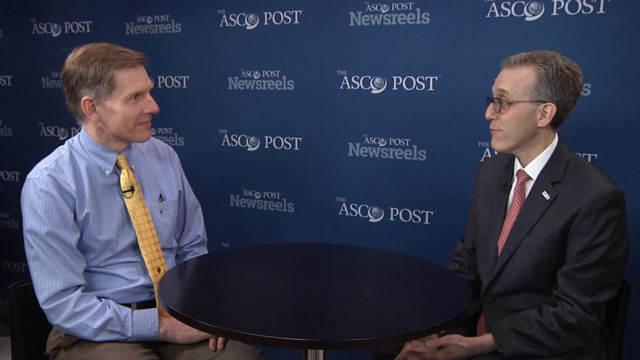
Anil D'Cruz, MD, on Elective Neck Dissection in Node-Negative Early Oral Cancer
2015 ASCO Annual Meeting
Anil D’Cruz, MD, of Tata Memorial Hospital, discusses results from his study that seem to resolve a 50-year-long debate on performing elective neck dissection at the time of primary surgery––a potentially practice-changing finding (Abstract LBA3).
Ruben A. Mesa, MD, and James O. Armitage, MD
James O. Armitage, MD, of The University of Nebraska Medical Center, and Ruben A. Mesa, MD, of the Mayo Clinic, discuss pacritinib and its significant efficacy in myelofibrosis (Abstract LBA7006).
Sagar Lonial, MD, and James O. Armitage, MD
James O. Armitage, MD, of the University of Nebraska Medical Center, and Sagar Lonial, MD, of Emory University School of Medicine, discuss results from two important studies that tested lenalidomide/dexamethasone with or without elotuzumab and daratumumab monotherapy (Abstracts 8508 and LBA8512).
Jedd Wolchok, MD, PhD
Jedd Wolchok, MD, PhD, of Memorial Sloan Kettering Cancer Center discusses therapies for treatment-naive patients with advanced melanoma (Abstract LBA1).
Nicholas C. Turner, MD, PhD, and Clifford A. Hudis, MD
Clifford A. Hudis, MD, of Memorial Sloan Kettering Cancer Center, and Nicholas C. Turner, MD, PhD, of the Royal Marsden Hospital NHS Trust, discuss fulvestrant and palbociclib as a treatment option in pre- and postmenopausal women with hormone receptor–positive, HER2-negative metastatic breast cancer that has progressed on prior endocrine therapy (Abstract LBA502).
Jedd Wolchok, MD, PhD, and Anthony J. Olszanski, RPh, MD
Anthony J. Olszanski, RPh, MD, of Fox Chase Cancer Center, and Jedd Wolchok, MD, PhD, of Memorial Sloan Kettering Cancer Center, discuss therapies for treatment-naive patients with advanced melanoma (Abstract LBA1).