Richard G. Margolese, MD, and Robert W. Carlson, MD, on NSABP B-35 Trial Results for Postmenopausal Women With DCIS
2015 ASCO Annual Meeting
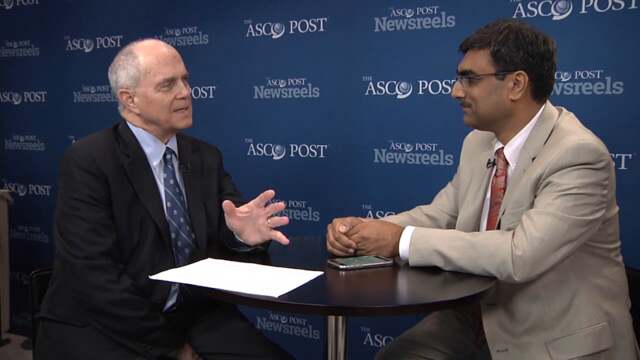
Robert W. Carlson, MD, of the National Comprehensive Cancer Network, and Richard G. Margolese, MD, of McGill University, discuss the improvement in breast cancer–free interval with anastrozole vs tamoxifen in patients with ductal carcinoma in situ undergoing lumpectomy plus radiotherapy (Abstract LBA500).
Derek Raghavan, MD, PhD
Derek Raghavan, MD, PhD, of the Levine Cancer Institute, gives his insights into key genitourinary cancer clinical trials presented at the 2015 ASCO Annual Meeting and his thoughts on where the research is headed.
Asher Alban Chanan-Khan, MD, and James O. Armitage, MD
James O. Armitage, MD, of the University of Nebraska Medical Center, and Asher Alban Akmal Chanan-Khan, MD, of the Mayo Clinic Cancer Center, discuss an important treatment option that significantly improved overall response rate and reduced risk of progression or death by 80% (Abstract LBA7005).
Julie Vose, MD, MBA
Julie Vose, MD, MBA, of the University of Nebraska Medical Center, reflects on the 2015 Annual Meeting and her year ahead as ASCO President.
Richard G. Margolese, MD
Richard G. Margolese, MD, of McGill University discusses the improvement in breast cancer-free interval with anastrozole vs tamoxifen in patients with DCIS undergoing lumpectomy plus radiotherapy (Abstract LBA500).
Andrew Zelenetz, MD, PhD
Andrew Zelenetz, MD, PhD, of Memorial Sloan Kettering Cancer Center, discusses two important lymphoma trials presented at ASCO and his views on whether their results are indeed practice-changing (Abstract 8504 and LBA8502).