Patrick Schöffski, MD, on Eribulin for Soft-Tissue Sarcomas
2015 ASCO Annual Meeting
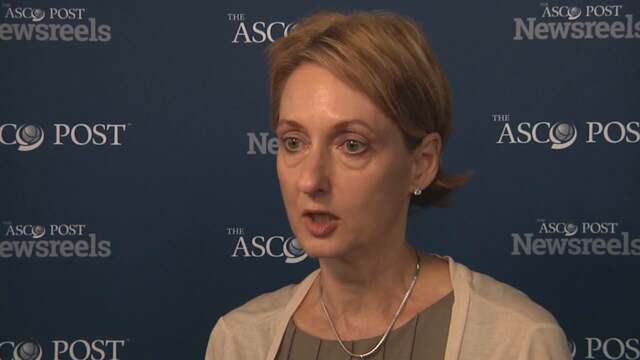
Patrick Schöffski, MD, of the University Hospital Leuven, discusses a phase III study in which he and his colleagues found, for the first time in soft-tissue sarcomas, a significant overall survival benefit of a single agent compared to a standard treatment (Abstract LBA10502).
Related Videos
Laurie H. Sehn, MD, MPH
Laurie Helen Sehn, MD, MPH, of the British Columbia Cancer Agency, discusses a first-ever finding on obinutuzumab and bendamustine in the setting of rituximab-refractory indolent non-Hodgkin lymphoma (Abstract LBA8502).
Maura N. Dickler, MD and Clifford A. Hudis, MD
Clifford A. Hudis, MD, and Maura N. Dickler, MD, of Memorial Sloan Kettering Cancer Center, discuss adding bevacizumab to letrozole as a first-line endocrine therapy for treatment of hormone receptor–positive advanced breast cancer (Abstract 501).
Eric Van Cutsem, MD, PhD, and Axel Grothey, MD
Eric Van Cutsem, MD, PhD, of University Hospitals Gasthuisberg/Leuven, and Axel Grothey, MD, of the Mayo Clinic, discuss the Italian-led study on trastuzumab and lapatinib in HER2-amplified metastatic colorectal as well as other colorectal cancer findings discussed at ASCO (Abstract 3508).
Nicholas David James, MD, PhD, and Celestia S. Higano, MD
Celestia S. Higano, MD, of the University of Washington, and Nicholas David James, MD, PhD, of Warwick Medical School, discuss data showing improvements in survival from adding docetaxel in men starting long-term hormone therapy for the first time (Abstract 5001).
Areej El-Jawahri, MD, and Eric Roeland, MD, FAAHPM
Eric Roeland, MD, FAAHPM, of the University of California, San Diego Moores Cancer Center, and Areej El-Jawahri, MD, of Massachusetts General Hospital, discuss two important studies on early palliative care and the use of anamorelin in advanced NSCLC with cachexia.