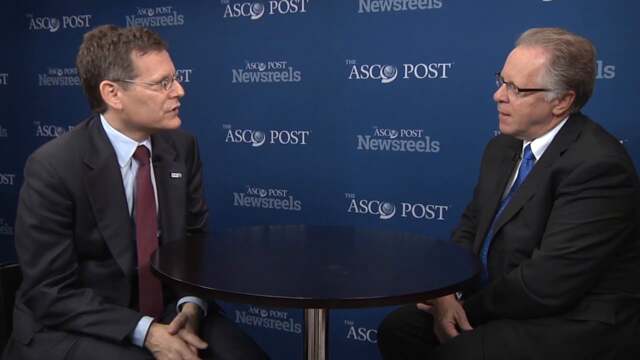
Laurie H. Sehn, MD, MPH, and James O. Armitage, MD, on Results of the GADOLIN Trial on Indolent Non-Hodgkin Lymphoma
2015 ASCO Annual Meeting
James O. Armitage, MD, of the University of Nebraska Medical Center, and Laurie H. Sehn, MD, MPH, of the British Columbia Cancer Agency, discuss a first-ever finding on obinutuzumab and bendamustine in the setting of rituximab-refractory indolent non-Hodgkin lymphoma (Abstract LBA8502).
Jan C. Buckner, MD
Jan C. Buckner, MD, of the Mayo Clinic discusses adjuvant whole-brain radiotherapy and the need for initial treatment with radiosurgery and close monitoring to preserve cognitive function in patients with brain metastases (Abstract LBA4).
Anil D’Cruz, MD
Anil D’Cruz, MD, of Tata Memorial Hospital, discusses results from his study that seem to resolve a 50-year-long debate on performing elective neck dissection at the time of primary surgery––a potentially practice-changing finding (Abstract LBA3).
Eric Van Cutsem, MD, PhD, and Axel Grothey, MD
Eric Van Cutsem, MD, PhD, of University Hospitals Gasthuisberg/Leuven, and Axel Grothey, MD, of the Mayo Clinic, discuss the Italian-led study on trastuzumab and lapatinib in HER2-amplified metastatic colorectal as well as other colorectal cancer findings discussed at ASCO (Abstract 3508).
Gregory T. Armstrong, MD, MSCE
Gregory T. Armstrong, MD, MSCE, of St. Jude Children's Research Hospital, discusses the findings of a landmark survivorship study (Abstract LBA2).
Andrew D. Seidman, MD, and Clifford A. Hudis, MD
Clifford A. Hudis, MD, and Andrew D. Seidman, MD, of Memorial Sloan Kettering Cancer Center, discuss the use of the decision support system Watson for Oncology and results of the iCanCare study on second opinions (Abstracts 566 and 6508).