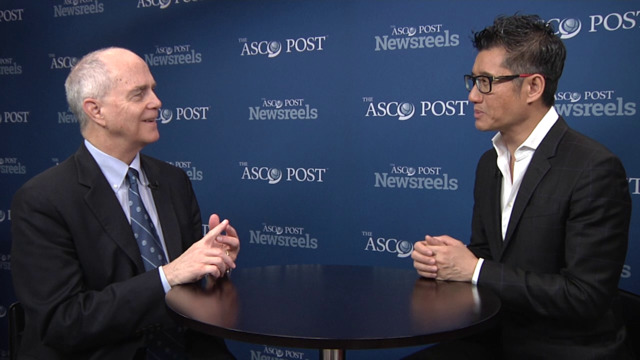
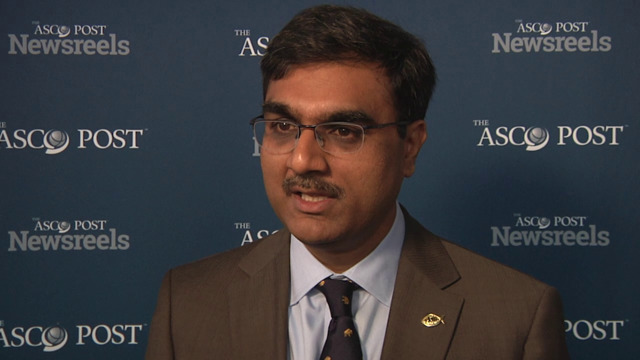
Jedd Wolchok, MD, PhD, and Anthony J. Olszanski, RPh, MD, on Results From the Checkmate 067 Trial on Nivolumab, Ipilimumab, and Advanced Melanoma
2015 ASCO Annual Meeting
Anthony J. Olszanski, RPh, MD, of Fox Chase Cancer Center, and Jedd Wolchok, MD, PhD, of Memorial Sloan Kettering Cancer Center, discuss therapies for treatment-naive patients with advanced melanoma (Abstract LBA1).
Related Videos
Tony Mok, MD, and James O. Armitage, MD
James O. Armitage, MD, of the University of Nebraska Medical Center, and Tony Mok, MD, of The Chinese University of Hong Kong, discuss oncology from an international point of view.
Gregory T. Armstrong, MD, MSCE, and Lisa Diller, MD
Lisa Diller, MD, of Dana-Farber Cancer Institute, and Gregory T. Armstrong, MD, MSCE, of St. Jude Children's Research Hospital, discuss the findings of a landmark survivorship study (Abstract LBA2).
Derek Raghavan, MD, PhD
Derek Raghavan, MD, PhD, of the Levine Cancer Institute, gives his insights into key genitourinary cancer clinical trials presented at the 2015 ASCO Annual Meeting and his thoughts on where the research is headed.
John Smyth, MD
John Smyth, MD, of the University of Edinburgh, discusses oncology from an international point of view.
Asher Alban Chanan-Khan, MD
Asher Alban Chanan-Khan, MD, of the Mayo Clinic Cancer Center, discusses an important treatment option that significantly improved overall response rate and reduced risk of progression or death by 80% (Abstract LBA7005).