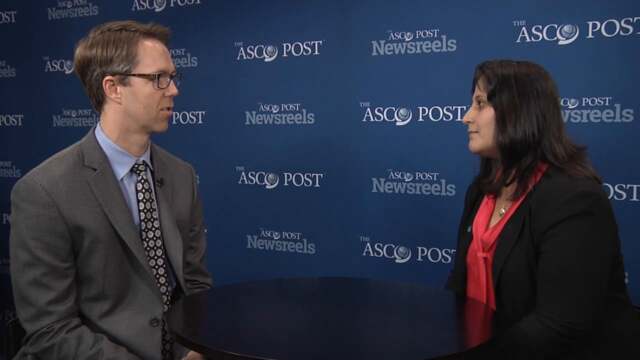
Claus Garbe, MD, Summarizes Results of the DECOG Trial on SLNB-Positive Melanoma
2015 ASCO Annual Meeting
Claus Garbe, MD, of the University of Tuebingen, discusses the survival of sentinel lymph node biopsy–positive melanoma patients with and without complete lymph node dissection (Abstract LBA9002).
David E. Gerber, MD, and James L. Mulshine, MD
James L. Mulshine, MD, of Rush University Medical Center, and David E. Gerber, MD, of The University of Texas Southwestern Medical Center, discuss the ALCHEMIST trial, an NCI initiative to address the role of molecular testing and targeted therapies for earlier-stage lung disease (Abstract TPS7583).
Jame Abraham, MD
Jame Abraham, MD, of the Cleveland Clinic discusses analyses of two trials for locally advanced, inflammatory, or early HER2-positive breast cancer using docetaxel, trastuzumab, pertuzumab, and neratinib (Abstracts 505 and 508).
Jedd Wolchok, MD, PhD, and Anthony J. Olszanski, RPh, MD
Anthony J. Olszanski, RPh, MD, of Fox Chase Cancer Center, and Jedd Wolchok, MD, PhD, of Memorial Sloan Kettering Cancer Center, discuss therapies for treatment-naive patients with advanced melanoma (Abstract LBA1).
Andrew Zelenetz, MD, PhD
Andrew Zelenetz, MD, PhD, of Memorial Sloan Kettering Cancer Center, discusses two important lymphoma trials presented at ASCO and his views on whether their results are indeed practice-changing (Abstract 8504 and LBA8502).
Areej El-Jawahri, MD, and Eric Roeland, MD, FAAHPM
Eric Roeland, MD, FAAHPM, of the University of California, San Diego Moores Cancer Center, and Areej El-Jawahri, MD, of Massachusetts General Hospital, discuss two important studies on early palliative care and the use of anamorelin in advanced NSCLC with cachexia.