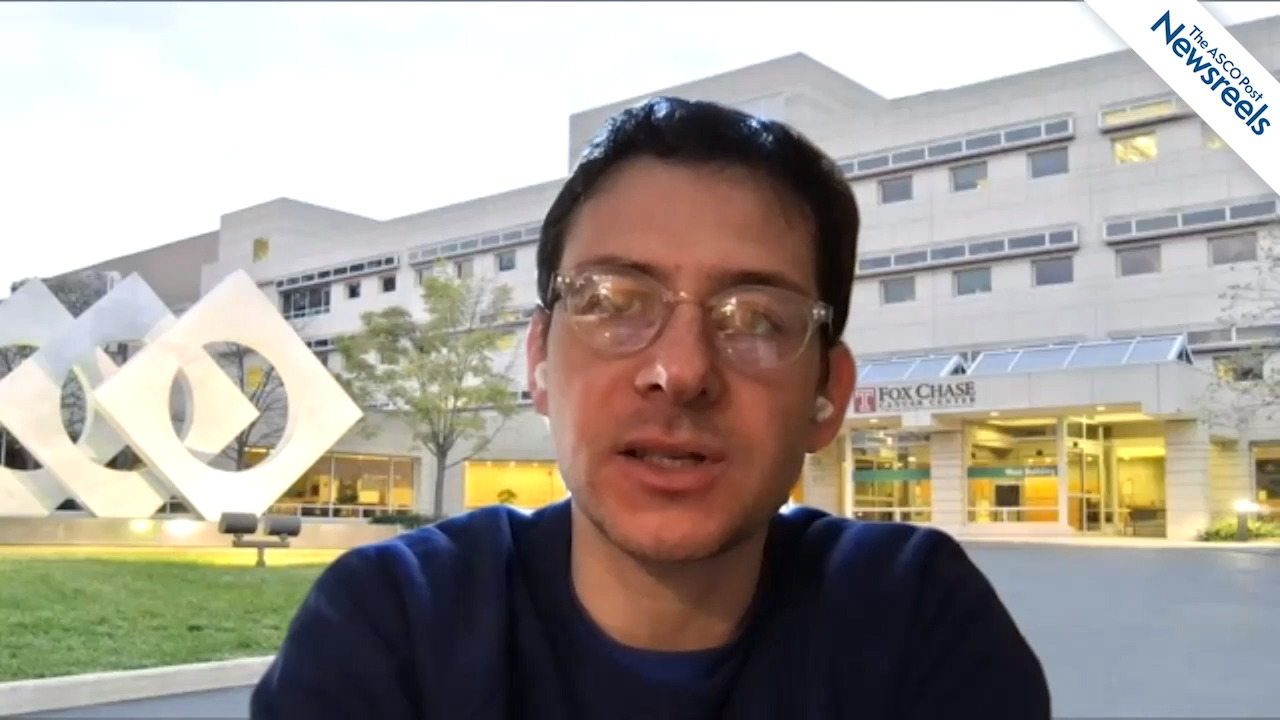
Elizabeth R. Plimack, MD, on Renal Cell Cancer Highlights From the 2021 Genitourinary Cancers Symposium
2021 Genitourinary Cancers Symposium
Elizabeth R. Plimack, MD, of Fox Chase Cancer Center, discusses key abstracts discussed at this year’s meeting on renal cell carcinoma and offers her views on the latest trends and findings (Abstracts 269, 308, 270, 313).
The ASCO Post Staff
Daniel M. Geynisman, MD, of Fox Chase Cancer Center, discusses phase II results from the RETAIN BLADDER study, which sequenced bladder tumor samples while treating patients with neoadjuvant methotrexate, vinblastine, doxorubicin, and cisplatin chemotherapy. The goal was to increase metastasis-free survival and also preserve the bladder and quality of life (Abstract 397).
The ASCO Post Staff
Sumanta K. Pal, MD, of City of Hope, discusses findings of the TIVO-3 study, which showed that the tyrosine kinase inhibitor tivozanib improved progression-free survival vs sorafenib in patients whose advanced renal cell carcinoma progressed after multiple lines of therapy (Abstract 278).
The ASCO Post Staff
Tracy L. Rose, MD, of the University of North Carolina at Chapel Hill, discusses phase II results of gemcitabine and split-dose cisplatin plus pembrolizumab as neoadjuvant therapy prior to radical cystectomy for patients with muscle-invasive bladder cancer. The trial showed this combination treatment is generally safe and may improve pathologic downstaging, but further study is warranted (Abstract 396).
The ASCO Post Staff
Elizabeth R. Plimack, MD, of Fox Chase Cancer Center, discusses phase III results from the KEYNOTE-426 study—specifically, an exploratory subgroup analysis of patients with advanced renal cell carcinoma who were randomly assigned to receive pembrolizumab plus axitinib and completed 2 years of treatment (Abstract 327).
The ASCO Post Staff
Elizabeth R. Plimack, MD, of Fox Chase Cancer Center, discusses key abstracts discussed at this year’s meeting on bladder cancer and offers her views on the latest trends and findings (Abstracts 391, 393, 434).