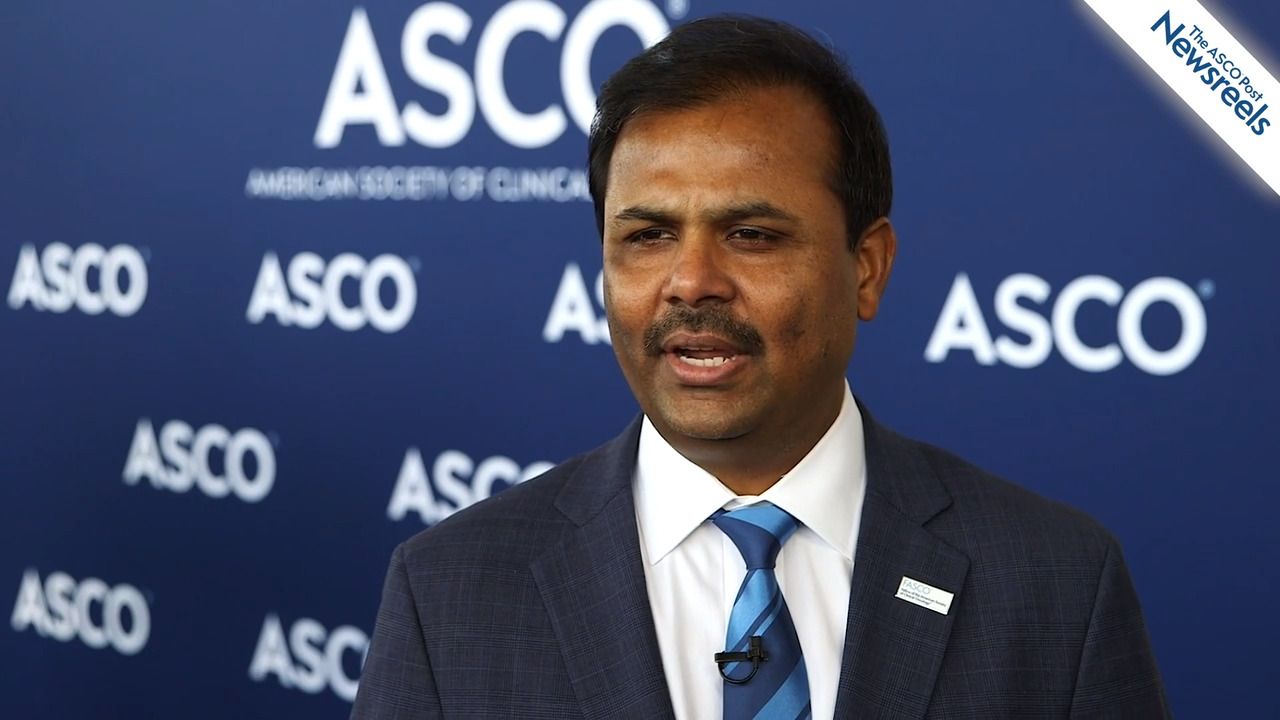
Jame Abraham, MD, on NALA Trial Findings in HER2-Positive Metastatic Breast Cancer
2019 ASCO Annual Meeting
Jame Abraham, MD, of the Cleveland Clinic, provides commentary on the NALA study findings on neratinib plus capecitabine vs lapatinib plus capecitabine in patients previously treated with HER2-positive metastatic breast cancer (Abstract 1002).
Kim N. Chi, MD, of BC Cancer, discusses updated results from a phase II study of cabazitaxel vs abiraterone or enzalutamide in patients with poor-prognosis metastatic castration-resistant prostate cancer (Abstract 5003).
Don S. Dizon, MD, of the Lifespan Cancer Institute, and Matthew A. Powell, MD, of Washington University School of Medicine, discuss phase III findings on paclitaxel plus carboplatin vs paclitaxel plus ifosfamide in chemotherapy-naive patients with stages I to IV, persistent or recurrent carcinosarcoma of the uterus or ovaries (Abstract 5500).
Paul G. Richardson, MD, of Dana-Farber Cancer Institute, discusses findings from the phase III ICARIA-MM trial showing that isatuximab, pomalidomide, and low-dose dexamethasone significantly improved progression-free survival and overall response vs pomalidomide and dexamethasone (Abstract 8004).
Kerry A. Rogers, MD, of The Ohio State University, discusses a 3-year follow-up of phase Ib safety and efficacy findings with the selective BTK inhibitor acalabrutinib and the anti-CD20 monoclonal antibody obinutuzumab in patients with CLL (Abstract 7500).
Suresh S. Ramalingam, MD, of Winship Cancer Institute, Emory University, discusses findings from the ECOG-ACRIN 5508 study, which showed that single-agent bevacizumab or pemetrexed is the optimal maintenance therapy for advanced nonsquamous NSCLC (Abstract 9002).