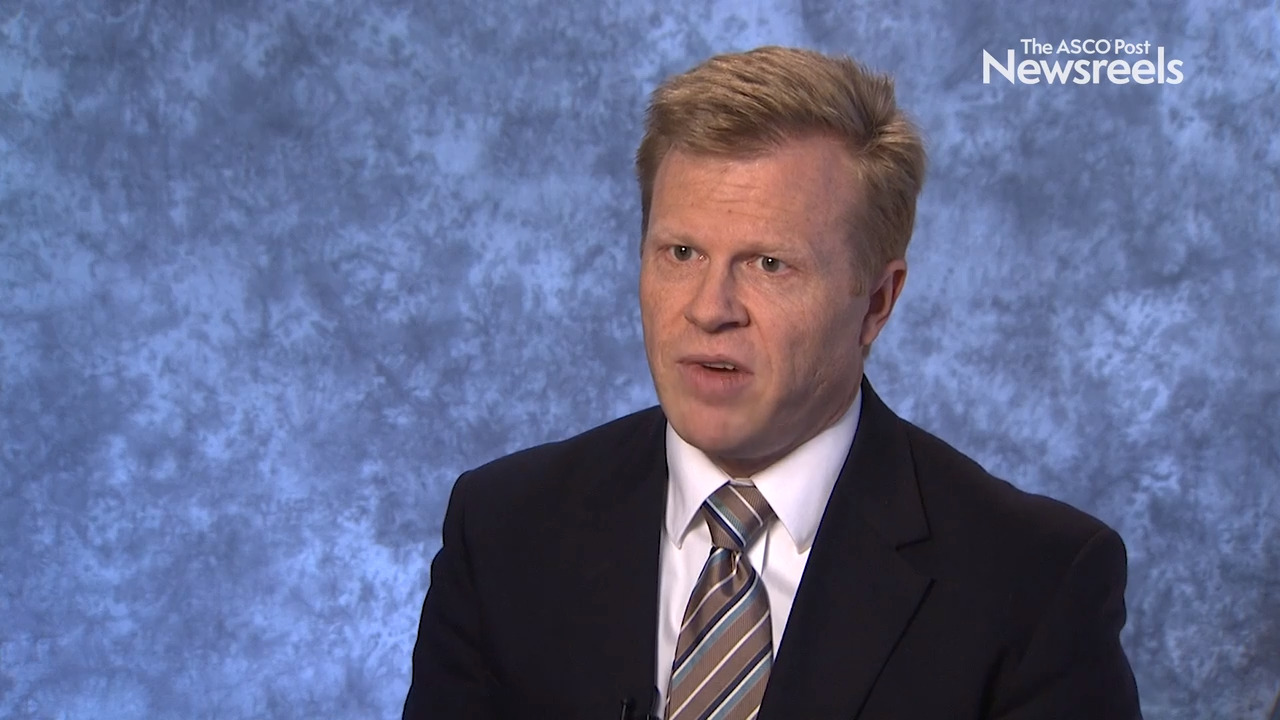
Steven M. Horwitz, MD, on PTCL: Results From the ECHELON-2 Trial
2018 ASH Annual Meeting & Exposition
Steven M. Horwitz, MD, of Memorial Sloan Kettering Cancer Center, discusses phase III findings on brentuximab vedotin and CHP vs CHOP in the front-line treatment of patients with CD30-positive peripheral T-cell lymphomas (Abstract 997).
Paul Richardson, MD, of Dana-Farber Cancer Institute, discusses updated results and the first report on progression-free survival for melflufen therapy administered to people with multiple myeloma that is refractory to daratumumab and/or pomalidomide (Abstract 600).
Julie Vose, MD, MBA, of the University of Nebraska Medical Center, and Loretta J. Nastoupil, MD, of The University of Texas MD Anderson Cancer Center, discuss findings from a multicenter study of axicabtagene ciloleucel CD19 CAR T-cell therapy for relapsed or refractory aggressive B-cell lymphoma when used as a standard of care (Abstract 91).
Shaji K. Kumar, MD, of the Mayo Clinic, discusses phase III findings on daratumumab plus lenalidomide and dexamethasone vs lenalidomide and dexamethasone in people with newly diagnosed multiple myeloma who are ineligible for transplant (Abstract LBA2).
Steven M. Horwitz, MD, of Memorial Sloan Kettering Cancer Center, discusses phase IIa study findings on the novel SYK/JAK inhibitor cerdulatinib for relapsed/refractory peripheral T-cell lymphoma and cutaneous T-cell lymphoma (Abstract 1001).
Tait D. Shanafelt, MD, of Stanford University, discusses phase III study findings on ibrutinib-based therapy vs standard fludarabine, cyclophosphamide, and rituximab chemoimmunotherapy in untreated younger patients with chronic lymphocytic leukemia (Abstract LBA4).